I’m pleased to announce that Todd Truitt will join the Bacon’s Rebellion team as a regular contributor. His editorial concentration will be K-12 education policy in the commonwealth.
Todd is a parent of two Arlington Public Schools (APS) students in Arlington County and an education advocate during his free time. He has been active on K-12 education policy issues as a volunteer at the local level for 5 years and at the state level for two years. His main areas of focus in education policy are on accountability, assessment, instruction (especially math) and school finance.
Petersburg, VA, which voted nearly 90% for @SpanbergerForVA is an absolute hell hole… but they’ll send zoning inspectors out to fine you for trying to improve your lot, while the neighbor’s crack house is ignored https://t.co/ZzdvF8kpD9pic.twitter.com/clLmDkHckC
This is a cautionary tale. So when the ghoulishness of Canada spreads to Virginia you can‘t say you weren’t warned.
Here’s how it starts:
In 2016 Canada passed the so-called MAID law, legalizing medical assistance in dying.
It was presented as a compassionate measure. One that would allow suffering patients, whose deaths were imminent, to get help from their doctors in ending their lives.
However, it wasn’t long before so-called medical doctors were actively killing patients who were not near death but whose conditions were uncomfortable. A decade later, they’re starting to execute the mentally ill. (Killing the mentally ill was approved in Canada last year but implementation was supposedly delayed until March 2026. The case cited below shows it’s already in effect.)
Between 2016 and 2023 60,000 Canadians were killed by these executioners with medical degrees. In 2023 alone 15,000 Canadians were murdered by medical providers.
MAID now accounts for 4.7% of all deaths in Canada. Continue reading.
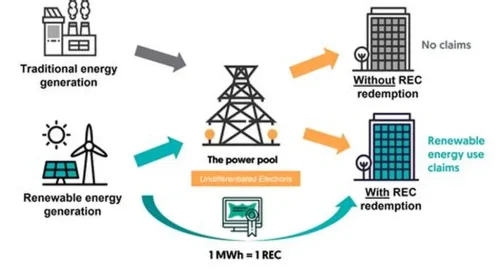
All electrons are agnostic until buying a REC makes you green!
A key, but poorly understood, provision of the Virginia Clean Economy Act (VCEA) is a requirement that Virginia’s two largest electric utilities must either generate or purchase a growing number of renewable energy certificates (RECs). Eventually their RECs must equal 100% of their non-nuclear generation. What are RECs and why do they matter to you?
Put simply, a REC is an electronic record that proves a generator produced one megawatt hour of electricity from an approved “renewable” source, usually solar or wind. It can be a utility, an independent energy generator, a business with solar on its roof or even a shared community solar system that is granted a REC. A small portion of RECs are awarded for hydro or geothermal generation.
The certificate is issued and tracked by a third party, and – here is the point – can be sold. Recording and tracking RECs is one of the jobs done by the PJM Interconnection regional grid operator. There are several marketplaces compiling and transferring them.
The buyer then “retires” the REC, in effect cashing in the environmental virtue of that “green” energy. It can be retired only once. The entity that earns the REC can also be the one to retire it, but usually they are traded.
One website that reports on the REC industry put the total world REC market at more than $20 billion in 2024, predicting it will exceed $40 billion by 2030. The annual compound growth rate is higher than 10%. The same website was quite open about what is going on:
“By buying RECs, companies can effectively offset their carbon emissions and achieve 100% renewable energy consumption without significant investment in renewable energy infrastructure.”
Women can sue their bosses for running a workplace that feels like a fraternity house, but men can’t sue when their workplace feels like a Montessori kindergarten.
The incoming Spanberger administration, writes Victoria Cobb, president of the Family Foundation, “is structured to consolidate power in Richmond, expand bureaucratic reach, and normalize government intrusion into family life, healthcare, education, and the economy.”
From a Thursday Family Foundation Action Letter:
Governor-elect, Abigail Spanberger, is quickly making her selections for cabinet and senior staff appointments. But these are not just routine staffing decisions, they are signals of the kind of administration and government she intends to implement. And the signal coming from Richmond is deeply troubling for Virginians who value limited government, individual liberty, parental rights, and constitutional restraint.
As the saying goes, personnel is policy. When you look carefully at who is being placed in charge of health care, labor, education, public safety, elections, and the overall legal strategy of the Governor’s Office, a consistent theme emerges: centralized authority, aggressive regulation, and ideological governance, with little regard for the proper limits of government power.
Below are some of (not all) Governor-elect Spanberger’s troubling appointments:
As it becomes clear that the 90-day pause of the Dominion Energy Virginia offshore wind project is probably its final death rattle, the folks who encouraged the Trump Administration to kill it are looking to shift the blame to outgoing Virginia Republican Governor Glenn Youngkin.
One of the organizations that filed a federal lawsuit against the project, a lawsuit that itself proved to be a futile exercise, is promoting a letter it sent the governor demanding he rescind his previous support for the $11.2 billion facility, which was just about to enter its final stage of construction when the federal pause order came down just before Christmas.
The National Legal and Policy Center was joined in the lawsuit by the Committee for a Construction Tomorrow (CFACT) and the Heartland Institute. All have been dancing a joyous victory jig on the project’s watery grave for about two weeks, although the Trump Administration’s pause order had nothing to do with the allegations of injury to the whales they had raised.
Nobody with the utility, the Commonwealth of Virginia or the federal agencies involved has formally declared the project dead. The silence is deafening. News reports indicate Dominion is telling the federal court hearing its challenge to the order that the federal government has refused to provide details on the supposed new national security threat it has identified. The goal of the pause apparently was not to give the utility, and the developers of four similar projects elsewhere on the East Coast, a chance to look at how to mitigate that “risk” after all. More should be clear after a hearing on January 16.
As all this unfolds, this policy group wants Youngkin to do a public mea culpa:
Delegate Kelly Convirs-Fowler, D-Virginia Beach, has introduced a bill (HB 188) to increase state income taxes in Virginia, raising the marginal tax rate from 5.75% to 10% on people making over $1 million.
Virginia already has higher state income taxes than most of its neighbors. Kentucky has a maximum tax rate of 3.5%, North Carolina has a maximum tax rate of 3.99%, West Virginia has a maximum tax rate of 4.82%, while Virginia has a maximum tax rate of 5.75%. Tennessee has no state income tax. As a result, Virginia is now one of the higher-tax states both in terms of dollars paid, and tax burdens compared to other states.
That’s a big change from the recent past. In 2015, Virginia had lower state income tax rates than West Virginia, North Carolina, and Kentucky. Back then, the top marginal tax rate was 6.5% in West Virginia, 6% in Kentucky, and 5.8% in North Carolina, compared to 5.75% in Virginia. And the lowest tax rate (for low-income households) was 5.8% in North Carolina, 3% in West Virginia, and 2% in Kentucky, compared to 2% in Virginia (most taxpayers pay the top marginal tax rate in each state). But since then, Virginia’s neighbors have cut tax rates a lot, unlike Virginia.
For each legislator, particularly Sickles, Bulova, and Ebbin, the appointments will result in a financial windfall for each of them in the future. That is because members of the General Assembly are members of the Virginia Retirement System.
Next week, Virginia will open the 2026 regular session of the Virginia General Assembly, with the Democratic Party ruling both House and Senate, then proceed to inaugurate a new governor, Abigail Spanberger.
How will it go?
Ah, yes, there’s the question. You can guess, but you don’t really know and that will make the weeks and months ahead “instructive.”
Virginia’s cultural unity, the sureness and confidence of its political institutions, got clattered and banged in the first quarter of the 21st century. Virginia has never been more pluralistic, never more given to negotiation. We ignore the cleavages, grasp for rhetorical reassurances and, with reason, the Virginia Chamber of Commerce prefers it that way.
But, c’mon. We have a geographic, political arrangement called “Virginia” you can sketch on a map and that’s about it.
The fellow who employed me 40 years ago – Jerry Baliles – carried every Virginia congressional district in his successful 1985 bid for governor. Democratic lawmakers commanded the General Assembly then, too, but you’d find them dispersed about the entire state. Their political thinking favored disparity, as well.
Think Kipling. “Oh, East is East, and West is West, and never the twain shall meet.” Democrats command the populous eastern half of Virginia and Republicans hold the west and trees don’t vote. Where does that leave us?
Forget raising the income or sales tax, it appears the 2026 Virginia General Assembly may try to balance the state budget by imposing a new 10% tax on all the sports fantasy game players in the Commonwealth.
Just when you think you know all the nooks and crannies of state government, another surprise appears. Who else knew that Virginia had required registration of sports fantasy game operators (those offering prize money) since 2016? But proposed legislation will take that all to a new level, changing simple registration into full-scale regulation and heavy taxation.
This is about Senate Bill 129, filed by (now departing, it seems) Senator Adam Ebbin, D-Alexandria. Ebbin is leaving at some point in the session to take a full-time job from new Governor Abigail Spanberger, but somebody else will pick up this bill. There could be some serious revenue produced by a 10% tax on all the gross receipts of these games.
The bill also replaces a modest agency registration fee with a mandatory $50,000 license fee, something else the operators will find a way to pass onto their customer-players. This all seems aimed at the large marketplace for sports fantasy games, but the definition is broad enough that this could expand. Is anybody organizing Dungeons and Dragons tournaments for cash? Once dollars are on the table, the government gets very nosy and greedy.
This looks and smells like plenty of other laws and regulatory structures already on the books pushed by the dominant players in an industry to discourage potential competition. The list of firms already registered in Virginia is dominated by the big gaming firms also heavy into direct sports gambling, already regulated and taxed by the state. This passes and the cost of entry alone will protect their turf, but some ominous criminal sanctions for the unlicensed included in the bill will add to their comfort zone.
The people who care more about this than I do need to take up the battle. But step one is to warn them the bill is coming, and that is now done. Take it viral, readers. As the tribes gather down on Ninth Street for our annual festival of greed and government intrusion, this rule remains in force: No one’s life, liberty or property are safe while the legislature is in session.
The year: 2075. The American colonies on the Moon are getting restless under Washington’s tyrannical rule….
This second edition of “Dust Mites” has a snazzy new cover, includes helpful lunar maps, and is 5,000 words tighter than the original. The sequel, “Trogs,” is scheduled for publication this summer.
Advertisement
Advertisement
Advertisement
Advertisement
About
Bacon’s Rebellion is Virginia’s leading politically non-aligned portal for news, opinions and analysis about state, regional and local public policy. Read more about us here.
Fund the Rebellion
Shake up the status quo! Your contributions will be used to pay for faster download speeds and grow readership. Make a one-time donation by credit card or contribute a small sum monthly.
Can’t wait until tomorrow
For your Bacon’s Rebellion fix?
Enter your email address to receive immediate notifications of new posts by email.
SUBSCRIBE
Search Bacon’s Rebellion
Categories
Archives
The Jefferson Council
Protecting Thomas Jefferson’s Legacy at the University of Virginia
Forgot Your Password?
Shoot me an email and I’ll generate a new password for you.