• “Cheap” Solar Costs More Than Offshore Wind?

    Whether Dominion is building the solar farm or just buying its output makes a huge difference in cost.

    by Steve Haner

    In preparing for the latest round of new additions to its solar generation assets, Dominion Energy Virginia rejected eight privately- developed projects which were substantially cheaper than the projects it wanted to build on its own with ratepayer money. Just how much more expensive the company-owned projects will be is not clear, but the higher costs will be locked in for decades.

    It is the 2020 Virginia Clean Economy Act which is driving the massive solar buildout, and one part of the statute is being read one way by the utility and another way by most of the other stakeholders. Dominion believes the law requires it to provide a fixed 35% of the new renewable electricity from third-party providers under long-term power purchase agreements (PPAs). It claims the law dictates that it must own 65% of the generation assets directly.

    Just about every other party to the most recent application for new solar believes that 35% is a floor, a โ€œno less thanโ€ target, and a higher percentage could be from PPAs. Entities taking that position include the Office of the Attorney General,ย  environmental activists, and even large electricity users such as Walmart. The issue dominates final arguments on the application filed this week at the State Corporation Commission.

    What is the solar price differential? As with far too many of these disputes, most of the key financial information is confidential, available only to case participants who have filed a promise to maintain secrecy. But in its final brief, the staff for Attorney General Jason Miyares (R) provides some dramatic comparisons. (more…)


  • Glenn Loury Highlights Jefferson Council Event

    *** Sponsored Content ***

    Glenn Loury

    Glenn Loury is one of the foremost African-American intellectuals in the country. No, actually, thatโ€™s selling him short. Heโ€™s one of the foremost intellectuals โ€“ period — in America. As an economics professor at Brown University, an author, a columnist, a podcaster, and a self-described โ€œliberal who has been mugged by reality,โ€ he has emerged as a leading conservative voice in the debate over Diversity, Equity & Inclusion.

    I saw Loury in action at an American Council of Trustees and Alumni event last year, and I can tell you, he is phenomenal. DEI in higher education, he charges, makes African-American students think of themselves as victims, deprives them of agency, and induces passivity and fragility. He also makes the case for Black patriotism. Black people, he says, are blessed to be Americans.

    Thatโ€™s not to say America is perfect. Persistent racial inequality is real, he says. But the higher-ed panaceas of โ€œanti-racismโ€ and DEI are grievously flawed.

    As the keynote speaker of The Jefferson Council’s April 4 annual meeting, Loury will explain whatโ€™s wrong with DEI, suggest what can be done about it, and stand up for the founding fathers, the American Constitution, and the American democratic system that has created unparalleled opportunity for Blacks in the 21st century. (more…)


  • Meet Abrar Omeish, Exhibit A in the Woke Army

    by Asra Q. Nomani

    Exclusive: In 2019, Abrar Omeish canvassed for support at a fundraiser for the anti-Semitic group American Muslims for Palestine and said she wanted to change the โ€œnarrativeโ€ on Palestinians. She was elected to office and launched a tirade against the state of Israel, which she smeared as an โ€œapartheidโ€ nation, repeating the talking points of an anti-Semitic brigade in the Woke Army. Here is the full transcript.

    Last month, at Luther Jackson Middle School, parents gasped as a Fairfax County Public Schools board member, Abrar Omeish, stumbled through a clumsy speech and called the historic battle of Iwo Jima โ€œevil,โ€ even though the decisive victory by U.S. Marines led to eventual victory by Allied forces against Japan and Nazi Germany and its leader Adolph Hitler, ending the brutal genocide of Jews in the Holocaust.

    In the days after, the remarks sparked a national outcry, even spilling over globally, with Virginia Lieutenant Governor Winsome Sears, a former U.S. Marine, assailing the remarks and a pair of comedians asking indelicately: โ€œHow did this clown get elected to a school board?โ€

    Editorโ€™s note: For Asraโ€™s twitter conversation on the event see here.

    I know the answer because I witnessed it happen, and the answer reveals an unholy alliance that I expose in my new book, Woke Army, between the Democratic Party and rigid anti-Israel, anti-Semitic establishment Muslim leaders in the United States. These establishment Muslims include activists, politicians, and academics โ€” from Womenโ€™s March co-founder Linda Sarsour to Rep. Ilhan Omar (D-MN), Rep. Rashida Tlaib (D-MI), University of California at Berkeley academic Hatem Bazian. and the Council on American-Islamic Relations (CAIR).

    What is particularly disturbing is that this Woke Army set its sights on K-12 schools and their children. School board member Abrar Omeish is Exhibit A in this dangerous alliance in K-12.

    I saw it first-hand one Saturday night on Sept. 7, 2019, documenting the evening in video shared here for the first time.
    (more…)


  • Virginia Hospitals Under Pressure on Finances and Personnel

    By James C. Sherlock

    Bon Secours’ St. Mary’s Hospital

    I have written for years about Virginia hospitals and their state oversight, including Virginiaโ€™s monopolistic Certificate of Public Need (COPN) law and its administration by the Department of Health.

    Virginia hospitals, and indeed those across the nation, are now under more stress than in generations.

    Hospitals nationally are under financial pressures while public views of hospital finances are opaque and out of date.

    Increasing shortages of qualified medical personnel are both driving up costs and challenging services in all of Virginiaโ€™s hospitals. ย The worst shortages are where you think they are. ย In hospitals serving poorer populations.

    One study quoted by Oracle

    …projects that if US workforce trends continue, more than 6.5 million healthcare professionals will permanently leave their positions by 2026, while only 1.9 million will step in to replace them, leaving a national industry shortage of more than 4 million workers.

    That Oracle article is worth a read.

    We will see increasing cutbacks of hospital services in Virginia. ย Some may find themselves unable to maintain some or all of their inpatient services.

    A few may close.

    I interviewed Virginiaโ€™s Secretary of Health and Human Resources on this front-burner situation.

    (more…)


  • Bacon Bits: Social Breakdown Update

    Every so often you might read some uplifting story in the news — a woman is rescued from a burning car, a charity raises money to buy Christmas toys for homeless tots — that makes you feel better about the world. Don’t be gulled. We live in the wealthiest society with the highest level of education and the most advanced technology the world has ever seen. Yet things are getting worse! Signs of the times pulled from today’s headlines:

    Virginia sees highest number of babies born with syphilis in several decades.ย Reports WAVY-TV: The number of syphilis cases in Virginia has rebounded to the highest level in years.ย  The rate among women has surged 159% between 2013 and 2021, which drives up the rate of syphilis in newborns.ย  The Virginia Department of Health reported 20 cases of congenital syphilis last year, the highest number in three decades. Up to 40% are born stillborn or die from the infection. Survivors can have deformed bones, an enlarged liver, blindness or deafness.

    Meanwhile, the death rate of American kids is skyrocketing. Deaths of American kids spiked 205% between 2019 and 2020, the result of increased car wrecks, shootings and drug overdoses, reports the Richmond Times-Dispatch. According to Virginia Commonwealth University researcher Steven Woolf , even poisonings are up. Woolf said he has not seen an increase like this in his career. โ€œThis is a red flashing light. We need to understand the causes and address them immediately to protect our children.โ€ Motor vehicle fatalities remain the highest cause of childhood death, but homicides and suicides are catching up. (more…)


  • On to Richmond!

    by Dick Hall-Sizemore

    For all those Northern Virginia critics of Richmond on this blog, e.g. Don Rippert, the Richmond Times-Dispatch reported yesterday that the Richmond metro area has grown faster than Northern Virginia for two years in a row.ย  In fact, the growth rate of the Richmond metropolitan area is at least triple that of each of the rest of Virginia’s five largest metro areas.

    Furthermore, a lot of that growth is coming from Northern Virginians moving to Richmond, drawn by the lower cost of living and aided by the growth of remote working.

    Personally, I would not mind the area not growing so much, but it is nice to know that not all Virginians view the Richmond area as a provincial outpost.


  • Election Musical Chairs

    Del. Lamont Bagby (D-Henrico)

    by Dick Hall-Sizemore

    Redistricting and the death of U.S. Representative Donald McEachin have voters in the Richmond area feeling as if they are in a combination of musical chairs and โ€œWhoโ€™s on first?โ€ We need a program to keep track of who is running for what.

    For those readers of Baconโ€™s Rebellion who donโ€™t read the Richmond Times-Dispatch regularly or who have not bothered to keep up, but who enjoy political shenanigans and maneuvering, what follows is a summary of the events so far.

    There is one factor that simplifies this narrative somewhat. The election districts involved are heavily Democratic; therefore, whatever the Republicans do does not matter much. Consequently, I will restrict the narration to the Democrats.

    McEachinโ€™s unexpected death a few weeks after the November general election in which he had been elected to his fourth term in Congress led to a cascade of special elections. Quickly declaring themselves candidates for the Democratic nomination for the Congressional seat were Sen. Jennifer McClellan (Richmond) and Del. Lamont Bagby (Henrico). Both were strong candidates. McClellan had represented the area, first in the House and then in the Senate, for many years, had been a candidate for the Democratic nomination for governor, and was well respected. Bagby had been in the General Assembly for several terms and had a large public profile as chairman of the Legislative Black Caucus. (more…)


  • Is Washington and Lee Committing Suicide?

    by Kenneth G. Everett

    One of my ’64 classmates, and a good friend throughout our four years at Washington and Lee University, grew up in a Chicago suburb and graduated from a top high school there. Once during an idle moment while we were studying for a Charlie Turner exam in European history, I asked him why he, a big-city Illinois boy, chose to attend a small southern college like W&L. He answered, “Because my dad thought it was a good conservative school.”

    Indeed, W&L was “a good conservative school” back then โ€” and one in the best and most authentic sense, despite some faults it has long since shed. Long gone are such perishable appendages to W&L’s conservatism as “conventional dress” (the requirement to wear a coat and tie to class and in public), the all-male student body, and the racial segregation that still lingered at the school in those days and was associated with the conservative element of society.

    But for a long time thereafter, the more fundamental, rightly imperishable portion of W&L’s conservatism remained intact: the rigorous Honor System, the code of personal honor and gentlemanly conduct, the correspondingly pervasive ambience of civility and respect of persons, along with instructional and curricular adherence to the enduring truths bequeathed to us by Western Thought and Tradition.

    Those imperishables were deeply rooted in W&L’s long history, ingrained in its traditions, and illumined by the inspiring examples of the lives and characters of our venerated namesakes, George Washington and Robert E. Lee. I think no one during my W&L years could have imagined that these W&L values and traditions, so fundamental to civilization itself, would ever come under full assault by educated people.
    (more…)


  • RVA 5×5: Monopoly on Richmond

    by Jon Baliles

    There has been a lot of chatter this week about Monopoly doing a Richmond version featuring notable places and landmarks to replace the well-known properties like St. Jamesโ€™ Place, Reading Railroad, and Boardwalk.

    According to Em Holter at the Richmond Times-Dispatch, the creators of Monopoly want to hear from YOU about what to include in the 22 spaces that make up a Richmond Monopoly board.

    โ€œโ€ฆHasbro licensee Top Trumps USA, which is tasked with creating the board, will need to hear from Richmonders just what those signature sites are. The company is asking residents to land on chance, draw a card and submit their ideas at [email protected] as to what they would like to see featured on the Richmond Monopoly game before March 20.”

    How many jokes can you make using โ€œStop. Do not pass go. Do not collect $200,โ€ in reference to Richmond?

    Ohhh, the possibilities are endless. I can imagine the snarky replies already submitted and soon to be, and it will probably have the Hasbro people wondering just what they have done.

    According to Hasbro executive John Marano, โ€œThis is a board game built by Richmond, for Richmond. I want them to be proud and I want them to be involved, because at the end of the day, thatโ€™s what makes it successful for us.โ€

    The company has done city-specific boards in other cities like Pittsburgh, Kansas City, San Diego, Philadelphia, Boise, Portland, and Sacramento. J.C. Poma, vice president of community relations for Richmond Region Tourism said, โ€œWeโ€™re so excited to see what you come up with for this great board game.โ€

    The selections for that board will be interesting for sure when the game is released this fall, but few maps or boards will ever be as funny as the 2015 Judgmental Map of Richmond โ€” when you could still laugh at stuff like that. Maybe Monopoly will top that (but I doubt it from a humor perspective), so get busy and submit your suggestions to Hasbro before March 20!

    Jon Baliles is a former Richmond City Councilman. This is an excerpt from the original article posted on his blog, RVA 5ร—5. It is posted here with permission.


  • Who Really Runs UVa?

    by James A. Bacon

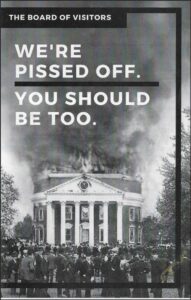
    Earlier this month, an anonymous group distributed a pamphlet, “We’re Pissed Off: You Should Be, Too,” on the University of Virginia grounds that issued a broadside against the university’s governance structure. Although Board of Visitors member Bert Ellis was the primary object of their ire, the authors criticized the Board generally as “an undemocratic institution.”

    “Seventeen people who are appointed by the State, which only provides 11% of UVA’s academic division’s funds, are deciding where 100% of it goes as the BOV gets the final say over approval of the annual budget,” states the pamphlet. “The Board of Visitors (BOV) as an institution is inherently undemocratic. It does not have enough checks and balances put into place to protect students, as well as faculty, staff, and UVA’s administration.”

    This is a useful conversation to have. From the student’s or graduate student’s perspective, I suppose, the Board does seem undemocratic. Board members are appointed by Virginia’s governor. Neither students nor faculty get to vote on who serves on the board. But, then, the taxpayers of Virginia don’t get a direct vote either. Neither do parents paying tuition. Neither do alumni who collectively contribute as much to UVa’s funding as the Commonwealth of Virginia does. (Philanthropy and endowment income have surpassed state contributions as a revenue source.)

    UVa, like other higher-ed institutions, is a strange beast. Its rules of governance are unlike those of government, or corporations, or charitable organizations. UVa is more like a feudal institution. It has an academic division and a healthcare division. The academic division has 13 colleges and schools, each with its own dean and varying degrees of autonomy and philanthropic funding. Students have a significant role in self governance. So do faculty. Affiliated with the university is a bewildering assemblage of autonomous groups that carry out important functions, each with their own boards.

    Nominally, the Board of Visitors governs this feudal kingdom. But in reality it does not exercise much power. It is easily manipulated by the administration. This is not unique to UVa or a rap on President Jim Ryan. It’s the way almost all universities work. (more…)


  • Virginiaโ€™s Best-Attended School Divisions 2021-22 – Itโ€™s Not About Money

    Overall best attendance among Virginia Public School Divisions 2021-22

    by James C. Sherlock

    We often, because it is important, concentrate on what is not working in Virginia’s state and local governments.ย Occasionally it is equally important to congratulate the winners.

    In this report I will list Virginiaโ€™s best-attended school divisions in 2021-21, both by all students and by sub-groups.

    You will be surprised by some of the winners.

    These rankings offer crucial measures of school division effectiveness and reflect the efforts and values of students, families and teachers. (more…)


  • Arlington’s Monument to Peace and Reconciliation Slated for Demolition

    Cherry trees bloom in Jackson Circle around the Confederate Monument in Section 16 of Arlington National Cemetery. The Confederate Monument was unveiled June 4, 1914, according to the ANC website. (Arlington National Cemetery photo by Rachel Larue)

    by Robin Traywick Williams

    It is dangerous these days to advocate for anything even tangentially associated with the words โ€œConfederate,โ€ but after almost three years of monument-bashing, it might be worth discussing where this is going. In addition to Lee, Stuart and nameless soldiers on courthouse lawns, Columbus, Lincoln, and Juniper Serra have all fallen. Will the country take a deep breath and consider whether significant works of art bear saving because of their historical and cultural value or will self-appointed arbiters of righteous thinking move on, unrestrained, to burning Monticello and imploding the slave-built White House?

    The Naming Commission has submitted its final report, and not surprisingly, it recommends the renaming or removal from military installations of every item related to the Civil War, down to the last toenail clipping. The panel of eight political appointees was nothing if not thorough, finding offense even in the use of the color gray on military insignia as well as in the name of a Confederate horse.

    Renaming bases and removing prints of Civil War battles is one thingโ€”the hallowed ground of Ft. Benning will remain, and there are thousands of reproduction printsโ€”but the Commission has taken the astonishing step of recommending the demolition of a culturally and historically important work of art by an internationally-renowned artistโ€”in Arlington Cemetery, no less.

    On the block is the Confederate Memorial to Reconciliation and Reunification, which is on the National Register of Historic Places as a contributing part of the Arlington National Cemetery Historic District. Created by one of Americaโ€™s most celebrated artists, Sir Moses Ezekiel, the monument was endorsed by four presidents and dedicated by Woodrow Wilson at an event attended by veterans of the North and South, who shook hands and embraced.

    The monument recognizes an important moment in the evolution of the history of America, the spiritual and emotional reconciliation of two regions that had fought bitterly 50 years earlier. Although the country was technically reunified in 1865, the heavy hand of Reconstruction made reconciliation challenging, as Southerners struggled to rebuild their war-torn states under steep federal burdens. But in 1898, the sons and grandsons of Confederate soldiers joined the U.S. Army in large numbers to help fight the Spanish-American War. President McKinley, himself a Union veteran, saw an opportunity to bind up the nationโ€™s wounds with a generous show of gratitude towards the South. Congress concurred, and provision was made for proper treatment of Confederate graves, including re-interment of hundreds in Section 16 of Arlington Cemetery. (more…)


  • Under RGGI Virginia Releases More CO2, Not Less

    With the March 8 RGGI results, Virginia power producers have now paid $590 million in carbon taxes. Click for larger view.

    by Steve Haner

    Since Virginia joined the Regional Greenhouse Gas Initiative (RGGI) compact at the start of 2021, according to data reported by the U.S. Energy Information Agency, the amount of carbon dioxide emitted to provide electricity to customers in the state has grown. Despite two years of RGGI caps and taxes, total CO2 emissions did not shrink, but grew by 3.7 million tons.

    That is because the emissions total includes tracking all power producers providing electrons to the state, which is not the same as emissions from power producers located within the state. Virginiaโ€™s membership in RGGI is having the exact opposite effect from what its adherents claim it does because, as many predicted, it has forced Virginia to import far more electricity than it used to.

    During the two-year period, electricity consumption within the state grew to 130 million megawatt hours, up 11%. Electricity imports grew from 14 million megawatt hours in 2020 to more than 39 million MWH in 2022, up 280%. RGGI has simply driven power production from fossil fuels used by Virginia to other states. As it has for the other RGGI member states.

    These conclusions come from EIA data compiled by David Stevenson, director of the Caesar Rodney Institute in Delaware, and long a skeptic on the benefits of RGGI in this region. He added them to the growing list of public comments on the Virginia Air Pollution Control Boardโ€™s pending proposal to take Virginia out of RGGI at the end of 2023. More details and citations from Stevenson are contained in a longer discussion which you can read here; and in a table he created, which is reproduced below. (more…)


  • Jeanine’s Memes

    From The Bull Elephant


  • Engaging Differences — or Imposing Conformity?

    by James A. Bacon

    In its March board meeting, the University of Virginia Board of Visitors addressed the topic of intellectual diversity. The unspoken assumption among some board members was that there is precious little diversity in the philosophical outlook of UVa’s faculty, which skews heavily to the left, or the courses they teach. But Provost Ian Baucom made the case that it is possible to foster a diversity of viewpoints by structuring the curriculum to allow for open dialogue.

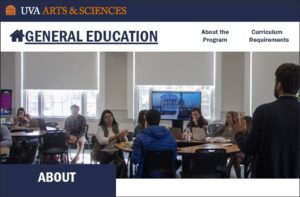
    As an example, Baucom pointed to the “Engaging Differences” courses for first-year students, which the university website describes as “the cornerstone of the liberal arts experience at UVA.” These courses are designed to “equip our students to articulate provisional analyses that reflect an openness to debate and differing values.”

    The aim, Baucom elaborated for the board, is to encourage students “to think about how you argue for or against a position.”

    The University lists 15 Engaging Differences courses. You can see the course descriptions here. The overwhelming majority struck me as employing leftist vocabulary, assumptions and frames of reference. The question arises whether the discussion that arises within such ideological frameworks can allow for much genuine diversity of thought.

    I will detail my concerns in just a moment. But first I want to give fair time to UVa spokesman Brian Coy. Here is how he responded to my questions: (more…)