• Webbโ€™s Last Ditch Attempt to Save the Confederate Memorial at Arlington

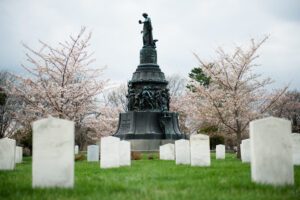
    The Confederate Memorial in Arlington.
    (Arlington National Cemetery photo by Rachel Larue)

    by Shaun Kenney

    Former Virginia Democratic U.S. Senator Jim Webb is begging federal officials to save the last remaining Confederate memorial at Arlington National Cemetery in a forceful op-ed to The Wall Street Journal. Webb writes:

    [President William] McKinley understood the Civil War as one who had lived it, having served four years in the 23rd Ohio Infantry, enlisting as a private and discharged in 1865 as a brevet major. He knew the steps to take to bring the country fully together again. As an initial signal, he selected three Civil War veterans to command the Cuba campaign. Two, William Rufus Shafter, given overall command of the Cuban operation, and H.W. Lawton, who led the Second Infantry Division, the first soldiers to land in the war, had received the Medal of Honor fighting for the Union. The other, โ€œFighting Joeโ€ Wheeler, the legendary Confederate cavalry general, led the cavalry units in Cuba, after being elected to Congress in 1880 from Alabama and working hard to bring national reconciliation.

    Four days after the Spanish-American war ended, McKinley proclaimed in Atlanta: โ€œIn the spirit of fraternity we should share with you in the care of the graves of Confederate soldiers.โ€ In that call for national unity the Confederate Memorial was born. It was designed by internationally respected sculptor Moses Jacob Ezekiel, a Confederate veteran and the first Jewish graduate of the Virginia Military Institute, who asked to be buried at the memorial in Arlington National Cemetery. On one face of the memorial is the finest explanation of wartime service perhaps ever written, by a Confederate veteran who later became a Christian minister: โ€œNot for fame or reward, not for place or for rank; not lured by ambition or goaded by necessity; but in simple obedience to duty as they understood it; these men suffered all, sacrificed all, dared all, and died.” (more…)



  • Charlottesville Schools Ban Student Cell Phones

    A Yondr cell phone pouch.

    by James A. Bacon

    The Charlottesville public school system has banned the students’ use of cell phones. Superintendent Royal Gurley decries students’ “addiction” to the mobile devices, and teachers have complained that the phones have become a tremendous disruption in the classroom, reports The Daily Progress. The restrictions, school officials hope, will “increase connectivity between classmates and teachers improve mental well-being.”

    Predictably, some parents are pushing back.

    โ€œItโ€™s too extreme,โ€ M.J. Smith, whose son is a senior at Charlottesville High School, told The Daily Progress. โ€œI think itโ€™s in the right place, but it comes across as heavy-handed and not well thought out in light of the active anxiety that the community is facing with another school year and active shooter robocalls. Weโ€™re all worried about that.โ€

    I’ve got some questions for parents opposed to the ban. (more…)


  • Student Vets Win Back Their Space

    Military memorobilia at the Veterans Center. Photo credit: WVIR-TV

    by James A. Bacon

    The Student Veterans of America (SVA) at the University of Virginia notched up a small win Friday when Student Affairs officials reversed a decision to expropriate some of the Veterans Center space at Newcomb Hall. But the veterans’ battle for recognition and respect at UVa is far from over.

    What they need most, student veterans say, is for Student Affairs to designate someone with specialized knowledge of the G.I. Bill and other veterans issues to help them through UVa’s bureaucratic maze.

    Veterans comprise a tiny fraction of the undergraduate student body at UVa. SVA leadership estimates there are only 60 veterans among the 17,000 undergraduates. That count may not have identified every undergraduate veteran, but Tomas De Oliveira, president of the club, says it represents most.

    “It’s a chicken-or-egg problem. There aren’t enough vets to justify a significant commitment of UVa resources,” De Oliveira says. But the lack of support makes it difficult to recruit veterans cycling out of the military. UVa vets have friends. Word gets out. “Why would I recommend UVa?” (more…)


  • Deja Vu, All Over Again

    Cluster development in western Loudoun Co. Photo credit: Washington Post

    by Dick Hall-Sizemore

    Todayโ€™s Washington Post has an article about efforts to preserve farmland in Loudoun County.

    That headline instantly took me back to the late 1970s and early 1980s when there was a flurry of activity regarding the need to preserve farmland and provide landowners incentives to keep their farmland from being developed.

    Loudoun County was in the center of that activity. At that time, the population of the county was about 57,000. Development in the area near Dulles Airport and the Rt. 7 corridor was in the early stages. A large part of the county was open land, consisting of large estates, as well as medium and small farms. The tools for preserving that land that were being discussed, sometimes heatedly, were conservation easements and transfer of development rights. A sample report of some of those studies is here. (more…)


  • Virginia’s Schools Really Do Need More Money

    by Suzanne Munson

    Recent General Assembly debates about state budgets open a cornucopia of questions about the future of education in Virginia — charter schools, lab schools, vouchers, funding for religious schools? Now might be a good time to examine some background about public education in Virginia.

    Thomas Jefferson proposed the stateโ€™s first legislation in support of universal education, for rich and poor alike, in 1779. He viewed pubic education as necessary for an informed, successful democratic republic: โ€œIf a nation expects to be ignorant and free, it expects what never was and never will be.โ€

    As school funding involved tax dollars, well-to-do Virginia legislators ignored Jeffersonโ€™s appeal for decades. Meanwhile, our neighbors to the north were educating their populace. It would take a Civil War and its aftermath for this state to develop a nascent system of public education.

    Today, Virginiaโ€™s school divisions across the board receive 14% less funding from the state than the 50-state average, equal to about $1,900 less per student. This is neither admirable nor sensible, if we are to have a successful economy, students trained for challenging work, and an informed electorate.
    (more…)


  • Beach School Board Votes on Parentsโ€™ Rights Tonight

    by Kerry Dougherty

    Tonightโ€™s the night, Virginia Beach. A chance to show the leftist school board members that parental rights matter in the Resort City.

    There are several ways to do it: flood school board members with emails, sign up to speak at tonightโ€™s board meeting (you have until noon) or just go to the meeting that starts at 6 and frown when the leftists start wringing their hands about the โ€œrightsโ€ of troubled teens to keep their gender confusion secret from their parents.

    Last month the Youngkin administration put the finishing touches on its new transgender model policies for schools. What they came up with is a rational, reasonable approach that allows students to change their gender in school WITH PARENT APPROVAL.

    The way it should be handled. (more…)


  • Decency and Democracy Prevail in Roanoke County

    by Scott Dreyer

    In recent years, much of America has been convulsed by riots, arson, looting, and mayhem to the point where basic safety and simple dialogue have become impossible. When faced with shocking headlines, many can only shudder in horror and be thankful they donโ€™t live in such places.

    In what some call โ€œthe Virginia Wayโ€ and โ€œthe Roanoke Way,โ€ however, our region has largely avoided such large-scale disorder. Even during the tumultuous days of school integration in the 1950s and โ€™60s, when many U.S. cities had riots, violence, and police brutality, integration in the Roanoke Valley was largely peaceful, thanks to a generation of both white and black leaders who acted like adults and generally shared a common Christian worldview.

    Thus, when the July 27 Roanoke County School Board meeting fell into chaos, it made headlines, shocked many, and showed that mob rule threatens to derail dialogue and official proceedings.

    For over two hours, Board members listened to 27 people speak during the public comment period. Then, when School Superintendent Dr. Ken Nicely was discussing new regulations from the Virginia Department of Education in Richmond, he was interrupted with heckling that included profanity.

    Chairman Brent Hudson warned that profanity would not be tolerated, but it continued. Since Nicely was unable to clearly continue his presentation, Hudson took the remarkable step of ordering the room cleared. Two agitators refused to leave: one is a Roanoke City resident and the other a County resident who confronted Hudson in a threatening manner. Police arrested both. (more…)


  • More Ruminations on Higher Education in Virginia

    Radford University

    by Dick Hall-Sizemore

    James Sherlock has done a great service for this blog by starting a conversation on the future of higher education in the Commonwealth.ย  There are several paths that could be followed.

    One of his contributions was identifying the schools that have been losing enrollment. I was not surprised that Longwood, Radford, and Mary Washington led the list. They are essentially going after the same students. I was aware that VCU enrollment was down. It may be the victim of its over-optimistic projections. However, its enrollment decline may have been temporary. The Richmond Times-Dispatch reports today that one the largest freshman classes in the schoolโ€™s history arrived on campus this past weekend. I was surprised that the enrollment at Old Dominion has declined. Being the only major four-year institution in South Hampton Roads, one of the stateโ€™s growth leaders, and having a natural constituency with all the military installations in the area, one would have thought it was prepared for healthy growth. Alas, with the Virginian-Pilot being only a shadow of its former self, there are no media reports on the size of its incoming class this fall. (more…)


  • Huge Swings in Student Populations Among Virginiaโ€™s 4-year Public Colleges and Universities Have Consequences

    University of Mary Washington

    by James C. Sherlock

    I have previously in this series on Virginiaโ€™s public institutions of higher learning (IHEโ€™s) used the term โ€œcannibalization” to describe some getting bigger and some getting smaller, a few much smaller, in terms of student populations.

    I will here provide the numbers to back that up.

    While the total undergraduates dropped 1.5% (minus 2,572) in the system between the fall of 2018 and the fall of 2022, the increase in graduate students (plus 3,604) made up for it and the total campus population changed 0.4%.

    Basically flat.

    But those system numbers mask huge swings in student populations, both undergraduate and total, among the 15 schools. The data compiled in that spreadsheet are sourced from the State Council on Higher Education in Virginia (SCHEV).

    The trends have enormous consequences for Virginiaโ€™s 4-year colleges and universities, both those that are growing and those that are shrinking.

    The same trends have easily predicted consequences for Virginia students if not reversed. (more…)


  • Leftist Media Canonizes Another Killer

    by Kerry Dougherty

    Ronald Albert Barnes.

    That was the name of the Southampton County Correctional Center guard who died in March of 1975 after being beaten and stomped by two inmates, including convicted rapist Tony Lewis.

    If you read Sundayโ€™s Virginian-Pilot, maybe you were moved by the front-page valentine to โ€œTony The Tiger,โ€ as he was affectionately known by his family, who are trying to get him out of prison after 50 years behind bars.

    The story – โ€œA Pursuit Of Freedom Blocked At Every Stepโ€ – is what journalists used to call a โ€œSunday thumb sucker,โ€ a long-form piece dedicated to a heartwarming topic.

    Perhaps you, too, read yesterdayโ€™s drivel about how this poor guy from Hampton – grew up fatherless in the projects, blah, blah, blah – and has been incarcerated since he was 16. His first conviction was for a 1973 rape (absolutely zero details on THAT crime) and later for his part in the murder of the prison guard, an escape attempt and other crimes associated with a deadly prison riot.

    Inches and inches of ink about a killer. Yet the newspaper couldnโ€™t be bothered to print the name of the man he murdered.

    Color me unsurprised.

    Letโ€™s be honest, giving the dead man an identity might turn Tony the Tiger into Tony the Ruthless Killer and dilute the sympathy The Pilot is trying to gin up for the inmate. (more…)


  • The Rats Return

    VMI Rats

    by James A. Bacon

    Good news from the Virginia Military Institute! After seeing a drastic falloff t0 374 entering students last year, 491 students matriculated this fall. Last year’s decline capped off years of disastrous public relations stemming from a campaign by The Washington Post and the Northam administration to depict VMI as a racist, sexist institution. The Post has since redirected its venom to conservative VMI alumni, taking the heat off the institution, and Northam is history.

    Last year, according to VMI officials, the administration ramped up its recruitment efforts, focusing on geographic areas with larger populations of military families and low-income or minority students.ย About 85.5% of this yearโ€™s cadets are men, and 14.5% are women. Interestingly, VMI did not provide a breakdown by race/ethnicity, even though achieving racial diversity has been a top priority.

    Meanwhile, controversy continues to roil the military school. As Bacon’s Rebellion noted two weeks ago, Board of Visitors Chairman Thomas R. Watjen had asked VMI’s University Counsel, who reports to Attorney General Jason Miyares, to investigate allegations that VMI officials had sought negative press about The Cadet, the independent student newspaper that has been a thorn in the side of Superintendent Cedric Wins and his administration. But now, reports Cardinal News, Watjen says VMI “will handle the matter internally.” (more…)


  • The Real Deal

    by James A. Bacon

    Who do you think provides the more authentic insight into the mindset of the American working class: elite media, which filters its portraits of blue-collar Americans through the cultural and ideological lenses of its Ivy League reporters, or a home-grown balladeer like Farmville resident Oliver Anthony?

    Anthony (real nameย Christopher Anthony Lunsford) became an overnight musical sensation with his YouTube song, “Rich Men North of Richmond.” He is the real deal, singing raw country music unaffected by the wokeness that has infected the new generation of Nashville superstars. His “lived experience” clearly informed the lyrics to the song.

    “People in the music industry give me blank stares when I brush off 8 million dollar offers,” he wrote in a recent Facebook post reacting to his sudden fame. “I don’t want 6 tour buses, 15 tractor trailers and a jet. I don’t want to play stadium shows, I don’t want to be in the spotlight.” (more…)


  • Virginiaโ€™s State Higher Education System – A Concept for Magnet Schools among the Smaller Ones

    Radford University

    by James C. Sherlock

    Yesterday I posted an article listing a series of challenges facing Virginiaโ€™s Institutions of Higher Learning.

    Today I will offer a concept for a solution designed to address both the cost of a 4-year degree and the thriving of the smaller schools.

    Create a magnet school program in the smaller schools:

    • for majors that are increasing in popularity; and
    • to meet Virginiaโ€™s critical workforce needs.

    To reduce costs for the schools and students, the magnet schools would focus on attracting third- and fourth-year undergraduates to a limited number of magnet majors as transfers from the community college system.

    They inevitably would get some third-year transfers from the larger schools for strong majors, but that is not the focus.

    The Community College system already has its guaranteed entry program, with courses specified by and tailored for specific institutions.

    To strengthen specific departments, the schools would need to spend money.

    I recommend developing a state fund administered by SCHEV, access to which would require firm plans not only to strengthen specific departments, but also to cut costs elsewhere.

    The largest schools would not be permitted to apply, with a potential exception of a program for undergraduate nursing and education student stipends.

    (more…)


  • Dominion Plan to Maintain Gas Attacked at SCC

    Percentage of Virginians reporting difficulty in paying for electricity, including those setting their thermostats to uncomfortable levels. From expert testimony filed by the University of Michigan’s Justin Schott, based on census data. Click for larger view.

    By Steve Haner

    First published this morning by the Thomas Jefferson Institute for Public Policy.

    The front line in the war against fossil fuels in Virginia has now shifted back to the State Corporation Commission, and as usual only one side has fielded an army and brought heavy weapons to the battlefield.ย  Those who might defend the continued use of coal and natural gas are missing in action.ย ย  (more…)


  • Correction

    by James A. Bacon

    In two recent stories about administrative bloat and faculty bloat at the University of Virginia, I published inaccurate information. I stated that annualized full-time-equivalent student enrollment between fiscal 2012 and fiscal 2022 increased 1.1%. The correct figure was 8.8%. The result of the error was to exaggerate the degree to which the increase in salaried staff and teaching faculty outpaced the increase in student enrollment.

    However, the larger point of the articles stands: the increase in staff and faculty exceeded that of enrollment by a wide margin. The headcount of salaried staff increased 25.4% over the same period and the headcount of tenure-track faculty, instructors, and lecturers increased 25.7%.