

-
Jeanine’s Memes
-
Follow-up on Sen. Hashmi
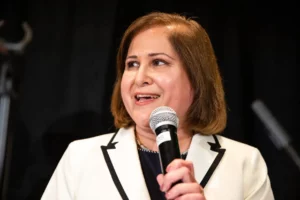
Sen. Ghazala Hashmi (D-Chesterfield)
Photo credit: VPMby Dick Hall-Sizemore
Kerry Doughtery has evinced a certain amount of outrage on this blog about state Sen. Ghazala Hashni (D-Chesterfield) not living in the district in which she ran and won re-election. (See here and here.)
The recent redistricting had placed Sen. Hashmi’s long-time residence just outside the district which she represented. In order to be able to run in her old district, the senator rented an apartment in that district and listed it as her primary residence. A group of residents filed a petition with the court claiming that she had not abandoned her longtime residence in which her husband still lived. They monitored the movement of the family’s vehicles and claimed that Hashmi still spent time there.
A retired judge has ruled that the evidence showed that Sen. Hashmi had established a domicile at the apartment and thus met the requirements of the law and had not falsified her residency in papers she filed with the Board of Elections. In her testimony, Hashmi said that she had moved furniture and personal effects to the apartment, established an office there, and changed her voting registration and driver’s license to reflect her new address. She did not deny spending some nights at her former home, partly to help care for her husband, who was dealing with a medical issue. She said that she and her husband plan to buy a home in the new district.
My Soapbox

The actions taken by Sen. Hashmi to deal with being redistricted out of her legislative district are not unusual; other legislators have resorted to similar moves in the past. They may not seem right, but they are not illegal. It is amazing that legislators will go to the hassle and expense of renting apartments and then moving, and perhaps uprooting their families, just to remain in the General Assembly.
-
Charlottesville, Its Public Schools and UVa – Part Four – Chronic Absenteeism, Social Promotion, VTSS and UVa’s Ed School
by James C. Sherlock
There is a rule: nothing else schools do will matter much for kids who are chronically absent.
In Charlottesville, it is the Black children who dominate the chronic absenteeism statistics.
Their SOL performance validates the rule.

The process for preventing and dealing with chronic absenteeism within the school system is so lengthy, bureaucratic and “progressive” (literally and figuratively) that it has failed Black children starting in kindergarten.

Absenteeism and social promotion are recipes for educational failure.
They also contribute directly to the breakdown of order and discipline in schools, as kids who are frustrated and lost in class act out first in disruptive, and then destructive ways.
Yet CCS schools allow runaway Black chronic absenteeism without truancy charges and engage in wholesale social promotion of Black students who do not have the academic skills to learn in the next grade.
Lest they be labeled racist.
What they get are racist outcomes. (more…)
-
Bacon Meme of the Week

-
Fear and Loathing of Youngkin’s Higher Ed Policy
 by James A. Bacon
In early October Governor Glenn Youngkin asked Attorney General Jason Miyares for a formal opinion on a seemingly innocuous question: whose interests are members of Virginia’s public university governing boards supposed to represent? Miyares responded that the “primary duty” of the boards of visitors is to the commonwealth, not to the institutions themselves. The conclusion would seem to be so obvious, so clearly the intent of the state code, that it doesn’t warrant discussion.
But some people espy a vague but malign intent behind the finding.
Speaking to the higher-ed trade journal, Inside Higher Ed, Claire Gastañaga, former director of Virginia’s ACLU and a former deputy attorney general overseeing Virginia’s public colleges and universities, said Miyares’ opinion is a threat to the autonomy of public institutions. In the publication’s words, she “fears it signals an attempt by the governor to justify the removal of board members whose actions don’t align with his priorities” and replace them with appointees who share his priorities. Gastañaga pointed to the Bert Ellis bogeyman as evidence that Youngkin is scheming something nefarious. (more…)
-
Open House Races in NoVa Already Crowded
 by Jeanine Martin
Here are the candidates so far in the 2024 election for open seats in the U.S. House of Representatives in the 7th District, currently held by Democrat Abigail Spanberger, and in the 10th District, currently held by Democrat Jennifer Wexton:
Virginia’s 10th district
Del. Michelle Maldonado (D-Manassas) is the latest to announce her candidacy in the crowded Democrat field competing for the nomination for Congress in the 10th district.
Other Democrats running in the 10th are:
Eileen Filler Corn (D-Fairfax), former Speaker of the House of Delegates. (She does not reside in the 10th district but that is not necessary to run for Congress.)
State Sen. Jennifer Boysko (D-Fairfax)
Del. Suhas Subramanyam (D-parts of Loudoun and Prince William). He was elected to the state Senate earlier this month.
Del. Dan Helmer (D-part of Loudoun and Prince William)
Del. David Reid (D-Loudoun)
Atif Qarni, former Secretary of Education under Ralph Northam. (more…)
-
Virginia Beach Nixes Kitty Hawk Wind Cables

Site map for the first phase and cable connection route for the proposed Kitty Hawk Wind project. by Steve Haner
The political leaders of the City of Virginia Beach have informed an offshore wind developer that they oppose its plan to bring power cables ashore at Sandbridge Beach. No formal vote was taken on the application, however, according to media reports.
The story appeared in The Virginian-Pilot and on local television station WAVY around Thanksgiving. When Bacon’s Rebellion last visited this matter, Virginia Beach City Council had conducted a May public hearing at which most speakers strongly opposed the power cable location. (more…)
-
Tough Question: What’s Going On at the Virginia General Assembly?
 by Gordon C. Morse
Forty years ago, I wrote an essay for the Richmond Times-Dispatch — “The Long and the Short of the Assembly” — that noted “a growing sense that the Virginia General Assembly is not performing satisfactorily,” that it had “devolved into an unhappy spectacle.”
Revisiting that essay recently immediately gave me a headache. The question then and now is whether Virginia’s process for considering proposed new laws or enacting changes to existing laws provides sufficient opportunity for the public, as well as the legislative membership, to understand what’s happening at any given moment and, at some level, participate?
It has long been the habit in Virginia – based on 18th, even 17th century inclinations – to simply get lawmaking done, and as quickly as possible. Having sufficient public “access” was not a major hang-up.
To put it another way, doing legislative work in Virginia was always regarded as important, but there were always other, equally important, things to do. Growing and harvesting crops, for instance. Well into the middle of the 20th century, Virginia remained an agrarian economic/social construct. The legislative calendar reflected that reality.
That changed (sort of) with the 1970 revisions to the Virginia Constitution and there’s no need to dive deep on that subject here, except to say that there were, even then, lingering doubts about the efficacy of unrestrained democratic institutions. This concern was most dramatically expressed when, during the 1901-02 Virginia Constitutional Convention, a proposal to hold the General Assembly to a single meeting once every four years was only narrowly defeated.
But a growing state has growing needs — as my prior boss Gov. Gerald L. Baliles once liked to put it — and the remedies enacted more than 70 years ago, which go to the specific lawmaking structure, may no longer be adequate. (That’s an understatement.) (more…)
-
Charlottesville, Its Public Schools and UVa – Part Three – CCS Abandons Truancy Filings, Absenteeism Soars

Courtesy of wallpaper.com by James C. Sherlock
The effects of public policies can be murky.
Not this one.
The subject in this Part 3 is alarming chronic absenteeism of Charlottesville City Schools (CCS).
At issue is the virtual abandonment by that division of the use truancy filings with the Juvenile and Domestic Relations Court, removing parental consequences.
That change has been accompanied by enormous increases in absenteeism and everything, all bad, that comes with it.
The numbers are stark. (more…)
-
Everyone Loves Free Speech… In Theory

Governor Glenn Youngkin at the higher-ed summit at the University of Virginia. Photo credit: The Daily Progress by James A. Bacon
Governor Glenn Youngkin outlined yesterday his vision for colleges and universities in Virginia as bastions of free speech and intellectual diversity where people come together to devise solutions to society’s most pressing problems.
“How do we ask serious questions and foster informed debate so we can get to answers?” he asked in a pragmatic defense of free speech in a keynote speech at a statewide higher-ed conclave held at the University of Virginia. The answer was implicit in the title of the event: the Higher Education Summit on Free Speech and Intellectual Diversity.
The summit was attended by representatives, including many presidents, of every public university in Virginia and more than half of the state’s private higher-ed institutions. The end goal of the event, said Secretary of Education Aimee Guidera in introductory remarks, was for every institution to create an “action plan” to advance the goals of free speech and intellectual diversity.
Youngkin began laying the groundwork a year ago when he addressed the Council of Presidents and pushed them toward the same goals. The Council, comprised of Virginia college and university presidents, adopted a statement endorsing free speech and intellectual diversity in the abstract. But as discussions at Wednesday’s summit made clear, there is considerable gray area in applying free speech principles in the real world. The next step is to move beyond the expression of abstract principles to putting those principles into action. (more…)
-
How Youngkin Can Avoid Lame Duck Status
 by Scott Lingamfelter
Elections produce clarity. One thing is noticeably clear after Republicans failed to achieve majorities in both chambers of the Virginia General Assembly. For the next two years, the prospects for Republican Gov. Glenn Youngkin‘s legislative agenda are bleak.
That’s the bad news.
Here is the good news: it doesn’t have to be that way.
The inclination of those defeated in elections is to engage in “blamestorming,” seeking to find fault with this or that election strategy. We’re seeing that now as some Republican legislators grouse about the governor’s decision to emphasize abortion restrictions that played badly in some swing districts. That messaging debate should occur. But it’s imperative that the governor and the GOP in Virginia do some serious brainstorming on how to win back the hearts and minds of voters. Serious-minded governance can do that. (more…)
-
Around the Commonwealth: Local Unions and Housing Help
by Dick Hall-Sizemore
Some interesting recent actions by local governments:
Local employee unions–Many on this blog predicted that local government bodies, especially those in “progressive” urban areas would not be able to resist attempts by local employee unions to enter into collective bargaining. The City of Norfolk has demonstrated that it can and will resist. As reported by The Virginian Pilot, the Norfolk City Council this week voted 5-3 against a request by the Police Benevolent Association to enter into collective bargaining. The city council did create four “employee committees” that are to meet with the city manager. Input from those committees will be factored into council’s budget decisions.
Helping employees buy a house–Henrico County will pay up to $25,000 for a down payment on a house for qualified county or school employees. The county has designated $2 million for this initiative. Therefore, at least 80 employees will be able to benefit.
To benefit fully from this offer, the employee must work five years for the county. According to the county administrator, the county views this as a tool to retain employees.
As reported by the Henrico Citizen, the program is available to first-time home buyers who have worked for the county or school system for at least year on a full-time basis. The home to be purchased must be located in Henrico County and cost no more than $425,ooo. Furthermore, eligibility for the program is limited to employees who live in a household with income not exceeding $98,400 for two or fewer persons or $114,900 for three or more persons. The down payment provided by the county will be treated as an “interest-free, forgivable loan, and 1/60th of the balance will be forgiven each month that the employee lives in the house and remains employed by Henrico. If the employee stops working for the county or sells the house before the five-year window has ended, he or she will be required to repay the remaining balance.”
-
‘Defund the Police’ and Other Nonsense
by Joe Fitzgerald
“Defund the police” is a stupid slogan.
Give its proponents the benefit of the doubt, however. Maybe what they meant was return police to their core mission of protecting life and property, remove their frequent role as social worker or mental health counselor, demilitarize their responses to all but the most dangerous situations, and soften the qualified immunity defense. It’s still a stupid slogan, especially at the local level.
“Let cops be cops” might have been a better slogan if the murder of George Floyd hadn’t stoked anti-police sentiment in so many. The more rational response might have been reforms to the concept of qualified immunity, which is roughly the idea that a police officer can’t be prosecuted for a harmful or destructive reaction if he thought he was doing the right thing. “Defund the police” seems predicated more on the idea that all police are bad or that paying them less will improve policing or that having fewer of them will reduce crime.
The attitude behind the slogan on the left is half of a symbol of the polarization that keeps government from accomplishing anything. The other half is the anti-teacher sentiment on the right. Public safety and education are the two largest segments of any local budget. Someone once observed that a local government is a school system with a police force. In Harrisonburg, those two segments of the city budget consume 57 percent of local funding. (more…)
-
Charlottesville, Its Public Schools and UVa – Part Two – Black Students
by James C. Sherlock
What drew me to this story is the fact that Black students in Charlottesville City Schools (CCS) have suffered to a degree unequaled elsewhere in the Commonwealth.
Keeping in mind the domination of Charlottesville and its schools by the University of Virginia and its School of Education and Human Development discussed in Part One, we will move ahead from there.
CCS is a school system designed unusually with six schools for Pre-K-4, one for grades 5 and 6, another for 7 and 8, and a single high school with a couple of alternative programs.

Map of elementary school boundaries courtesy of Charlottesville City Schools. Author’s annotations in overlays reflect Virginia School Quality data The map above shows that the Pre-K-4 school boundaries roughly follow the city’s neighborhoods.
Now look at the elementary school performance and attendance annotations.
The biggest anomaly is that the gap between White and Black academic performance in CCS is an ocean. Worse than Richmond both in absolute performance by the Black students and relative to White students.
I can find nowhere in the Commonwealth, including other college towns (and I looked), in which White and Black public-school students exist in academic disparity to the extent they do in Charlottesville.
The Charlottesville High School riots reflect that gulf. Buford Middle is worse.
CCS has managed to fail those Black children in a relatively balanced student demographic of 42% White, 29% Black, 14% Hispanic, 5% Asian and 10% multiple races.
The teachers have far more advanced degrees, most from UVa’s ed school, than the average school division.
It just doesn’t work.
-
Most ‘Diverse’ General Assembly in Virginia History Takes Over in January
 by Ken Reid
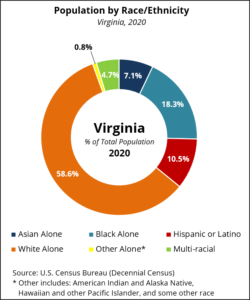
The new post-redistricting Virginia General Assembly that will take control in January, probably with a Democrat majority, will be the most ethnically, racially and religiously diverse group of legislators in Richmond in history, and about ¼ will be female.
In addition, some 52 of the 140 members of the General Assembly will be totally new to the State Capitol – most never having served in any elected office before.
This make-up is largely due to the huge number of retirements from the last GA, which was primarily forced by bipartisan redistricting in 2021, where a number of incumbents were placed in the same district and chose not to run against each other for re-election.
Whites will be the minority in the Democrat Caucus in each house, which also could be a first. The House of Delegates as a whole will be 67% white, down from 78% after the 2017 “Blue wave” elections, when Republicans maintained control by a coin toss – and that’s because the overwhelming number of Republicans are white.
In the State Senate, 30 of the 40 senators will be white in 2024, largely due to the Republican presence.
This analysis, based on examining the biographies of the new GA members on Ballotpedia, shows the following breakdown, though one race (the 82nd house race between incumbent Republican Kim Taylor and Democrat challenger Kim Adams) is headed to a recount with Taylor ahead by 78 votes (more…)



