• The Case for an RVA Meals Tax Amnesty

    Richmond City Hall

    by Jon Baliles

    Today we are posting a special edition featuring an email from former restaurateur Brad Hemp that he recently sent to City Council about the meals tax fiasco you have probably heard about as a result of seven years of neglect at City Hall. The Mayor raised the meals tax in 2018 to help build new schools and pledged in return he would also help the restaurants. He raised the tax, and three schools were built, but heย forgot about helping the restaurants.

    Now, here we are, years later, and the only thing coming from City Hall are vacillating and daily changes and pledges to fix the problem on a โ€œcase-by-caseโ€ basis (in a vain attempt to get the media stories to stop). As someone who lived and breathed the restaurant business (and could teach the Mayor and Council a few things about it), Hemp has some suggestions to fix the mess. The question is, will the Mayor and City Council finally listen and do something?

    RVA 5×5 โ€” PREFACE
    The best government is almost always the one that listens. It makes it easier for people to enjoy their lives, better their neighborhoods, open or run a business, and have fun. The worst government is almost aways one that pretends to know everything and thus ignores listening to or helping the people by doing things like,ย just as an example, forcing through a second casino referendum right after the first one lost. Another way to demonstrate bad government is to find straw-man excuses forย erroneous billing of residents for personal property, real estate and water, and misapplying payments ofย meals taxes for restaurants and never notifying anyone when a bill is late while interest and penalties skyrocket. The โ€œleadersโ€ at City Hall say itโ€™s the fault of state code, or the postal service, or bad technology, or the current lunar cycle. Donโ€™t look inward to see if itโ€™s an internal problem, blame it on everyone and everything else. (more…)


  • Will Dominion Fool Us Again with SMR Cost Bill?

    Artist rendering of a NuScale small modular reactor plant, proposed but now not being built in Idaho.

    By Steve Haner

    Fool me once, shame on you.ย  Fool me twice, shame on me.ย  A utility-backed bill to stick electricity ratepayers with the high-risk costs of developing small (modular) nuclear reactors, approved by a Senate committee Friday, is a โ€œfool me twiceโ€ example.ย  Shame on the General Assembly if it falls for it. (more…)


  • Only Tax Increases Still Pending at Assembly

    Gov. Glenn Youngkin

    By Steve Haner

    Governor Glenn Youngkinโ€™s package of proposed tax changes is now stalled in both the Virginia Senate and the House of Delegates. A House subcommittee spiked it Feb. 5 and then dashed other bills imposing major tax increases on higher income Virginians. A full Senate committee refused his bill on Feb. 6.

    Of course, anything is possible until the General Assembly adjourns in March, but it seems only two major tax increase proposals are still viable in the 2024 Assembly. ย 

    The first would allow all Virginia cities and counties to add an additional 1% to the sales and use tax within their borders for school spending, if a local referendum approves it. Current law has allowed that in eight counties and one city but this bill would expand that to the entire state. It is advancing in both chambers.ย 

    The second, not usually discussed as a tax hike, is the proposal for a new state trust fund to provide weekly payments to employees taking family or medical leave from work. The bill calls for a payroll tax to fund the benefits but does not specify a tax rate or indicate just how much of an employeeโ€™s wage would be taxed. The Virginia Employment Commission based its fiscal estimates on a tax of just under 1%.ย ย 

    Bills creating this new state-paid family and medical leave benefit program are now in the budget committees of both chambers, and they have until February 18 to reveal their budget amendments. This program could easily become a $1-2 billion annual entitlement. The underlying federal Family and Medical Leave Act (FMLA) provides no income replacement, just up to 12 weeks of job protection for covered absences. (more…)


  • The General Assembly’s Gift to Virginia’s Students

    by Matt Hurt

    During the 2024 General Assembly session, two bills were introduced which have the potential to provide two additional weeks of uninterrupted learning that Virginiaโ€™s students in grades three through eight havenโ€™t had in a few years.ย  Specifically, HB 1076 and SB 435 are two very concise sister bills which simply intend to allow school divisions the flexibility to administer other assessments in lieu of the through year growth assessments (HB2027/SB1357) that were required by the 2021 General Assembly, so long as the alternative assessments are aligned to Virginiaโ€™s Standards of Learning.ย  Last week HB 1076 passed the House 80-18 and SB 435 made it through the first Senate subcommittee.

    The through year growth assessment legislation was certainly well intentioned.ย  Educators have clamored for years for a process that would demonstrate student growth throughout the school year and to use this measure for accountability purposes.ย  The problem with this method of determining growth is that there is a great incentive to obtain high scores at the end of the year, and equally great incentive to obtain low scores at the beginning of the year in order to demonstrate high degrees of growth.ย  This problem was explained in detail here, and the negative unintended consequences yielded were outlined here.ย 

    Currently, these through year growth assessments disrupt instruction in each elementary and middle school for a week in the fall and another week in the winter.ย  While these assessments take a little less time to administer than the end-of-year SOL test, the entire process still takes a significant amount of time.ย  For example, many students with disabilities require testing accommodations such as small group or one-on-one testing, having the test read aloud, etc., all of which requires teachers to spend extra time testing that they would normally spend instructing students.ย  Classroom teachers, special education teachers, intervention teachers, instructional aides, etc. are all pressed into service to help with testing, and this limits the amount of time that they work with students. (more…)


  • General Assembly Committees Approve Bill That Would Allow Even Serial Killers to Seek Release


    from Liberty Unyielding

    When Virginia abolished the death penalty in 2021, Virginians were assured it wasn’t needed, because the worst killers could be given life sentences without the possibility of parole.

    But now, even the worst killers could eventually be released. Committees in Virginia’s Democratic-controlled legislature have approved bills to allow all inmates serving long sentences to seek release after specified periods — even serial killers and others who committed aggravated murders who once would have been eligible for the death penalty. HB 834 and SB 427, known as the “second look” bills, have been amended to create three tiers for release. Most inmates could seek release after 15 years, while those who commit the most serious offenses would have to wait 20 years or 25 years, depending on their offense.

    For Virginia inmates whose prison sentences are shorter than 15 years, this legislation would change nothing. Most rapists who are first-time offenders, and many second-degree murderers, receive sentences of less than 15 years to begin with.

    But for serial killers and others who commit aggravated murders who are serving a sentence of life without parole, the passage of this “second look” legislation would be a big change. It could give them even more than parole. Inmates released on parole are subject to the supervision of a parole officer, and if they misbehave or evade oversight, they can be sent back to prison for a long time. By contrast, an inmate who has been released under the “second look” legislation lacks these guardrails, and is not accountable to a parole officer, because his release marks the end of his sentence. (more…)


  • Stratford Hall Tax Exempt Status Preserved

    Stratford Hall in Westmoreland County

    The real and personal property tax exemptions for the historic colonial plantation Stratford Hall, the ancestral home of the Lees of Virginia, have been spared by the Virginia Senate. It once again amended a bill stripping tax exemptions from other organizations with connections to the Southern Confederacy, removing the popular tourist attraction that was home to two signers of the Declaration of Independence.

    Senate Bill 817 then went on to pass 23-16, with two Republicans joining the 21 Democrats in favor. The sponsor, Senator Angelia Williams Graves (D-Norfolk), did not explain in her brief floor presentation why she relented on imposing local property taxes on that one facility but not the others. There was no debate on the bill, pro or con, before the vote for passage this afternoon. (more…)


  • Boomergeddon Countdown: Ten Years… Nine…

    by James A. Bacon

    The last time the United States had a serious conversation about deficit spending and the accumulating national debt was in 2010 with the publication of the Simpson-Bowles study. (That’s about the same time I wrote Boomergeddon, predicting that the United States had 20 to 30 years before the fiscal wheels fell off the bus.) After the usual tut-tutting, and Republicans blaming Democrats, and Democrats blaming Republicans, nothing was done. Indeed, in the following era of artificially low interest rates that made deficit spending seem painless, Congress, successive presidents, and the media ignored the issue and deficits ballooned.

    Now the national debt exceeds $34 trillion, the debt-to-GDP ratio exceeds 100%, the structural budget deficit is running between $1 trillion and $2 trillion annually, and it will be only a decade before the Social Security Trust fund runs out and sparks a fiscal/political crisis. Political polarization is even worse today than it was during the Obama presidency. Democrats and Republicans accuse one another of sabotaging democracy, and trust in our institutions has reached an all-time low. It’s as if the captain and the executive officer of the Titanic were fighting for control of the vessel, rolling on the deck trying to gouge each others’ eyes out, even as its prow dips below the icy waters.

    Meanwhile, there is no cognizance in the political rhetoric here in Virginia of the fiscal perils to come. The Commonwealth is required by its state constitution to balance its budget, and the state has managed to retain its AAA bond rating, so we are not as wildly profligate as some other states. I suppose there will be some temporary comfort in the thought that we were not the first to plunge into ungovernable anarchy when the federal government fails. But that comfort likely won’t last long. (more…)


  • 2023 School Success Stories

    by Matt Hurt

    According to the SOL data from the end of the 2022-2023 school year, thirty-four Virginia schools (of three hundred seventy-seven) in the Comprehensive Instructional Program (CIP) consortium achieved the highest level (Level I) for all academic indicators the state uses for accreditation. The intended purpose of these performance benchmarks is to ensure we effectively assure success for all students, regardless of subgroup status. ย The Level I benchmarks for the academic indicators for school accreditation ratings are listed below.

    English Performance

    • Overall school combined rate (combination of students who scored proficient or advanced and students who were not proficient but made significant gains towards proficiency) of at least 75%;
    • Each subgroup (for which there are at least 30 students in the subgroup enrolled in the school) must also meet the 75% combined rate. ย Subgroups used for accreditation purposes are as follows: Asian students, Black students, economically disadvantaged students, English learners, Hispanic students, students with disabilities, White students, and multiracial students.

    Math Performance

    • Overall school combined rate (combination of students who scored proficient or advanced and students who were not proficient but made significant gains towards proficiency) of at least 70%;
    • Each subgroup (for which there are at least 30 students in the subgroup enrolled in the school) must also meet the 70% combined rate. ย Subgroups used for accreditation purposes are as follows: Asian students, Black students, economically disadvantaged students, English learners, Hispanic students, students with disabilities, White students, and multiracial students.

    Science Performance

    • Overall rate of students who scored proficient or advanced of at least 70%.

    Once these outcomes were discovered, several of these schools were visited prior to teachers leaving for summer break. ย Schools with the highest poverty rates and/or highest minority enrollments were targeted since time only allowed for eight school visits (Bessie Weller Elementary- Staunton City, Highland View Elementary- Bristol City, Saltville Elementary- Smyth County, Sugar Grove Elementary- Smyth County, St. Paul Elementary- Wise County, Tazewell High School- Tazewell County, Tazewell Intermediate School- Tazewell County, Woolwine Elementary- Patrick County). ย During these visits, teachers and principals shared the factors that they felt were most significant in their success. ย The following narrative is intended to communicate the most common factors for success noted by these dedicated educators.

    (more…)


  • RVA HISTORY: Strides of Strength

    by Jon Baliles

    Richmond unveiled a new sculpture last week on the site of the old Westhampton School (near St. Maryโ€™s Hospital) that marked the desegregation of the West-End school in 1961. The 12-foot piece, entitled โ€œStrides,โ€ marks that day when 12-year old student Daisy Jane Cooper (now Jane Cooper Johnson) arrived as the first African American student following a three-year legal battle that took a U.S. District Courtโ€™s intervention. (Photo courtesy of Bon Secours.)

    At age 9, Jane was having to travel five miles to get to the segregated Carver Elementary School. In 1958, civil rights attorney Oliver Hill submitted an application to the Richmond City School Board on behalf of Jane’s mother to transfer Jane to the all-white Westhampton School. The State Pupil Placement Board rejected the request, which led to the lawsuit that lasted three years and resulted in a groundbreaking victory in 1961. It impacted not only Richmond City schools but other localities as well โ€” and the ruling meant that African-American students no longer required permission from the State Board to attend a white school.

    A year after first walking through the doors of Westhampton, Cooper also became the first African-American student to integrate Thomas Jefferson High School in September 1962, after deciding she wanted to go there instead of the all-black Maggie Walker High School. (more…)


  • Stay Calm: Police Finally Release Make and Model of the Va. Beach Pier Car

    by Kerry Dougherty

    Everyone try to maintain your composure. Letโ€™s all stay calm. Perhaps a few moments of meditation are in order.

    Deep breath.

    Ready?

    We finally know the make and model of the car that drove off the 14th Street pier more than a week ago.

    The police had that information but withheld it from the public, they said, โ€œto avoid a panic.โ€

    The car that spent almost a week in the Atlantic because the city couldnโ€™t figure out how to remove it from its watery 17-foot grave is a red Nissan Kicks.

    Good Lord thatโ€™s shocking. Thank goodness THOSE details didnโ€™t leak. Imagine what might have happened.

    In case youโ€™re wondering, as I was, what a Nissan Kicks looks like, weโ€™ve included a photo of the panic-inducing compact SUV from the NissanUSA website. (more…)


  • Failure Is Not an Option with Proposed SOL Revisions: Part Two

    Lisa Coons

    by Charles Pyle

    Last month, we examined two items on the agendas for the Board of Educationโ€™s January 24-25 meetings that seemed to fly in the face of Governor Glenn Youngkinโ€™s 2021 campaign promises to raise expectations for students and schools and increase transparency in how the commonwealth reports on the performance of both.

    Under one of Superintendent of Public Instruction Lisa Coonsโ€™ proposals โ€” which was abruptly removed from the agenda of the boardโ€™s January 25 business meeting โ€” students would no longer fail Standards of Learning tests in reading and math. Rather, students who failed to meet the proficiency benchmarks would be reported as performing at the โ€œbasicโ€ or โ€œbelow basicโ€ levels.ย 

    As pointed out in last monthโ€™s article, while these descriptors mirror those on the national reading and math tests, the potential for confusion would be high given that Virginia sets the proficiency bar on its reading and math SOL tests much lower than the benchmarks students must meet on the national tests, known as the National Assessment of Educational Progress.

    Youngkin expressed his concerns about Virginiaโ€™s low expectations on the campaign trail in 2021, and vowed in his May 2022 report โ€œOur Commitment to Virginians: High Expectations and Excellence for All Studentsโ€ to raise the commonwealthโ€™s expectations for students to equal the rigor of the national benchmarks. The governorโ€™s report noted that while other states raised standards during recent years, Virginiaโ€™s expectations relative to national standards had slipped to the lowest in the nation.ย 

    But a recent but little-noticed National Center for Education Statistics study confirms that this is still the case, despite the governorโ€™s promise to raise expectations. (more…)


  • The Most Improved Virginia School Division in 2023

    by Matt Hurt

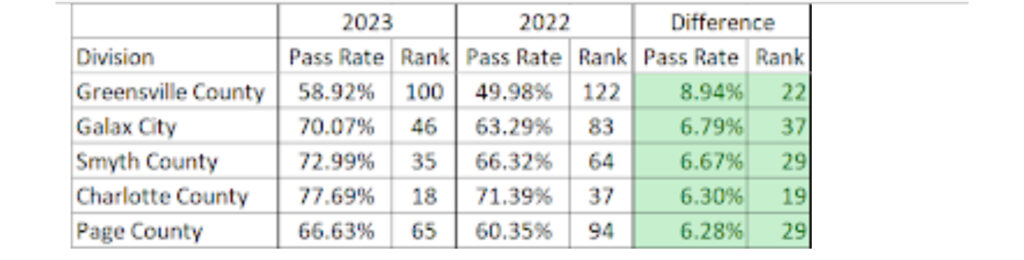
    In a previous paper (Tales of Student Success in 2023) the successes of four of the top five divisions that realized the greatest improvement in SOL pass rates in 2023 were highlighted. Since then, I was afforded the opportunity to visit Greensville County, the division that realized the greatest improvement in Virginia. During this visit teachers and administrators outlined the aspects in their division which they felt lead to these significant improvements. These stories mirror those in the other divisions previously discussed.

    Table 1: Top SOL Pass Rate Improvement Divisions from 2022 and 2023

    The educators in Greensville County attributedย  their significant improvement in student outcomes to a number of factors. They felt that the increased focus on relationships, expectations, leadership, and focusing on the positives helped them to ensure more success for their students than in the past.

    Teachers related that they had invested more heavily in relationships with their students over the last few years. As in some other rural areas, these teachers reported that they were mostly from the county, but may not have lived in the same communities as their students. Through discussion with peers, teachers began to consider that some students live in situations that are significantly different from their middle-class experiences. Some of the teachers were familiar with these situations and shared this perspective with others. (more…)


  • Rare SCC Deadlock Sinks Dominion’s Energy Plan

    By Steve Haner

    The year long debate over Dominion Energy Virginiaโ€™s proposed integrated resource plan, which threw climate catastrophe activists into a frenzy because it added a new natural gas plant, is ending with no decision.ย  Two State Corporation Commission judges split on whether to approve it, basically a win for the anti-fossil fuel forces.

    In December, a hearing officer assigned to study the case had ruled that Dominionโ€™s plan should be rejected because it included the expansion of gas generation, when the anti-natural gas forces in the General Assembly had passed laws against that 2020 and 2021. ย Those laws did include provisions for maintaining or adding fossil fuel generation on the basis of a threat to reliability, but only under limited circumstances. (more…)


  • Jeanine’s Memes

    From The Bull Elephant


  • No More Legacy Admissions in Virginia

    Out of luck

    by James A. Bacon

    Bills to ban preferential treatment for relatives of alumni at Virginia’s public universities flew through the 2024 session of the General Assembly in remarkable time. In a legislature marked by intense partisan divisions, companion bills passed subcommittees, committees, and the full Senate and the House of Delegates on unanimous votes. According to the Richmond Times-Dispatch, Governor Glenn Youngkin has indicated he will sign the bill.

    โ€œIf weโ€™re going to have an even playing field, letโ€™s have an even playing field,โ€ said Democratic Sen. Schuyler VanValkenburg, D-Henrico, who sponsored the Senate bill.

    VanValkenburg’s statement presumably alludes to last year’s U.S. Supreme Court ruling restricting preferential treatment in college and university admissions on the basis of race. Many Republicans and conservatives argued that policies should not tilt the playing field for or against members of a particular race or ethnic group. Admissions, they contend, should be based on merit.

    In this case, Virginia Republicans appear to be true to their meritocratic principles. Attorney General Jason Miyares was among those backing the ban on legacies. The Times-Dispatch summarized his thinking this way: “Colleges should judge applications based on what a student can control โ€” such as classes, grades and extracurriculars โ€” not the color of their skin or their parentsโ€™ school.” (more…)