• The Return of Compulsory Chapel: George Mason Will Require Students to Take โ€˜Social Justice’ Courses

    by the staff of Liberty Unyielding

    It’s the “return of compulsory chapel: George Mason University, a Virginia public institution, will require students to take two social justice courses,” notes Walter Olson of the Cato Institute. A student taking such courses will have “to demonstrate” “competencies” in “diversity,” “equity.” and “inclusion.” George Mason University is Virginia’s largest university.

    Last month, George Mason University announced:

    Students entering Mason in Fall 2024 or later will be required to take two Mason Core courses that have the Just Societies flag….

    Courses with a Just Societies flag must meet both of these outcomes, in addition to other required course outcomes related to the primary Mason Core Exploration category.ย Upon completing a Just Societies course, students will be able to demonstrate the following two competencies:

    1. a) Define key terms related toโ€ฏjustice, equity, diversity, and inclusionโ€ฏas related to this courseโ€™s field/discipline and
      b) Use those terms to engage meaningfully with peers about course issues …
    1. Articulate obstacles to justice and equity, and strategies for addressing them, in response to local, national, and/or global issues in the field/discipline

    The National Review says thatthe classes no doubt will be grievance-dominated and utopian.”

    There is a course approval process for faculty wishing to teach these required courses. But as a practical matter, only courses with a left-leaning ideological slant are likely to be approved. “What do you suppose would happen if a GMU professor proposed a course on the theme that the most just society would be one with a minimal government?,” asks George Leef of the James G. Martin Center for Academic Renewal. (more…)


  • The VMI Class of ’25’s Elephant in the Room

    by the staff of The Cadet

    The Virginia Military Institute (VMI) Rat Mass of 2024+3 is now the Class of โ€™27. That recognition brings a time to pause and reflect on the past and future of what was and is no longer. The mantle will soon pass to the Class of โ€™25 for their Ratline next year and it is time to address โ€œthe elephant in the room.โ€ Unless โ€™25 brings it back, the Ratline will continue to degrade into a risk-averse basic training curriculum providing little more to incoming Cadets than how to march and endlessly repeating the Inscription on the Parapet and the VMI Mission. While the knowledge and understanding of this information is important for a Rat undergoing our indoctrination phase, what value does it provide if Rats do not have the time management skills, self-discipline, or physical ability to compete in our academic and military environment?

    It was the administration, not the First Class, that dictated the date for โ€œbreakout.โ€ The activities were known well in advance not only by Rats but by parents who asked on social media how they could attend. The much advertised โ€œfakeoutโ€ (fake breakout) to try and add a little mystery was an open secret, and directly pinpointed the true date of โ€œbreakout.โ€ Though the First Class, and especially the Rat Disciplinary Committee (RDC), worked hard, a majority of the Corps were not involved in the event that took place on Tuesday afternoon, starting around 2:00 p.m., and only lasted several hours. Turnout for the Second Class sweat party was weak, at best. Professors scheduled exams the next day requiring many to choose between participation and their grades. Coaches and (the senior cadets who mentor Rats) in NCAA programs were notified and briefed on the events, of which they immediately informed their freshman players. Rats were not even required to fill the sandbags used to depict their class year in the photo. They are now returning to storage until needed for the next spectacle.

    The administration stated the main Rat Mass priority is โ€œretentionโ€ with the Dean continuing to brief the Board of Visitors (BOV) on the failing numbers for Corps and, especially Rat Grade Point Averages (GPAs). An increasing number of Cadets who would normally be placed on academic suspension are being held in the Corps, while the Dean advocates for General Order 1 restrictions on Corps events that limits the โ€œleadership laboratoryโ€ experience of VMI to no more than a few hours a week.

    The Blue Book and other official documents have now expunged the term โ€œRatโ€ in favor of โ€œNew Cadet.โ€ Photos soliciting donations in the name of โ€œOne VMIโ€ show cadets packing stands for basketball and football while first Class Ratline activities were canceled in favor of mandatory attendance at those games. (more…)


  • Dueling Fiscal Impact Statements

    Del. Marcus Simon (D-Falls Church) Photo credit: Falls Church News-Press

    by Dick Hall-Sizemore

    Providing a fiscal impact statement (FIS) for legislation is a positive aspect of the legislative process. The statement can alert the legislators to the possible fiscal implications of a bill under consideration and its estimated cost. Thus, legislators are in a position to make a more informed decision about supporting the bill.

    The process for preparing FISs has been described and discussed in detail in an earlier post on this blog. There is a bill currently under consideration that nicely illustrates the ways in which fiscal impact statements can be misused. Before going into specifics, it would be useful to review how that happens.

    As with many things intended to be positive, FISs have a negative aspect, as well. For example, legislators can hide behind them. Subject-matter committees are supposed to make the policy decision on a bill and, if it is approved, refer it to the House Appropriations Committee or the Senate Finance and Appropriations Committee, as applicable, for the consideration of the fiscal impact. The money committees, in theory, are supposed to limit their consideration to whether the projected fiscal impact can be handled in the budget. In reality, however, those committees also take the policy aspects of those bills into consideration. As a result, legislators on the subject-matter committees who may think a bill is bad for any of several reasons, but do not want to oppose it for political reasons, can vote for it, knowing it will be referred to the money committee, which will likely kill it. (more…)


  • Biting the Hand that You Need

    by Dick Hall-Sizemore

    If you are a Virginia governor entering the last two years of your term with your party in the minority in both houses of the legislature and are depending on the other party to help you put in place a major project which would be part of your legacy, why would you publicly insult that party gratuitously?

    In a speech this weekend at Washington and Lee University, Governor Youngkin had this to say: โ€œToday’s progressive Democratic Party does not believe in โ€” nor do they want โ€” a strong America, an America with no rivals; they are content to concede, to compromise away, to abandon the very foundations that have made America exceptional.”

    Senate Democrats promptly announced that the bill to create an authority to oversee the $2 billion development for a professional basketball and hockey arena would not be on the agenda for Mondayโ€™s meeting of the Senate Finance and Appropriations Committee. Sen Scott Surovell, (D-Fairfax), the Senate Majority Leader explained that the speech “pretty much destroyed any sense that there was “good faith” in discussions between the administration and Democrats. Monday is the last day each house can consider its own bills, with the exception of the budget bill.

    I wonder if Youngkin was aware of his party leaderโ€™s attitude about Americaโ€™s โ€œfoundationsโ€ โ€” treaties are not to be honored; Americaโ€™s support is for sale; he would encourage Russia to do โ€whatever the hell it wanted toโ€ if an ally were not putting up as much as he thought they should.


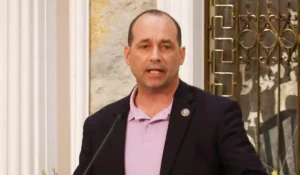
  • Rep. Bob Good Calls for Hearing on Naming Commission

    Rep. Bob Good

    by Donald Smith

    The Virginia congressman who represents Appomattox, where the Civil War started to end,* wants the House of Representatives to examine the impacts of Congressโ€™ attempt to grapple with the legacy of that war — an attempt that could lay the groundwork for the legacies of Confederate generals and soldiers to be deemed unworthy of public respect in American heritage and in modern-day American society.

    Bob Good, representative from Virginiaโ€™s 5th Congressional District and chairman of the House Freedom Caucus, issued this press release on Friday, February 2.ย  It calls for the House Oversight Committee to convene a hearing to review the operations and decisions of the Naming Commission.ย 

    Congress should conduct a thorough review to determine the true nature of the efforts to remove historic statues and memorials. Historical sites are meant to preserve moments that are critical to the growth and healing of our nation and should not be subject to the destructive ruse of political wokeness. I am calling for a full accounting of the actions taken by the Naming Commission so the American people can see for themselves how the Biden Administration used their tax dollars, and if they did so to arbitrarily erase our history.

    Good said that the โ€œneed for proper accountability and oversight regarding the rationale behind the Commission’s deliberationsโ€ warranted a hearing. (more…)


  • Bacon Meme of the Week


  • The Case for an RVA Meals Tax Amnesty

    Richmond City Hall

    by Jon Baliles

    Today we are posting a special edition featuring an email from former restaurateur Brad Hemp that he recently sent to City Council about the meals tax fiasco you have probably heard about as a result of seven years of neglect at City Hall. The Mayor raised the meals tax in 2018 to help build new schools and pledged in return he would also help the restaurants. He raised the tax, and three schools were built, but heย forgot about helping the restaurants.

    Now, here we are, years later, and the only thing coming from City Hall are vacillating and daily changes and pledges to fix the problem on a โ€œcase-by-caseโ€ basis (in a vain attempt to get the media stories to stop). As someone who lived and breathed the restaurant business (and could teach the Mayor and Council a few things about it), Hemp has some suggestions to fix the mess. The question is, will the Mayor and City Council finally listen and do something?

    RVA 5×5 โ€” PREFACE
    The best government is almost always the one that listens. It makes it easier for people to enjoy their lives, better their neighborhoods, open or run a business, and have fun. The worst government is almost aways one that pretends to know everything and thus ignores listening to or helping the people by doing things like,ย just as an example, forcing through a second casino referendum right after the first one lost. Another way to demonstrate bad government is to find straw-man excuses forย erroneous billing of residents for personal property, real estate and water, and misapplying payments ofย meals taxes for restaurants and never notifying anyone when a bill is late while interest and penalties skyrocket. The โ€œleadersโ€ at City Hall say itโ€™s the fault of state code, or the postal service, or bad technology, or the current lunar cycle. Donโ€™t look inward to see if itโ€™s an internal problem, blame it on everyone and everything else. (more…)


  • Will Dominion Fool Us Again with SMR Cost Bill?

    Artist rendering of a NuScale small modular reactor plant, proposed but now not being built in Idaho.

    By Steve Haner

    Fool me once, shame on you.ย  Fool me twice, shame on me.ย  A utility-backed bill to stick electricity ratepayers with the high-risk costs of developing small (modular) nuclear reactors, approved by a Senate committee Friday, is a โ€œfool me twiceโ€ example.ย  Shame on the General Assembly if it falls for it. (more…)


  • Only Tax Increases Still Pending at Assembly

    Gov. Glenn Youngkin

    By Steve Haner

    Governor Glenn Youngkinโ€™s package of proposed tax changes is now stalled in both the Virginia Senate and the House of Delegates. A House subcommittee spiked it Feb. 5 and then dashed other bills imposing major tax increases on higher income Virginians. A full Senate committee refused his bill on Feb. 6.

    Of course, anything is possible until the General Assembly adjourns in March, but it seems only two major tax increase proposals are still viable in the 2024 Assembly. ย 

    The first would allow all Virginia cities and counties to add an additional 1% to the sales and use tax within their borders for school spending, if a local referendum approves it. Current law has allowed that in eight counties and one city but this bill would expand that to the entire state. It is advancing in both chambers.ย 

    The second, not usually discussed as a tax hike, is the proposal for a new state trust fund to provide weekly payments to employees taking family or medical leave from work. The bill calls for a payroll tax to fund the benefits but does not specify a tax rate or indicate just how much of an employeeโ€™s wage would be taxed. The Virginia Employment Commission based its fiscal estimates on a tax of just under 1%.ย ย 

    Bills creating this new state-paid family and medical leave benefit program are now in the budget committees of both chambers, and they have until February 18 to reveal their budget amendments. This program could easily become a $1-2 billion annual entitlement. The underlying federal Family and Medical Leave Act (FMLA) provides no income replacement, just up to 12 weeks of job protection for covered absences. (more…)


  • The General Assembly’s Gift to Virginia’s Students

    by Matt Hurt

    During the 2024 General Assembly session, two bills were introduced which have the potential to provide two additional weeks of uninterrupted learning that Virginiaโ€™s students in grades three through eight havenโ€™t had in a few years.ย  Specifically, HB 1076 and SB 435 are two very concise sister bills which simply intend to allow school divisions the flexibility to administer other assessments in lieu of the through year growth assessments (HB2027/SB1357) that were required by the 2021 General Assembly, so long as the alternative assessments are aligned to Virginiaโ€™s Standards of Learning.ย  Last week HB 1076 passed the House 80-18 and SB 435 made it through the first Senate subcommittee.

    The through year growth assessment legislation was certainly well intentioned.ย  Educators have clamored for years for a process that would demonstrate student growth throughout the school year and to use this measure for accountability purposes.ย  The problem with this method of determining growth is that there is a great incentive to obtain high scores at the end of the year, and equally great incentive to obtain low scores at the beginning of the year in order to demonstrate high degrees of growth.ย  This problem was explained in detail here, and the negative unintended consequences yielded were outlined here.ย 

    Currently, these through year growth assessments disrupt instruction in each elementary and middle school for a week in the fall and another week in the winter.ย  While these assessments take a little less time to administer than the end-of-year SOL test, the entire process still takes a significant amount of time.ย  For example, many students with disabilities require testing accommodations such as small group or one-on-one testing, having the test read aloud, etc., all of which requires teachers to spend extra time testing that they would normally spend instructing students.ย  Classroom teachers, special education teachers, intervention teachers, instructional aides, etc. are all pressed into service to help with testing, and this limits the amount of time that they work with students. (more…)


  • General Assembly Committees Approve Bill That Would Allow Even Serial Killers to Seek Release


    from Liberty Unyielding

    When Virginia abolished the death penalty in 2021, Virginians were assured it wasn’t needed, because the worst killers could be given life sentences without the possibility of parole.

    But now, even the worst killers could eventually be released. Committees in Virginia’s Democratic-controlled legislature have approved bills to allow all inmates serving long sentences to seek release after specified periods — even serial killers and others who committed aggravated murders who once would have been eligible for the death penalty. HB 834 and SB 427, known as the “second look” bills, have been amended to create three tiers for release. Most inmates could seek release after 15 years, while those who commit the most serious offenses would have to wait 20 years or 25 years, depending on their offense.

    For Virginia inmates whose prison sentences are shorter than 15 years, this legislation would change nothing. Most rapists who are first-time offenders, and many second-degree murderers, receive sentences of less than 15 years to begin with.

    But for serial killers and others who commit aggravated murders who are serving a sentence of life without parole, the passage of this “second look” legislation would be a big change. It could give them even more than parole. Inmates released on parole are subject to the supervision of a parole officer, and if they misbehave or evade oversight, they can be sent back to prison for a long time. By contrast, an inmate who has been released under the “second look” legislation lacks these guardrails, and is not accountable to a parole officer, because his release marks the end of his sentence. (more…)


  • Stratford Hall Tax Exempt Status Preserved

    Stratford Hall in Westmoreland County

    The real and personal property tax exemptions for the historic colonial plantation Stratford Hall, the ancestral home of the Lees of Virginia, have been spared by the Virginia Senate. It once again amended a bill stripping tax exemptions from other organizations with connections to the Southern Confederacy, removing the popular tourist attraction that was home to two signers of the Declaration of Independence.

    Senate Bill 817 then went on to pass 23-16, with two Republicans joining the 21 Democrats in favor. The sponsor, Senator Angelia Williams Graves (D-Norfolk), did not explain in her brief floor presentation why she relented on imposing local property taxes on that one facility but not the others. There was no debate on the bill, pro or con, before the vote for passage this afternoon. (more…)


  • Boomergeddon Countdown: Ten Years… Nine…

    by James A. Bacon

    The last time the United States had a serious conversation about deficit spending and the accumulating national debt was in 2010 with the publication of the Simpson-Bowles study. (That’s about the same time I wrote Boomergeddon, predicting that the United States had 20 to 30 years before the fiscal wheels fell off the bus.) After the usual tut-tutting, and Republicans blaming Democrats, and Democrats blaming Republicans, nothing was done. Indeed, in the following era of artificially low interest rates that made deficit spending seem painless, Congress, successive presidents, and the media ignored the issue and deficits ballooned.

    Now the national debt exceeds $34 trillion, the debt-to-GDP ratio exceeds 100%, the structural budget deficit is running between $1 trillion and $2 trillion annually, and it will be only a decade before the Social Security Trust fund runs out and sparks a fiscal/political crisis. Political polarization is even worse today than it was during the Obama presidency. Democrats and Republicans accuse one another of sabotaging democracy, and trust in our institutions has reached an all-time low. It’s as if the captain and the executive officer of the Titanic were fighting for control of the vessel, rolling on the deck trying to gouge each others’ eyes out, even as its prow dips below the icy waters.

    Meanwhile, there is no cognizance in the political rhetoric here in Virginia of the fiscal perils to come. The Commonwealth is required by its state constitution to balance its budget, and the state has managed to retain its AAA bond rating, so we are not as wildly profligate as some other states. I suppose there will be some temporary comfort in the thought that we were not the first to plunge into ungovernable anarchy when the federal government fails. But that comfort likely won’t last long. (more…)


  • 2023 School Success Stories

    by Matt Hurt

    According to the SOL data from the end of the 2022-2023 school year, thirty-four Virginia schools (of three hundred seventy-seven) in the Comprehensive Instructional Program (CIP) consortium achieved the highest level (Level I) for all academic indicators the state uses for accreditation. The intended purpose of these performance benchmarks is to ensure we effectively assure success for all students, regardless of subgroup status. ย The Level I benchmarks for the academic indicators for school accreditation ratings are listed below.

    English Performance

    • Overall school combined rate (combination of students who scored proficient or advanced and students who were not proficient but made significant gains towards proficiency) of at least 75%;
    • Each subgroup (for which there are at least 30 students in the subgroup enrolled in the school) must also meet the 75% combined rate. ย Subgroups used for accreditation purposes are as follows: Asian students, Black students, economically disadvantaged students, English learners, Hispanic students, students with disabilities, White students, and multiracial students.

    Math Performance

    • Overall school combined rate (combination of students who scored proficient or advanced and students who were not proficient but made significant gains towards proficiency) of at least 70%;
    • Each subgroup (for which there are at least 30 students in the subgroup enrolled in the school) must also meet the 70% combined rate. ย Subgroups used for accreditation purposes are as follows: Asian students, Black students, economically disadvantaged students, English learners, Hispanic students, students with disabilities, White students, and multiracial students.

    Science Performance

    • Overall rate of students who scored proficient or advanced of at least 70%.

    Once these outcomes were discovered, several of these schools were visited prior to teachers leaving for summer break. ย Schools with the highest poverty rates and/or highest minority enrollments were targeted since time only allowed for eight school visits (Bessie Weller Elementary- Staunton City, Highland View Elementary- Bristol City, Saltville Elementary- Smyth County, Sugar Grove Elementary- Smyth County, St. Paul Elementary- Wise County, Tazewell High School- Tazewell County, Tazewell Intermediate School- Tazewell County, Woolwine Elementary- Patrick County). ย During these visits, teachers and principals shared the factors that they felt were most significant in their success. ย The following narrative is intended to communicate the most common factors for success noted by these dedicated educators.

    (more…)


  • RVA HISTORY: Strides of Strength

    by Jon Baliles

    Richmond unveiled a new sculpture last week on the site of the old Westhampton School (near St. Maryโ€™s Hospital) that marked the desegregation of the West-End school in 1961. The 12-foot piece, entitled โ€œStrides,โ€ marks that day when 12-year old student Daisy Jane Cooper (now Jane Cooper Johnson) arrived as the first African American student following a three-year legal battle that took a U.S. District Courtโ€™s intervention. (Photo courtesy of Bon Secours.)

    At age 9, Jane was having to travel five miles to get to the segregated Carver Elementary School. In 1958, civil rights attorney Oliver Hill submitted an application to the Richmond City School Board on behalf of Jane’s mother to transfer Jane to the all-white Westhampton School. The State Pupil Placement Board rejected the request, which led to the lawsuit that lasted three years and resulted in a groundbreaking victory in 1961. It impacted not only Richmond City schools but other localities as well โ€” and the ruling meant that African-American students no longer required permission from the State Board to attend a white school.

    A year after first walking through the doors of Westhampton, Cooper also became the first African-American student to integrate Thomas Jefferson High School in September 1962, after deciding she wanted to go there instead of the all-black Maggie Walker High School. (more…)