• SCC Approves Conservation Pilots. Big Whoop

    The State Corporation Commission has given Dominion approval to proceed with pilot projects to test the viability of nine different conservation programs. The power company is billing the projects, some of which should begin as early as this quarter, as “consistent with the new Virginia Energy Plan” and potentially helpful in advancing the General Assembly’s target of reducing electrical consumption 10 percent by 2022 compared to what it otherwise would have been.

    According to Dominion, pilot projects include:

    • Cycling central heating and air conditioning units during peak-demand times (1,000 customers)
    • Informing consumers about their real-time energy consumption patterns (1,000 customers)
    • Promoting programmable thermostats that allow customers to control their use of electricity (1,000 customers)
    • Educating customers about the value of reducing energy use during peak-use times (1,000 customers)
    • Free energy audits and energy efficiency kits to 150 residential customers, 100 ENERGY STAR new homes and 50 small commercial customers. Plus, 250 new homes will receive energy efficiency welcome kits that include compact fluorescent light bulbs.
    • Incentives for commercial customers to reduce load during periods of peak demand by running their generators to produce up to 100 megawatts of electricity — enough electricity to power as many as 25,000 residences at peak.

    Bacon’s bottom line: These are all positive steps, but they barely scratch the surface of what’s possible. In “Conservation Capitalism,” I described a private-sector initiative (with support from Virginia Tech) to pump $500 million into retrofitting office buildings in the Washington metro area. Meanwhile, the potential exists to achieve massive reductions in electricity consumption in Northern Virginia’s ubiquitous, energy-hogging server farms and data centers.

    While I insist that investments in energy conservation should be market driven, not government mandated on the basis of arbitrary goals, I do believe that regulatory policy — especially the structuring of electric rates — should be overhauled to reward conservation. Jim Kibler, with AGL Resources, described recently in “Cleaner, Cheaper, Better,” how a “decoupling” rate strategy could encourage natural gas companies to promote conservation. We should explore something similar for electric power. I suspect that we’ll find it ludicrously easy to achieve the state’s 10 percent conservation goal over the next 14-15 years. We should not use these pilot programs, as helpful as they are, as an excuse not to push for more ambitious, market-driven changes.

    (Photo cutline: The Wattson, a unit the measures household electric consumption in real time. Photo credit: Conservation Consultants Inc.)

  • Inter-Regional Transfers of Wealth – A Hampton Roads Perspective

    A common theme of the bloggers who frequent Bacon’s Rebellion (including myself) is to decry the inequitous funding formulas the Commonwealth uses to allocate state tax revenues for education, transportation and other purposes. Northern Virginians feel particularly aggrieved that their region sends far more tax revenues to Richmond than it receives in return. One hope they fervently nourish is that one day Northern Virginia legislators will unite with those of another metropolitan region — Hampton Roads is most commonly cited — to overturn the status quo.

    A new report published by the College of Business and Public Administration at Old Dominion University provides a useful reality check. This group publishes an annual “State of the Commonwealth” report. This year’s report includes a chapter entitled, “Is Hampton Roads Receiving Its ‘Fair’ Share?” The answer, not surprisingly, is, no, the region isn’t getting its fair share. Who benefits? According to this group’s appraisal, Northern Virginia comes out ahead more often than not.

    The ODU profs focus on three major growth areas in state government spending: K-12 and higher education, car tax relief and transportation.

    Where Northern Virginians might look at the raw dollars that flow to Richmond and flow back, the Hampton Roads analysts invoke the Composite Index, encoded in the legislation that allocates state aid to education, which measures a municipal government’s “ability to pay” based on relative wealth and taxing capacity. Localities judged to have a greater ability to generate their own tax revenues get less money; those judged to have less capacity receive more state aid. As it turns out, the state falls short of its goal of covering 55 percent of all statewide costs, so everyone, even wealthy Northern Virginia jurisdictions, fall short of the ideal. But Hampton Roads localities, note the ODU authors, fall short by wider margins.

    The unweighted average of the composite index for the 10 cities within Hampton Roads is .3358, signifying that these cities should contribute 33.58 percent of the funding for their K-12 public schools. However, their unweighted average contribution is 48.7 percent [a gap of 15.1 percentage points]. …

    If there are beneficiaries from the current way state K-12 financial aid is distributed, it is the counties of Northern Virginia (Arlington, Fairfax and Prince William), whose average unweighted gap between the composite index and their actual local funding is only 7.56 percent[age points]. This reflects the fact that the Commonwealthโ€™s current K-12 funding formula is subtly biased in favor of wealthy school districts that have a high ability to pay. …

    Every neutral observer to whom we talked about this subject believes that the current funding mechanism is disadvantageous to Hampton Roads.

    The ODU analysts concede that the funding formulas for higher education don’t treat Hampton Roads quite so shabbily. Norfolk State University receives the highest level of state appropriations of any one of the state’s 15 universities. William & Mary and Christopher Newport receive support close to the state average. ODU, note the authors disapprovingly, received only 90 percent, second lowest in the state. (George Mason receives the lowest support of any institution — this is one area where the authors do not contend that Northern Virginia comes out ahead.)

    As an aside, the ODU analysis does smack of special pleading. The ODU authors don’t make a point of the fact that Hampton Roads is the only region of Virginia that has four state-supported colleges or universities (not counting community colleges). Northern Virginia has only George Mason. Richmond has only Virginia Commonwealth University (two, if you include Virginia State University in Petersburg). If the measure is total state support for higher education per capita, based on the population of the region, I suspect that Hampton Roads would come out looking far better than the other two large metro regions.

    Next, the ODU authors turn their attention to car tax relief, in which the state reimburses municipalities for limits placed on their personal property taxes. The ODU authors mince no words:

    There is no recognizable connection between any identified social need and the funding stream that has accompanied the car tax cut. Monies that could otherwise have been used for eliminating disparities among school divisions, for meeting the rising costs of Medicaid or for improving our institutions of higher education are now returned to the wealthiest jurisdictions in the state in what, for Virginia, is an unprecedented transfer of wealth. Just seven jurisdictions receive more than half of all the money from the car tax reimbursement program, and those seven local governments generally have the least fiscal strain and the greatest ability to raise their own funds.

    Fairfax County, for example, received $220.34 per capita in car tax reimbursements, while Lee County received a paltry $22.17 per capita. As one legislator from Northern Virginia put it, โ€œThank you very much!โ€

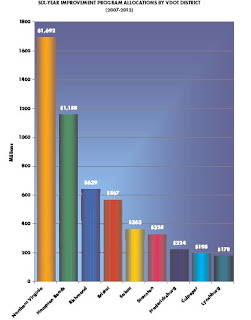
    That analysis is pretty hard to dispute. Finally, the report looks at transportation funding. The chart below, which projects Virginia Department of Transportation allocations by transportation district over the next six years, pretty much says it all.


    It’s hard to see how Northern Virginia would complain. Admittedly, the chart would look different if it showed per capita allocations. Such an adjustment would make the allocations look considerably more equitable. But there’s still not much to justify the Northern Virginia perception that the region is getting royally hosed. The real problem, the ODU authors conclude, is not that the funds are allocated by region unfairly, but that there are too few funds to build all the roads that people want.

    My advice to my friends in Northern Virginia: Be careful what you wish for. Open up the Pandora’s box of inter-regional transfers of wealth, and you may be surprised what pops out!


  • Gas Taxes for Everyone

    There’s been talk locally about raising taxes on this, that and the other in order to generate more money for road construction. In the mix is a gas tax hike. While there may be some merit to this, particularly in lieu of those silly abuser fees, it’s important to keep in mind that Virginia pols aren’t the only ones looking at increasing the gas tax:

    A congressionally mandated panel yesterday recommended more than doubling the tax, which since 1993 has been set at 18.4 cents a gallon for gasoline and 24.4 cents a gallon for diesel, over five years to boost funding for transportation projects. The panel of public and private experts is hoping that states also will opt for big gas-tax increases.

    The panel’s vision would take the U.S. down a more European path, with higher gas taxes and greater investment in high-speed rail and other modes of transportation.

    “Nobody likes saying we’ve got to raise taxes,” said Wisconsin Transportation Secretary Frank Busalacchi, who is on the 12-member panel. “But there’s no way we’re going to get there without the gas-tax increase … The country has to come to grips with this.”

    (Wisconsin, by the way, has one of the highest gas taxes in the nation.)

    That’s not to say that these recommendations are universally welcomed. A minority of the panel, led by Transportation Secretary Mary Peters, argues that:

    …the federal role in funding transportation, which is determined by Congress and laden with special-interest projects, is too flawed to warrant expansion. Instead, they suggest, the federal role should shrink and states should rely on toll increases and private investment to supplement the funds they get from gas taxes.

    “There is nothing to indicate that Washington would do a better job spending billions more of the taxpayers’ money than it has so far,” Ms. Peters said yesterday. “The answer isn’t more taxes…it is having the courage to say the current system is broken and it is time to find a better way to invest in, manage and operate our transportation system.”

    Sounds like Jim Bacon, no?

    But there is some evidence that Congress might not be a wise steward of any additional gas tax money. Not long after the bridge collapse in Minneapolis last summer that spurred congressional interest in infrastructure needs, Sen. Tom Coburn put forward a series of amendments to the transportation bill that would have diverted earmarked monies to repair work.

    The amendments all failed.

    Where the federal debate goes is any one’s guess. It is unlikely, given the current high price of gasoline and the teetering economy, that a gas tax hike will pass in the near future (and that goes double in an election year). But the groundwork has been laid, the first shot fired, etc., etc.

    The Solons here in Richmond would be well advised to pay attention to what their federal cousins are up to.


  • Taking the Bull by the Horns… Er, by the…

    The 2008 session of the General Assembly has barely commenced, and already we’re generating editorial copy for the amusment of the rest of the world. Del. Lionell Spruill Sr., D-Chesapeake, has introduced a bill that would ban the display of ornaments that resemble human genitalia on automobiles. The display of such ornaments would be a misdemeanor punishable by a fine of up to $250.

    Say what? It appears that websites are selling ornaments resembling bull testicles to hang underneath trailer hitches. Not to be picky, but… do we really want a law that will prompt a lawsuit — just for yucks? Do we really want the state Supreme Court adjudicating whether ornamental bull testicles sufficiently resemble human testicles to warrant a fine?

    On the other hand, this bill gives a whole new meaning to the term “abuser fees.”

    (Photo credit: Associated Press.)


  • Is Virginia’s Social Safety Net in Tatters?

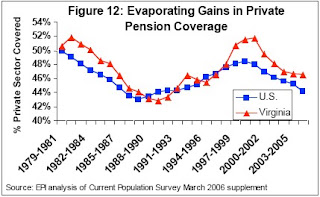
    Please humor me as I make one last blog post on “A Growing Divide: The State of Working Virginia.” The ground-breaking study by the Commonwealth Institute presents two more sets of important data: the percentage of Virginia workers with health care insurance, and the percentage of workers with pensions.

    It’s a classic good news/bad news situation. Here’s the good news: Virginians fare better than other Americans. We have a smaller percentage of the population without health care coverage, and a smaller percentage without pensions. Here’s the bad news: Like the United States overall, our numbers are heading the wrong way.

    The health care insurance trends can be seen in Figure 10 (taken from the study), which depicts total private and public health care coverage. Summarizes the report: “In an environment where health care costs are rising rapidly, often substantially outpacing inflation, employers are finding it increasingly expensive and therefore financially difficult to continue to provide the same level of benefits. In particular, small businesses have found it difficult to afford to provide coverage for their employees.

    “Consequently … this has contributed to substantially fewer workers receiving health insurance benefits through their employer compared to two decades ago. In fact, since 1979 the percentage of the working population that obtains health insurance coverage from their employer has decreased from a high of 70 percent to a near all-time low of 57 percent in 2006”

    From 70 percent to 57 percent — that is significant erosion in the private sector. Indeed, if the trend does not reverse itself, as it did briefly a decade ago, we can fairly label it a crisis. To pay the cost of treating the medically indigent, hospitals and other health care providers shift costs to private-sector plans. If those plans shrink in the numbers of people they cover, the cost shifting becomes increasingly acute and onerous. Either private insurance becomes more unaffordable, prompting more businesses to drop their plans, or health care providers such up the losses. Neither path is financially sustainable.

    While the medical-insurance piece of the privately funded safety net is fraying, “A Growing Divide” concludes, so is the pension piece. Says the study: “Following an eleven year surge in pension coverage through 2001, the state has seen steady decreases in the percentage of workers that are covered by these plans and was down to 46.5 percent in 2006, a decline of almost 10 percentage points in just five years.”

    I’m not certain this is quite the crisis it seems. Does the decline in “pensions” signify only a decline in the number of traditional, fixed-benefit plans? If those plans are being replaced with 401(k) plans, that’s not necessarily a bad thing. Employers may be shifting some of the risk of financial performance to employees, which could be a mixed blessing, but 401(k)s are portable. As the workforce becomes increasingly mobile, switching jobs with ever greater frequency, employees don’t lose accumulated pension benefits when they’ve failed to “vest” in a plan. Instead, they they take their 401(k) retirement benefits with them wherever they go.

    I would like some clarification on that final point before concluding that an increasing percentage of Virginians are heading to the poorhouse in their old age.


  • Workforce Productivity: A Virginia Success Story

    While a recent report by the Commonwealth Institute, “The Growing Divide: The State of Working Virginia,” issued stark warnings about growing income disparities in Virginia, it did offer one morcel of good news. Even as United States workforce productivity has soared over the past two decades or so, productivity gains in Virginia grew even faster. In inflation-adjusted numbers, Virginia productivity in 1998 stood only marginally ahead of the U.S average, with worker economic output measuring between $56,000 and $57,000 per year. By 2005, Virginia per-worker output surpassed $65,000 — surging $2,000 ahead ahead of the U.S. average, as shown in Figure 4, reproduced from the report.

    In Bacon’s Rebellion’s “Economy 4.0” schema, productivity and innovation are the wellsprings of economic progress and material prosperity. It is a basic tenet of economic theory that, in the long run, wages and salaries can rise no faster than the growth rate in productivity. Rising productivity is very, very good news. Without rising productivity, there would be no growing income to distribute, either equitably or inequitably.

    Write the authors: “Virginia has one of the most productive labor forces in the country. … As a result, Virginia workers continue to be competitive and have performed well in recent years. This has led some to classify Virginiaโ€™s labor forces has one of the stateโ€™s โ€œgreatest assets.โ€

    The authors continue:

    Worker productivity has grown consistently since 1991, although throughout most of the 1990s this growth was relatively small. Beginning around 1998, however, a different pattern begins to emerge. Since 1998, annual growth in worker productivity in Virginia has accelerated substantially, averaging around 3 percent per year through 2005. Additionally, during this same period Virginiaโ€™s labor productivity has generally outperformed not only the national average, but has even rivaled the highest performing state in several individual years.

    Given the rising productivity, the report suggests, one would expect rising workers’ incomes as well. But, alas, growth in median household income has been erratic, declining in 2004 and 2005, as shown in Figure 6, reproduced from the report.

    The question that “A Growing Divide” asks — are poorer Virginians failing to share in the general prosperity — is a legitimate one. One would like to think that all segments of society (save, perhaps, the criminal class) benefit from increasing prosperity and rising general wage/salary levels. But I would append a number of observations:

    1. As noted in a previous post, there are two Virginias — Northern Virginia and the Rest of Virginia — with significantly different wage levels and cost of living differentials. To what extent do the changes in statewide averages reflect shifts in regional dynamics? I don’t know, but I fear that any generalizations are of limited value until we do know.
    2. Real adjusted median incomes have been rising in Virginia over the long run – indeed, until 2003, it appears that they were rising faster than the national average. The last two years in the chart may be an anomaly. Let’s see what the next year’s data reveals before drawing hard-and-fast conclusions.
    3. It is entirely possible that the disparity in income gains reflects a disparity in productivity growth. It the fact that certain sectors of the economy are soaring in productivity, leaving other sectors as dust on the factory floor, a sign of unfairness or injustice? Can we realistically expect all sectors of the economy to advance at equal rates? Would we prefer to hold back the dyanamic sectors of the economy out of some twisted sense of social equity?

    I would suggest that there are three reasons for the apparent inability of less affluent Virginians to keep pace with the more affluent. One is the impact of globalization, which provides greater rewards for those who compete successfully on a global scale. A second is the structural problem of reinventing mill-town economies, based on cheap, semi-skilled labor, for the Knowledge Economy — a process that can take years, if not decades. A third reason is illegal immigration, in which hundreds of thousands of illegals compete for lower-wage work, depressing general wage levels for those at the bottom of the economic pyramid. If we want to redress the inequality in incomes, let us first make sure we identify the underlying causes.


  • Richmond Blows It

    Wilder and city establishment strike out and lose Braves. Predicament shows just how hopelessly dysfunctional Richmondโ€™s leadership really is.

    Three years ago, I was sitting in the skyscraper office of a large Atlanta real estate firm listening to Thomas D. Bell Jr., CEO of the firm, talk about how Atlanta was trying to deal with its problems. Atlantaโ€™s political and business officials had mobilized a regional task force to address the Dixie Dynamoโ€™s major issues including clogged roads, dire shortages of drinking water, lack of affordable housing and uncontrolled sprawl.

    I was there on assignment for a national business magazine and I was struck by how the Atlantans seemed to have it together. The Georgians donโ€™t dither around about petty regional jealousies and the black-white playing cards. They seem to have gotten beyond those issues long ago. And while there are elements of Atlanta that I donโ€™t go for, I appreciated their can-do attitude, realizing that this has made them the most important city in the Southeast.

    How unlike Richmond, I realize. My current home town once was the capital of the South but that moniker proved very short lived. Both Richmond and Atlanta were largely destroyed by the Yankees but Atlanta roared back in ways that left Richmond in the dust.

    And now, Atlanta has outflanked Richmond again. The Triple-A Richmond Braves have one season left to play here. Theyโ€™re being herded out of town by their owner, the Atlanta Braves who got fed up with indecision and stupidity in Richmond. They got tired of having to kiss Mayor Doug Wilderโ€™s behind again and again as he came up with screwball alternatives to renovate the badly-outdated Diamond, such as the hapless Fulton Gas Works. They got frustrated that no one else in Richmondโ€™s establishment could break the ice and get Wilder off the dime. And, I guess, they got tired with the same old nonsense about how historic and wonderful Richmond is supposed to be when the truth is that it is a dysfunctional, leaderless place.

    Donโ€™t get me wrong. Iโ€™m not in love with the Atlanta Braves, whom I consider a rather bloodless crew. To be sure, there are limits to be put on public funding for the benefit of the huge and well-oiled corporation that owns the two Braves teams.

    But the Diamond? Come on. The stadium, only 23 years old, is a shameless dump. The Atlanta Braves are correct to expect a lot better. Norfolk managed to build a beautiful, waterfront park. As for the Diamond, before my father died three years ago, he used to come up from North Carolina for the games he loved. He couldnโ€™t walk that well. I donโ€™t know if many of you have elderly parents or handicapped relatives, but have you ever tried using the elevator at the Diamond? It fits maybe four people, is very slow and has walls that are all put beaten out. Big lines form of people in wheelchairs or crutches waiting to fit in the tiny box.

    So as Wilderโ€™s typically abrasive personality prevailed, and no one else in the establishment had the guts to confront him, the Braves got frustrated over the acidic local politicking over various new stadium venues. They said, โ€œscrew itโ€ and quietly began talking with officials of Gwinnett County, Ga., an Atlanta suburb in October. Commerce-minded Georgians donโ€™t mess around and on Jan. 15, the Braves announced the new home for their Triple A team.

    In Richmond, of course, Henrico and Chesterfield want to go their way and Richmond doesnโ€™t know which way it wants to go on any number of important issues, from regional transit, to corporate recruitment, to growing disparity in incomes to controlling sprawl. Instead of taking meaningful action, the city and region hire the same old consultant who writes pretty much the same old report that they all read 15 years ago.

    For baseball teams, Atlantaโ€™s switcheroo follows a pattern that Major League Baseball teams are trying to locate their farm clubs closer to home. The relatively new Washington Nationals, their new DC stadium almost ready, have a Triple A club in Columbus, Ohio. It would be an extreme long shot if the team could move to Richmond. But it sure would be a great replacement and would follow the close-to-home trend. Of course, Wilder would have to be somehow kept on ice as Richmond proceeded with plans to rip down the Diamond and put a better stadium nearby.

    Iโ€™d like that very much. Dad would have, too. After all the first game he ever took me to was Griffith Stadium, home of the Senators, back in the late 1950s. Now that was an old firetrap.

    — Peter Galuszka

    (Photo cutline: The Diamond, stadium of the Richmond Braves. Photo credit: Nationals Nation.)


  • Income Disparities in Virginia: A Growing Divide?

    Last November, Peter Galuszka penned a column for the Bacon’s Rebellion e-zine, “The Invisible Working Class,” in which he decried the condition of working class Virginians. Drawing upon the book, “Deer Hunting with Jesus: Dispatches from America’s Class War,” by Winchester writer Joe Bageant, Peter offered considerable anecdotal evidence for the shrinkage of manufacturing jobs, stagnant incomes and lack of medical insurance. If he had had access as well to a new report by the Commonwealth Institute, he would have had a field day.

    The Commonwealth Institute, a liberal think tank focusing on Virginia, covers the same ground as Peter and Joe — but with charts, graphs and statistics. The Institute’s newly issued report, “The Growing Divide: The State of Working Virginia,” reaches much the same conclusions. Among its main findings:

    • While Virginia’s growth in average wages has outpaced the national average, the trends are primarily benefiting Virginians in the top income brackets. Median wages (marking the point where 50 percent of wage earners fall above and 50 percent below) have stagnated or declined.
    • The gap in wages between whites and African-Americans in Virginia has been consistently higher than the U.S. and has not decreased substantially since 1979.
    • Despite favorable economic conditions, the number of Virginians without health insurance has been on the rise since 2001, and private pension coverage has declined almost 10 percent since 2001.

    First, let me applaud the Commonwealth Institute for approaching the issue of income distribution in Virginia on a dispassionate and factual basis. All too often, people make a lot of wild claims with no grounding in the facts. The Commonwealth Institute has transformed the terms of debate in what appears, at least upon cursory examination, to be a fairly even-handed treatment. Although their purpose is to highlight disparities and injustices, the authors readily acknowledge the strengths of Virginia’s economy.

    “The Growing Divide” is a fine example of the form that public policy debate should take. The report has opened up fresh avenues of inquiry, and it raises the level of debate in Virginia. I can pay no higher compliment.

    That said, “The Growing Divide” is not without its flaws and limitations. My primary concern is that it is deceptive to discuss average or median incomes in terms of statewide averages. There are two Virginias: Northern Virginia and the Rest of Virginia. Wages and salaries are significantly higher in NoVa than RoVa. From the numbers in the report, it is difficult to tell if the wage disparities reflect a growing income gap within regions or between regions. If the gap reflects mainly the higher wages and faster growing population of NoVa, that’s quite different than a growing gap within regions. If the wage differential in NoVa is offset by a higher cost of living (especially housing), the implied disparity in living standards may be more apparent than real. We just won’t know until someone crunches the numbers region by region.

    The same criticism applies to the comparisons of race. African-Americans comprise a higher percentage of the population in RoVa than NoVa. If wages are significantly higher in NoVa, and NoVa’s population is growing as a percentage of the state’s, the wage gap could signify little more than the fact that fewer African-Americans live in NoVa. Meaningful comparisons would look at the wage gap within regions.

    Despite this significant reservation, the study highlights indisputable problems such as the fraying private safety net (medical insurance and pension funds), and looks at income statistics in refreshing ways. I am particularly impressed by the discussion of productivity. I will mine this data in future posts.


  • Quote of the Day

    “The city seems prone to consulting things to death to such a degree that nothing happens. You’ve got to have the strength to pull the trigger.”

    — William Pantele, Richmond City Council president, in reaction to news that the Richmond Braves would leave the city after 42 years. After years of study, the Richmond region still hasn’t nailed down a definitive plan to replace the aging Diamond baseball stadium.


  • The Federal Subsidies for HOT Lanes

    The question arose in response to my December post (“HOT Lanes on the Capital Beltway Only Five Years Away“) about the role that Uncle Sam is playing in the financing of the $1.4 billion HOT lane project on the Interstate 495 Beltway. According to Quintin Kendall, deputy assistant secretary for management and budget at the Department of Transportation, TIFIA loans and PABs “were a large part of the deal all along.”

    For those unfamiliar with federal acronyms, TIFIA stands for the Transportation Infrastructure Finance and Innovation Act. That program provides direct loans, loan guarantees and lines of credit for surface transportation infrastructure projects.

    PAB stands for Private Activity Bonds. Federal law allows the federal government designate private companies to issue up to $15 billion in tax-free for qualifying projects.

    What this means for Virginians is that we are the beneficiaries of an indirect form of federal boodle. While the Beltway HOT lane project will not be subsidized through direct cash outlays, the Fluor-Transurban partnership building the HOT lanes will be able to line up financing on highly advantageous terms. How much of the implied subsidy will flow through to HOT lane riders and how much will bolster the bottom lines of Fluor and Transurban is not a topic upon which I am willing to hazard a guess.

    From the perspective of federal transportation policy, the Bush administration very much wants to get some demonstration congestion pricing projects up and running. HOT lanes on the beltway around the national capital would serve that aim nicely.


  • Searching for “Plan B”

    With education a topic of consideration on the blog recently, I’ll toss this into the mix:

    A prominent supporter of a market-based approach to improving public schools, Sol Stern, says he no longer believes charter schools or vouchers are a “panacea.”

    In an article published in the latest edition of City Journal, Mr. Stern, a Manhattan Institute fellow, portrays the libertarian approach that once inspired him as a failed experiment, and urges those who agree with him to search for a “Plan B.”

    I don’t have access to the City Journal article referenced in this New York Sun piece, so it’s difficult to assess just how dispirited some in the choice camp may be these days.

    But it seems rather deep, if Chester Finn’s lament is any indication:

    …Finn, who has been a vocal advocate of school vouchers and charter schools, said yesterday in an e-mail message that he has “growing sympathy” with Mr. Stern’s skepticism. Mr. Finn stoked debate himself recently by declaring that one factor hurting charter schools in Ohio is “too much trust in market forces.”

    I’m not sure it’s time to strike the tent and give up on school choice. I’m also not sure one can have “too much trust in market forces.”

    But has the time for choice come and gone? And if it has, is there a Plan B?


  • Wahoo Alumni Study Civil Rights Movement – For Recreation

    Here’s a sign of the times. I just received a e-mail from the University of Virginia “Travel & Learn” program, which I presume is targeted at alumni of advancing age like myself with the time and financial means to enjoy travel. The sales pitch is fascinating in itself:

    Join leading U.Va. faculty and their colleagues worldwide for the School of Continuing and Professional Studies portfolio of 2008 Travel & Learn Programs for Adults. Explore fascinating topics while at historic destinations in these short domestic and international seminars. Discover, as one participant wrote, “spending quality time with an extraordinary faculty in a beautiful setting studying a stimulating topic is a transcendent experience and downright fun.

    This is the future — travel and learn. Eco-travel and heritage-travel are hot. Baby Boomers aren’t content to loaf beside the pool, drink daiquiries and work on their tans. (Personally, I can dig the loafing by the pool and drinking daiquiries, but I’d rather read in the shade than expose my pale, white skin to the merciless pounding of the sun.) No, Baby Boomers want to keep their minds alive.

    Here’s the other remarkable thing: One of the programs is entitled, “Civil Rights and the South: In the Footsteps of the Movement.” The teacher is Julian Bond. Says the plug:

    See, live and understand the American Civil Rights struggle like you never have before as Julian Bond, Civil Rights leader, Chairman of the NAACP and faculty member of the University of Virginia, leads a remarkable journey through the movement as it happened.

    My generation of Wahoos is pretty conservative. It’s a remarkable sign of how far our society has come to think that anyone would find a profit opportunity in selling a vacation to beautiful downtown Montgomery, Selma and Birmingham to retrace the Civil Rights movement to people of my generation.

  • Brain Gain: Building Human Capital

    In the ongoing saga of the “Economy 4.0” series, I have arrived at the topic of building human capital — an issue that barely registers on the public-policy radar screen here in Virginia. Oh, sure, there’s lots of debate about education and training, which are components of the larger task of upgrading the level of skills and education in Virginia’s population, but discussions are narrow and institution focused. And there is next-to-no discussion about recruitment and retention — recruiting economically productive people to Virginia, and then ensuring that they want to stay here.

    What Virginia and its regions need, I argue, are comprehensive plans for (1) developing human capital (educating and training the people already here), (2) recruiting human capital, and (3) retaining human capital. No one leg of this trifecta can do the job alone.

    As an example of what can happen when only the first aspect is addressed, I cite the example of Massachusetts. Public education in the Bay State is consistently ranked as the best, or among the best, systems in the country. And no state can compare to the concentration of higher education — from Harvard and MIT on down. Massachusetts does, in fact, have among the best educated populations in the country. But between 2000 and 2004, an net average of 42,000 native-born migrants left the state. Folks, that’s called a brain drain.

    Currently, Virginia is a net beneficiary of migration patterns. We’re experiencing a modest Brain Gain. That’s an economic positive because the newcomers are more highly educated and make more money than the natives. Insofar as the newcomers are members of the creative class, they contribute disproportionately to artistic, scientific and entrepreneurial innovation as well.

    The United States is reaching a new era of chronic labor shortages as Baby Boomers retire and the ranks of younger generations are too frew in number to replace all of them. The battle for economically productive talent will intensify. Inevitably, states and regions will begin competing for top talent, just as they now compete for capital investment. Those regions that start thinking about how to win the migration wars will enjoy a significant competitive advantage over their rivals. Although some Virginia regions have been talking about the “creative class,” the discussion hasn’t gotten very profound or led to anything concrete. We need to get started.

    As awareness increases that human capital is the critical driver of economic prosperity, political, business and civic leaders will start paying more attention to creating more livable and sustainable communities as a way to attract and keep economically productive employees. Thus, economic development will morph into community development. As this set of issues comes to the fore, Virginia regions will be compelled to address the dysfunctional human settlement patterns that detract so much from sustainability and quality of life.

    I develop this line of argument in more detail in “Brain Gain,” supplemented with some cool internal-migration statistics. For your wonkish pleasure, I have made that data accessible for both the United States and Virginia. I think I’ve drawn some interesting and counter-intuitive conclusions. Perhaps readers can mine this data for more refined insights.

    Gray Matter Migration. A chart ranking the 50 states by net in-migration.

    Virginia Migration Winners and Losers. A spreadsheet ranking Virginia localities by net in-migration.

    (Cut-line: Homer Simpson lives in Springfield. Could he be a Virginian? Image credit: Asymptopia.)


  • Another Year, Another Rebellion

    The New Year has blown in a breath of fresh air: The January 14, 2008, edition of the Bacon’s Rebellion e-zine. If you don’t visit this blog regularly, subscriber for a free subscription to make sure you never miss an issue. Click here.

    Here is our line-up of commentary:

    Building Human Capital
    Human capital is the driving force of prosperity in a globally competitive economy. Soon, regions will vie for it like they compete for investment capital. Will Virginia be prepared?
    by James A. Bacon

    Gray Matter Migration. A Web chart ranking the 50 states by net in-migration.

    Virginia Migration Winners and Losers. A spreadsheet ranking Virginia localities by net in-migration.

    Hypercompetition
    Here’s the sub-text of Tim Kaine’s state of the commonwealth speech: Invest in Virginia’s economic future. We can afford it. Our economy is still out-performing the nation’s.
    by Doug Koelemay

    The Road Ahead
    As the MainStream Media fails to provide information citizens need to function as voters and consumers, a citizen-driven media will emerge to fill the void. It’s not yet clear what that new media will look like.
    by EM Risse

    Unleash the Private Sector
    Many localities are too financially strapped to execute Tim Kaine’s pre-K initiative for at-risk tots. He could bypass that bottleneck by engaging private daycare providers.
    by Chris Braunlich

    Rooting for Hillary
    Hillary Clinton has friends in strange places. Among the millions of Americans who reveled in her New Hampshire primary comeback, there were quite a few in Virginia’s Republican Party.
    by Norm Leahy

    Hot Air or Cold Logic?
    The Governor’s Commission on Climate Change could guide Virginia’s energy and environmental policy for years to come. One option it needs to consider: geo-engineering.
    by David Schnare

    Nice & Curious Questions
    Birdies, Bogies and the Back Nine: Golfing in the Old Dominion
    by Edwin S. Clay III and Patricia Bangs


  • Mo’ Money for Schools — to Honor the Civil Rights Movement

    So, this is what the Civil Rights movement has come to 50 years after Brown v. Board of Education: There’s nothing wrong with Virginia’s failing public school systems that showering them with more money won’t solve. In a nutshell that’s the message conveyed by Oliver Hill, Jr., and Andrew Block in an op-ed piece in today’s Times-Dispatch.

    Hill and Block construct a rickety argument that leans upon nearly every prop of liberal thinking about schools in common currency today. They start their column by hijacking the moral authority of the 1960s civil rights movement. “Our political leaders,” they write, “should continue to honor Virginia’s civil rights legacy by funding an educational system that meets the needs of all of our students, including those same children of color for whom so many fought so hard.”

    The Standards of Quality, which redistributes billions of dollars in state aid from affluent school districts to poor ones, is not enough to “ensure equality of educational opportunity,” they continue. Neither is the $354 million in “at risk” funding that supports special programs for poor children. Low-income students, they assert, need “additional resources to be successful.”

    Nowhere in their column do Hill and Block allude to the fact that many minority-dominated school districts spend significantly more per pupil than neighboring suburban school districts. Nowhere do they mention the scandalous bureaucracy and waste in many of those school districts — a bureaucracy that Mayor L. Douglas Wilder, incidentally, has targeted in his ongoing battle with the Richmond School Board.

    The thrust of the Hill-Block column is to absolve minorities from making any financial sacrifice themselves, restructuring educational bureaucracies or altering their own cultural values or attitudes towards education. More money is the solution, and the onus falls squarely upon the taxpayers of Virginia to dig deeper into their pockets — or dishonor the civil rights movement.

    This is the same old, minorities-as-victims ideology that has fostered passivity among poor African-Americans and kept them them dependent upon the largesse of whites. While Hill and Block purport to honor the heroes of the Civil Rights movement of 50 years ago, their antiquated thinking keeps poor African-Americans mired in the role of supplicants. Virginia would do far better to emulate the example of those hundreds of thousands of African-Americans who have escaped poverty and joined the economic mainstream of society. What was their secret? How can their success be replicated?