• Side Boobs and the End of Civilization

    The war against the much-dreaded and thoroughly feared side boob, has been temporarily avoided:

    Police plan to drop a misdemeanor obscenity charge filed against the manager of an Abercrombie & Fitch clothing store that displayed two photos of scantily clad men and a woman, a city attorney said yesterday.

    Police said they confiscated the photos from the Lynnhaven Mall store Saturday after some customers complained and Abercrombie management did not heed warnings to remove the images of three shirtless young men, with one man’s upper buttocks showing, and of a woman whose breast was mostly exposed.

    One can only imagine how many tickets Virginia Beach police issue to beachgoers who dare to expose such body parts during the high season… to protect the children, of course.

    Update: I took the liberty of adding one of the offending images (with the racier aspects tastefully blurred). Alas, the “side boob” image was so tame — far milder than you could find by typing “Jessica Alba” and “side boob” into Google — that it wouldn’t inspire enough prurient interest to warrant reproducing here. — Jim Bacon.


  • You’ve Seen Enough

    It seems Sens. Cuccinelli and Peterson have run into a roadblock on their way to greater budgetary transparency. In his newsletter, and in his inimitable style, Ken shows us that at least one of his Senate colleagues, Sen. Edd Houck, thinks we’ve got all the transparency we need right now, thank you:

    In our debate on the bill, he said that he doesnโ€™t see any problem with how open our government information is today. Now, remember, Sen. Houck is a Senate Budget Conferee! He has been in the Senate for over 25 years and he has Finance Committee staff at his disposal for his own self-education on budget matters. Do you have that? I didnโ€™t think so.

    Sen. Houck went on to say that he was offended by the notion that we needed the bill, as putting in the bill implied that Virginia government was somehow not open and transparent already (Iโ€™m not kidding. I mean, Iโ€™m funny, but I canโ€™t make this stuff upโ€ฆ). Virginia legislators, much less citizens, cannot find much budget or expenditure information online thatโ€™s worth the effort, and it certainly isnโ€™t out there in any organized fashion that makes sensible research possible (forget easy, letโ€™s start with possibleโ€ฆ).

    I wonder if Senator Houck would accept a challenge to take 10 minutes of his time to see if he can demonstrate that he can in fact find anything about specific expenditures via any online information now available from Virginia Government? Hmmmโ€ฆ Iโ€™ll ask. Iโ€™ll let you know what I hear back.

    Ah the Senate… no matter which party is in charge, it’s the grandees who oversee the budget that have the real power. And it seems they are unwilling to allow even the palest glimmer of light to intrude on their fiefdom.


  • The Free-Market Conservative’s Case for Journey Through Hallowed Ground

    At the risk of inciting my blogging friend Groveton, I recommend to readers an op-ed piece that I penned for the Fredericksburg Free Lance-Star, “History, lifestyles, and vistas are threatened,” in which I extol the virtues of the Journey Through Hallowed Ground.

    JTHG is one of the most promising experiments in free-enterprise conservation taking place in the country today. The broad-based initiative, which encompasses the region along the U.S. 15 corridor between Charlottesville and Gettysburg, is based upon respect for property rights. Contrary to the delusional claims of adversaries who see it as a Trojan horse for introducing land use controls, JTHG is conspicuous by its refusal to get embroiled in land use disputes. The group’s purpose is to create an alternate economic model for towns, hamlets and farms on the fringe of the Washington metropolitan area — a model built upon heritage tourism, Main Street revitalization, and sustainable agriculture — that enables landowners to make a decent living without selling off their property for scattered subdivisions and shopping centers.

    I’m not saying the model is perfect. Perfection is for heaven, not earth. JTHG wants a federal designation as a National Heritage Area, which would come with funds for educational programs, and it seeks National Scenic Byway status for Rt. 15, which also would entail the expenditure of federal funds. So, if you’re a deficit hawk worried about runaway federal funding, like Groveton, you might object to these priorities. Ed Risse offers a different criticism: If heritage tourism becomes really successful, how much automobile traffic will it generate, and what are the implications for highway congestion in the corridor and for environmental sustainability?

    Both legitimate points. But to my mind, those objections are far outweighed by the positive, uplifting example set by the Journey Through Hallowed Ground. JTHG aims to preserve our cultural and historic heritage, and it aims to do so not by filing lawsuits and lobbying for government restrictions on growth, but by creating economic value and preserving natural and manmade landscapes. How self-styled conservatives can object to that is a mystery to me.
    (Photo cutline: Oakhill plantation. Photo credit: Journey Through Hallowed Ground.)

  • Why Conservatives Should Oppose the Homestead Exemption: It Masks Out-of-Control Spending

    John L. Knapp, senior economist at the University of Virginia’s Cooper Center for public policy, very nicely sums up the essence of the proposed Homestead exemption on property taxes:

    Given the large rise in property tax levies during most of the new century, it is not surprising that taxpayer frustration has found its way into the proposed amendment. It is unfortunate that a simpler solutionโ€”restraint on spending by local government โ€” was not adopted. Instead, market-driven increases in assessed values were used to bring in significant amounts of new revenue.

    Exactly. To put it a bit less diplomatically, the Homestead exemption is a superficial, quick fix for out-of-control spending at the local level. The constitutional amendment would allow local governments to exempt up to 20 percent of the value of residential property from taxation. If it passes the General Assembly for a second time this year, it will go to the voters as a referendum, and it’s hard to imagine that the electorate will not vote itself a tax break. But there is less to the tax break than meets the eye.

    There is no way to know which localities will avail themselves of the exemption and which will not, so in his essay, “Problems with the Proposed Homestead Constitutional Amendment,” Knapp calculates the impact if all local governments instituted the full 20 percent exemption. It’s an unlikely scenario, and the impact would vary from jurisdiction to jurisdiction spending upon the local mix of residential and commercial tax base. But the calculation shows how the logic of the amendment would play out.

    In 2006, Virginia owners of owner-occupied, residential properties paid $4,943 million in taxes, and owners of all other real property โ€” residential rental property, business property, commercial property, and farm property โ€” paid $2,694 million in taxes. If all local governments passed the full Homestead exemption, homeowners would get a $988.6 million tax break! But wait… Local governments would have to make up that money somewhere, most likely by increasing the tax rate. This could be achieved, Knapp writes, by increasing the statewide average tax rate from $0.85 per $100 of assessed value to $0.97. “Homeowners then would have a tax bill of $4,552.5 million, an amount 7.9 percent less than before the exemption.”

    Bottom line: The touted 20 percent exemption will net only 8 percent lower taxes. Think voters will know that figure when they’re standing in the voting booth?

    Knapp points out, rightfully, that shifting the tax burden to business would have negative consequences: “There may be some existing businesses that would seek a lower tax jurisdiction and some potential businesses that would be deterred because of the higher taxes.”

    To my mind, the worst part of the proposed amendment is that it is no more than a spackle-and-paint job over the underlying problem, which is out-of-control local government spending. As Knapp notes, revenues from the property tax levy have increased roughly 10 percent annually each year throughout the 2000s.

    One more year with a 10 percent increase will more than overwhelm the 8 percent benefit from the Homestead exemption. Unless we figure out how to attack the underlying problem, homeowners will get one year of relief, them find the tax burden squeezing harder every year.

  • The Wild One Bypasses the Mainstream Media

    I continue to be fascinated by the e-mail missives sent out by Richmond Mayor L. Douglas Wilder as he bypasses the Mainstream Media to take his case to the public. His weekly “Visions” newsletter contains data that often gets filtered out in space-constrained news stories, as well as video sound bites that the televisions don’t have time to run. The merits of his arguments aside, the newsletter is one of the more sophisticated uses of digital media that I’ve seen employed in Virginia government. More savvy, even, than the communications coming out of the Governor’s office.

    Today’s edition is a good example. The Wild One takes after his nemesis, the Richmond School Board, for failing to provide handicapped access at city schools. Local news media had recently profiled a disabled child who cannot attend Fox Elementary School, the school nearest to his home, because money earmarked for design work to provide for an elevator had been spent for other unnamed projects.

    Since 1992, the year the Americans with Disabilities Act was passed, according to the newsletter, the city has provided the school system with $125 million in Capital Improvement Plan funding. A 2005 study put the cost of making ADA improvements for city schools at $18,354,500. But the school board had set aside no money in either fiscal 2007 or 2008 for ADA.

    The minute-long video clip is vintage Wilder: “If the people of the city of Richmond are satisfied with the waste and the inefficiency in the school system, after I have pointed out and shown what is needed to be done … if they’re satisfied with the school board, then I’m satisfied too.”

    As Mainstream Media continue to retrench, is this is the future of political communications? Electronic newsletters, embedded with video clips …. filtered through blogs?

  • Virginia and Climate Change: Tim Kaine Brings the Global Debate Home

    The reality of climate change is beyond debate, the Times-Dispatch paraphrases Gov. Timothy M. Kaine as saying during the initial meeting yesterday of his commission on Climate Change.

    “Gone are the days of debating whether man-made effects exist” with global warming, the Virginian-Pilot quotes him as saying. “Those days are gone.”

    The first of the two statements is a non-sequitor. No scientist anywhere, to my knowledge, disputes that “climate change” is a reality. The climate of the earth has varied enormously over hundreds of millions of years, experiencing wild swings between tropical heat and glacial cold.

    The second statement is uncontroversial for the most part, except perhaps among right-wing talk radio hosts. There is little dispute that human activities have impacted the climate. The extent of the impact may remain an open question but no serious person would contend that mankind has had no impact whatsoever.

    The two statements sound profound but they are so vague as to be meaningless. We’ve heard it over and over that the science of climate change and global warming is “settled” and that there is a “consensus” among scientists. In reality, climatology is a dynamic field with many findings that don’t fit the prevailing paradigm and loads of scientific controversy over narrow questions. Here are how I, as an amateur follower of the debate, break down the issues:
    1. How rapidly is the climate warming? Yes, virtually everyone agrees that the earth has been warming since the end of the Little Ice Age, which lasted from the 16th to the 19th century. Virtually everyone agrees that the warming trend extended through the 20th century and into the 21st. The big question is, how much? Measuring the “average” temperature of the earth is not an easy task. We’re getting better at it, but measurement is far from perfect. One example: Many measurements are subject to the “heat island” effect. In the United States, many temperature sensors are located in airports. Fifty years ago, the airports were situated in the countryside. Today, those locations have been encroached upon by urban development that can raise the ambient temperature several degrees. It is a matter of some controversy how best to adjust for such trends. Meanwhile, there are many other other assumptions and adjustments embedded in global temperature calculations. Just last year, NASA was forced to make an embarrassing downward adjustment to its temperature record for the years since 2000 after a methodological flaw in its calculations was exposed.
    2. Are current temperatures unprecedented? In the current cycle, which follows a brief cold spell in the 1960s-70s that spurred fears of an impending ice age, it appears that we have reached levels not seen since… the 1930s. We could well surpass that decade — which immortalized the image of, “It’s so hot you could fry an egg on the pavement” — if temperatures keep rising, but the climate still won’t exactly be “unprecedented.” Average temperatures were just as high during the Medieval Climate Optimum.
    3. What is causing global warming? The earth has been warming and cooling for billions of years. There are many non-human factors at work, including minor shifts in the earth’s orbit and cyclical outpourings of solar radiation (which affect the earth’s magnetosphere, which in turn effects the bombardment of cosmic radiation, which in turn effects cloud formation.) The question is: How much of the warming we are seeing now is the result from natural, cyclical processes and how much results from mankind’s release of C02 and other greenhouse gases? Teasing apart the impact of natural vs. manmade influences is exceedingly difficult.
    4. Global warming and sea levels. While the vast majority of climatologists are certain that planet is warming (though they don’t all agree on how much), it is far from clear what the impact will be. Widely feared — and a key justification for Virginia’s climate change commission — is the belief that icecaps will melt and sea levels will rise. While there is some scientific evidence for this view, there are many complicating factors. Rising temperatures may increase precipitation (e.g. snowfall) on major icecaps such as Greenland and Antarctica. Water (in the form of ice) could conceivably accumulate faster in the high, cold plateaus faster than it melts along the lower, warmer edges of the plateaus. The melting of the polar ice cap, by the way, would only contribute marginally to rising sea levels — to the extent that ice takes up a slightly larger volume than liquid water. My advice to polar bears: Move to the Greenland plateau. (Just kidding.)
    5. Global warming and the biosphere. Of particular interest to the Virginia study group should be the impact of Global Warming on… Virginia. As I understand the Global Warming models, manmade warming is expected to be most pronounced in cold, dry regions. Most, temperate regions such as Virginia should see less temperature change. It would be helpful to know to what extent will temperatures rise in Virginia, and to what extent will rising temperatures cause a change in habitat, affecting all manner of species? We should know to what extent indigenous species are vulnerable to temperature changes of the expected magnitudes. I have seen nothing on this. Another interesting question is the impact of higher C02 levels on plant growth. C02 is to plants what oxygen is to animals. If higher C02 levels promote plant growth, as I have read, this would be a good thing, I would think — unless you’ve got a kudzu infestation in the back yard.
    6. What can be done to avert Global Warming? Once we begin asking this question, we move out of the realm of science entirely and into the realm of public policy and ideology. There is widespread political support in Virginia for limiting greenhouse gas emissions, particularly among segments of the population comfortable with the idea of government exerting more control over the economy. But there are two sides of the climatic equation. Not only do humans emit more greenhouse gas than we used to, we are chopping down our rain forests, the world’s major repositories of C02. Why is the focus in Virginia exclusively upon reducing emissions? Why aren’t we asking what we can do to increase C02 absorption, possibly through reforestation?

    The biggest mistake we can make is to assume that the science is settled, that we “know” what the impact of Global Warming will be upon Virginia, and that we have to do something, anything, as in, intervene in the economy, to avert the approaching calamity. Climate change is an issue worth studying. But I see no justification yet for panicking into rash and ill-considered action.

    Regarding public policy, I think that free-market/fiscal conservatives can find some common ground with greenies on the Global Warming debate. Everyone should favor energy conservation, especially if energy conservation projects can be justified on a Return on Investment basis. State and local governments should be encouraged to conserve energy as a means to cut the cost of government… as well as to save the planet. Virginia should implement transportation policies that encourage people to drive less — as a strategy for reducing traffic congestion and cutting the pressure for more spending on roads… as well as to save the planet.

    If the Climate Change commission takes that approach, I’ll feel a lot more comfortable.


  • Hampton Roads/Tidewater’s Last Chance With HRTA

    My new state senator, John Miller (D-1SD), saw his bill to kill the HRTA die in committee. He had modified his own bill to end the unelected, unaccountable, unseparated powers Regional Government to exclude only The Peninsula. Still, it went down 10-4.

    Now, the only chance to kill the HRTA this session is the bill my delegate, Tom Gear (R-91HD), submitted. HB 829 redlines, repeals, the HRTA and its projects which don’t solve the transportation congestion here from the monster HB3202. The rest of HB3202 stands for the rest of the Commonwealth to suffer.

    The People of Tidewater still stand against this wrong plan, expansion of unnecessary government, and wrong taxes over 2:1.

    Yet, the bill isn’t even on the docket in the House Transportation Committee. Here are the committee members:

    * Del. Joe May (R-33) Chair
    * Del. Glenn Oder (R-94) Chair
    * Del. Mamye BaCote (D-95)
    * Del. Bob Brink (D-48)
    * Del. Bill Carrico (R-5)
    * Del. John Cosgrove (R-78)
    * Del. Adam Ebbin (D-49)
    * Del. Bill Fralin (R-17)
    * Del. Jeff Frederick (R-52)
    * Del. Tom Gear (R-91)
    * Del. Tim Hugo (R-40)
    * Del. Dwight Jones (D-70)
    * Del. Manoli Loupassi (R-68)
    * Del. Dave Marsden (D-41)
    * Del. Paul Nichols (D-51)
    * Del. Tom Rust (R-86)
    * Del. Chris Saxman (R-20)
    * Del. Ed Scott (R-30)
    * Del. Robert Tata (R-85)
    * Del. David Toscano (D-57)
    * Del. Shannon Valentine (D-23)
    * Del. Jeion Ward (D-92)

    So, why isn’t HB 829 up for a vote in committee? Who is afraid of what?

    My mayor, Gordon Helsel (Poquoson), and my local Republican precinct captain, Dr. Charles Flynn, were in Richmond yesterday to speak at the Senate.

    Perhaps more folks need to speak to both Republican and Democrats on the House Transportation Committee to get HB829 out for a vote. It’s just a vote for The People the need to see.


  • The (Sex) Show Must Go On

    Two weeks ago I took note that student organizers at the College of William & Mary wanted to host the traveling Sex Workers Art Show on campus, providing a venue for porn stars, strippers and other sex workers to deliver monologues and otherwise do their thing. (See “Hey, Can Students’ Parents Buy Tickets, Too?”)

    The big question in my mind was how President Gene Nichol would rule. Would he permit the show on the grounds of openness, tolerance and inclusion? Or would he reject it on feminist grounds that it “objectifies” women as sex objects? (Traditional canons of “good taste,” I assumed, were not even a consideration.)

    The Wooden Nichol has spoken: Tolerance and inclusion prevails over mysogeny and patriarchy.

    Meanwhile, according to the Daily Press, students are debating whether the sex show should be held on campus. The latest controversy is whether to allow members of the audience to film or photograph the show.


  • Has the Time for Bus Rapid Transit Finally Come?

    In a welcome show of bipartisanship, Democrats and Republicans have come together to patron HJ 98, which would authorize a joint subcommittee to study the establishment of Bus Rapid Transit corridors in Northern Virginia.

    While the chief patron is Del. Vivian Watts, D-Annandale, other patrons include conservative Republicans such as Delegates Bob Marshall, R-Manassas and Tim Hugo, R-Centerville, and Sen. Ken Cuccinelli, R-Fairfax. States the resolution:

    In conducting its study, the joint subcommittee shall look into the cost, efficacy, and relationship to the regional transportation network of establishing bus rapid transit corridors in the Northern Virginia Transportation District, including the need for and issues related to establishing dedicated lanes, location of stations, accessibility and station parking, ridership projections related to levels of service, cost-benefit analysis with other transit options, and other relevant considerations.

    I don’t know if this comes as a response to the demise of the Rail-to-Dulles project, but it’s good to see that Northern Virginia legislators are showing signs of moving on rather than trying to fight a battle that’s already been lost.

    My only concern is that BRT should not be considered in a vacuum. It should be viewed in a larger context that includes human settlement patterns and congestion pricing. The subcommittee needs to ask itself, do certain densities and streetscapes lend themselves to supporting BRT better than others? Also, to what extent would congestion pricing in heavily traveled corridors and districts encourage people to ride the buses?

    One last question: Why limit the study to Northern Virginia? Isn’t BRT a potential option for the Hampton Roads and Richmond regions as well?

    With those provisos, the study sounds like an excellent idea. (Hat tip: Too Many Taxes.)

    (Cutline: Bus Rapid Transit in Bogata, Colombia. Photo credit: the Rebuilding Place in the Urban Space blog.)

  • Why Liberals Should Oppose the Homestead Exemption: It’s Regressive

    The ladies and gents with the Commonwealth Institute must be working overtime because they’ve weighed in with their third major research paper in the past couple of months. “How Property Taxes Hit Home” examines the impact of rising property taxes and a proposed remedy, the so-called Homestead exemption.

    As one would expect from a liberal-leaning think tank, the report emphasizes the regressive nature of Virginia’s property tax as well as the proposed remedy for that tax. But as a tax conservative, I have to concede that authors Michael Cassidy and Sara Okos make some valid points.

    As this chart shows (click on chart to view larger, clearer image) low-income homeowners pay a larger percentage of their income to property taxes than homeowners in higher income brackets.

    That would seem to be a strong justification for the Homestead exemption, which would allow local governments to exempt up to 20 percent of a homeowner’s property from taxation, to provide relief from soaring property tax bills. This proposed constitutional amendment, which was been passed by the General Assembly last year, must be passed again this year and then approved by voters in a referendum.

    So, what’s not to like? Business lobbies aren’t happy about the bill because it would shift much of the tax burden to commercial taxes. The actual amount would vary from locality to locality, depending upon the balance of residential vs. commercial property in the tax base. But Cassidy and Okos are more concerned about the implications for income redistribution. “By reducing the taxable value of all Virginiansโ€™ homes by the same proportion (20 percent),” they write, “the homestead exemption stands as a tax giveaway to homeowners with extremely valuable homes.”

    At the lowest end of the income scale are not homeowners but renters, constituting about a third of the population. Renters would gain nothing from the homestead exemption. Indeed, the authors point out, insofar as apartment buildings and other commercial housing would shoulder a higher share of the tax burden, those costs would be passed on to renters. In other words, renters could be losers from the exemption.

    If the goal is to provide tax relief for homeowners of more modest means, Cassidy and Okos argue, there are better alternatives, such as exempting the first $20,000 of a property’s assessed value. That would provide an equal break for all homeowners, not one that benefits wealthier property owners disproportionately, and there would be less blowback for renters.


  • Heavy Rail and Mobility for the Handicapped


    I apologize to readers who have over-dosed on the Rail-to-Metro story, but it is one of the most important public works project in Virginia history. All facets of the story need to be explored.

    This Youtube video comes from Pat Kane, a Northern Virginia urban planner whom I first met in the late 1980s when I started covering transportation and land use issues for Virginia Business magazine. Back then, some 20 years ago, Kane was a visionary for re-developing Tysons Corner into the kind of higher-density pedestrian-oriented community that many people have since come to favor.

    Kane suffered from a stroke a couple of years back, rendering him unable to type. But his mind is still lucid. Thanks to Youtube, he can still express himself. In this video commentary, he makes the case for Rail-to-Dulles heavy rail. Fifty percent of the population does not drive, he notes — that includes teenagers, the elderly and the handicapped, like himself. One benefit of heavy rail that has not been factored into the debate, he suggests, is its ability to provide mobility for non-motorists.

    All the more reason to go back to the drawing boards and get Rail to Dulles right.


  • Coming Up Next: “Moral Majority” Drive?

    I can’t believe this made it through a Democratic-controlled state Senate, even if the custom is to honor the requests of local legislators. A bill sponsored by Sen. Steve Newman, R-Lynchburg, would name a section of U.S. 460 in Lynchburg the Jerry Falwell Parkway, according to the News & Advance. The Senate approved the bill unanimously.


  • Simpson on Rail to Dulles: No More “Illusion and Delusion”

    Federal Transit Administrator James S. Simpson is taking a lot of heat for turning down federal funding for the Rail-to-Dulles heavy rail project. Critics now are accusing the Bush administration of undermining support for mass transit.

    There was a huge concern that the Dulles issue is not unique to this region, that this is an effort on the part of the administration to re-channel funding to other directions,” said Washington Metro General Manger John Catoe, according to the Associated Press.

    But Simpson is not backing off his decision. In fact, he’s taken off his boxing gloves and seems ready for some bare-fisted brawling. Northern Virginia ought to stop waiting for “the federal dole,” he said. “The jurisdictions can’t wait for a wing and a prayer for Congress to pass something.”

    “Maryland, Virginia and D.C. need to step up to the plate and take care of the state of good repair,” he said, referring to the massive maintenance liabilities the Washington Metro has built up over the years. Adding to a system without being able to take care of what it already has is irresponsible, he told AP. “It’s like the subprime mentality — people don’t care what things really cost.”

    Said Simpson: “What this administration is all about is being practical in making investments and not using delusion and illusion to push a mega-project through.”

    Sign that man up as a columnist for Bacon’s Rebellion!

    For the record: I totally support the concept of heavy rail in the Dulles corridor. But I believe the project as currently conceived is a disaster. The Kaine administration and Fairfax County need to radically re-think the financing of the project and the optimum land uses around proposed Metro stops, then start over.

  • A Glimmer in the Darkness

    It looks like the General Assembly is actually taking seriously the possibility that revenues from the gas tax may one day become inadequate to fund Virginia’s transportation needs. (It’s already inadequate, but it will become even more inadequate.) As Bacon’s Rebellion has warned repeatedly, as motorists shift to hybrid vehicles, electric vehicles and other more exotic automobiles over the next decade or so, revenues from the gasoline tax will decline precipitously.

    Well, a Joint Subcommittee Studying Fuel Efficient Vehicles and Transportation Funding, chaired by Sen. Frank Wagner, R-Virginia Beach, invited various transportation experts to testify and everyone concluded, yes, there is a problem. States an executive summary of the Subcommittee report:

    Based on current gas prices, current consumer demand, and Congressโ€™ recently-enacted CAFE standards, the current methods of transportation funding in the Commonwealth will not keep pace with new energy technologies being used for motor vehicles (e.g., hybrid vehicles; increased use of alternative fuel) and the Commonwealth will see a decrease in motor vehicle fuels tax revenues.

    Jonathan Gifford, a professor at George Mason Universityโ€™s School of Public Policy, laid out a number of policy alternatives, including: increasing the fuel tax, eliminating fuel tax exemptions, cutting transfer payments to transit, imposing more tolls (HOT lanes, road metering), and congestion pricing. Bacon’s Rebellion’s preferred option, a Vehicle Miles Driven tax, apparently was not considered (unless road metering amounts to the same thing).

    It’s progress of a sort. At least the General Assembly recognizes that it has a problem. It remains to be seen if it will actually do anything about it.

  • Fresh Details of U.S. 460 Bids

    Here are the details on the proposed upgrade of U.S. 460 between Suffolk and Petersburg, from the Executive Summary of the U. S. Route 460 Communications Committee. The project, to refresh your memory, would be a public-private partnership. Some of this information had been published in newspaper accounts, but not all.
    The justification for the investment of considerable state funds and imposition of a toll is the need (a) to accommodate growing truck traffic from the ports in Hampton Roads and (b) to provide an alternative hurricane evacuation route. Detailed proposals will be due in Spring of 2008 and negotiation and execution of an interim or comprehensive agreement will occur in Fall of 2008.

    Cintra 460
    Concession period: 50 years
    Est. Completion: Jan. 2014
    Est. DB price: $1,051 million (2006)
    Public funding: $174.5 million (base case)
    Other funding: TIFIA loan $450 million
    Toll rate: $0.07 to 0.24/mile
    Equity contribution: Cintra will “provide equity in substantial amounts”

    Itinere
    Concession period: 60 years
    Est. Completion: Dec. 2013
    Est. DB price: $1,550 million (2006)
    Public funding: state/federal – $1,056 million
    Other funding: Private activity bonds – $477 million, TIFIA – $144 million
    Toll rate: $0.14/mile
    Equity contribution: $98 million

    VCP
    Concession period: 50 years
    Est. Completion: June 2014
    Est. DB price: $1,535 million (2006)
    Public funding:
    Other funding: Private activity bonds – $1,849 million, TIFIA – $219 million
    Toll rate: $0.24/mile
    Equity contribution: $363 million for base case

    What I’m still waiting to see is a detailed cost-benefit analysis of this project, which would create a brand, spanking new divided highway in place of the existing four-lane road with peak speed limits of 55 mph and numerous stoplights. What are the projected traffic volumes? What will be the impact on human settlement patterns along the corridor? I’m also wondering what alternatives were considered for upgrading the existing four-lane road.

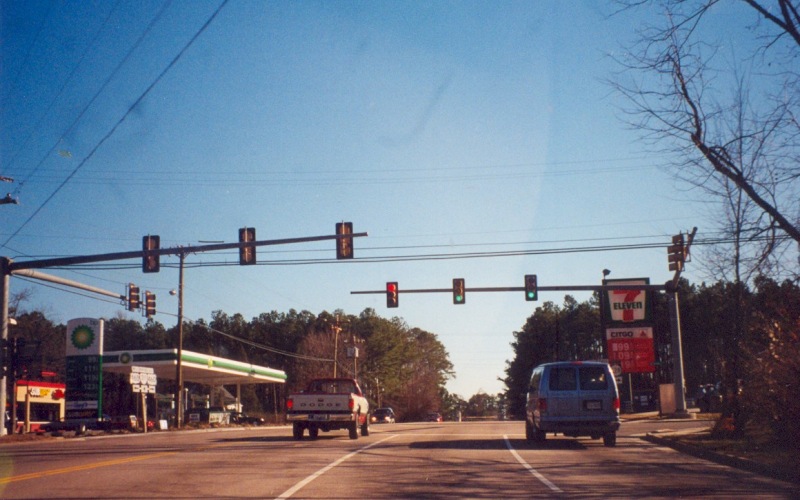
    (Photo cutline: U.S. 460 in Wakefield. Photo credit: Virginiahighways.com.)