• Too Many Millionaires in Virginia… Or Not Enough?

    Some say there are too many millionaires in the United States: The increase in the number of taxpayers earning seven figures or more each year is a sign of growing wealth inequality. Others see the surging number of millionaires as a positive: a reflection of economic dynamism and wealth creation. Not to mention, millionaires pay a disproportionate share of state and local taxes, and they donate to local charities.

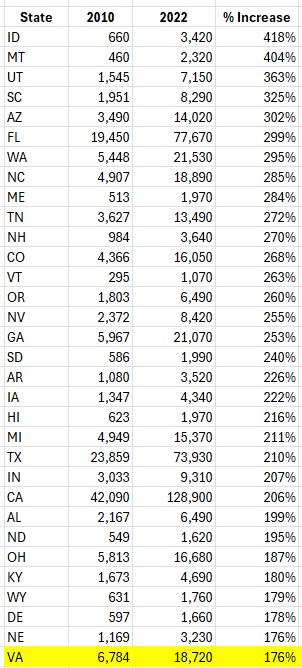
    For good or bad, this Internal Revenue Service (Via Competitive NYS) shows that Virginia minted new millionaires at a much slower rate between 2010 and 2022 than 31 other states. — JAB

    (more…)

  • Retail Theft in Virginia: $155 Per Resident Annually

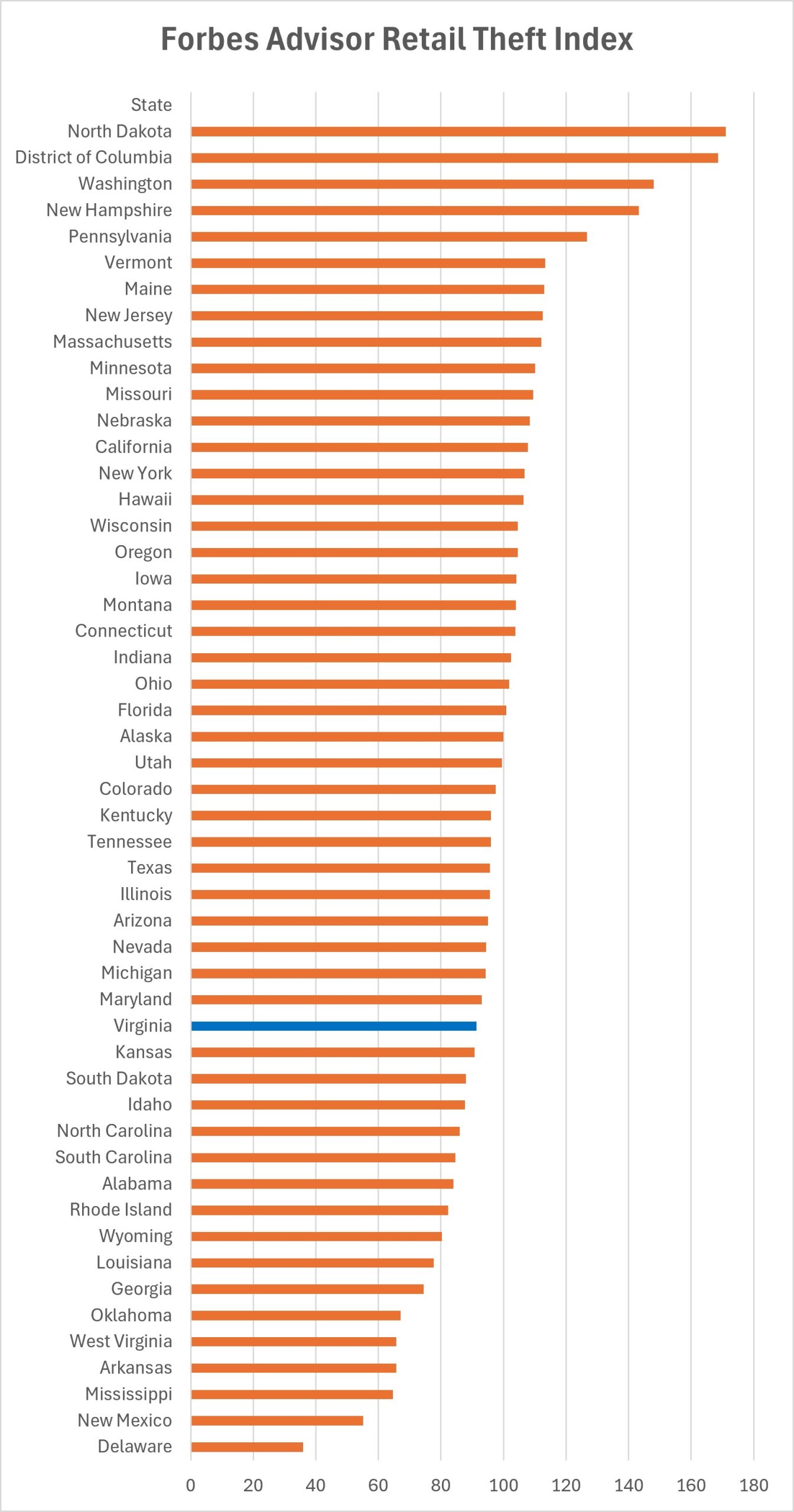
    Retail theft index ranked by Forbes index score.

    Reports Forbes: “Retail theft is more prevalent and has a larger impact on retail businesses of all sizes in some states compared to others. According to our analysis, Washington state ranks as the state most impacted by retail crime, while Wyoming ranks as the least impacted.”

    The cost of theft was highest in the state of Washington: $347 per resident. It was lowest in Wyoming: $17 per resident. At $155 per resident retail theft in Virginia is lower than the national average. — JAB


  • HUD Warns Colleges: End Racially Segregated Dorms

    From Virginia Tech to University of Wisconsin, separate is still unequal.

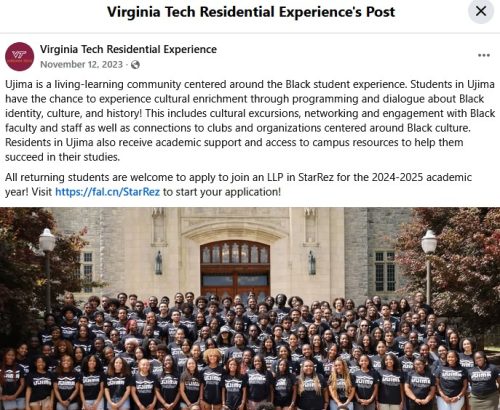
    Virginia Tech closed its Black-only dorm last year.

    by Victoria Manning

    It’s 2026, yet colleges and universities across the nation still push racial segregation on campus. Higher education institutions have spent the last decade building racially segregated dormitories under a friendlier nameโ€””black living learning communities.”

    Now President Trump’s Department of Housing and Urban Development (HUD) is ordering them to end housing segregation or face the consequences.

    On June 23, Craig Trainor, Assistant Secretary for HUD’s Fair Housing and Equal Opportunity, issued a Dear Colleague letter with a clear warning to higher education institutions. “Racial segregation was a moral abomination when it was demanded by the majority in certain regions of the United States many decades past. It is no less morally outrageous when it is demanded by other racial groups today.”

    Trainor points out that the 1968 Fair Housing Act prohibits segregating dwellings based on race. He warns that HUD “will ensure maximum accountability for . . . violating the Act.” HUD encourages whistleblowers to report these racist practices so they can be investigated.

    Colleges across the nation have used living learning communities (LLCs) to openly segregate student dormitories by race without consequences for at least the past decade. In 2018, Virginia Tech started a university sanctioned segregated dormitory for black students called the Ujima LLC.

    (more…)

  • The Rest of the Story on the Dominion Fuel Price Hike

    by Steve Haner

    But will you gladly pay in 2041 for your warm house in 2026? Dominion thinks so.

    The stories making the round last week about Dominion Energyโ€™s bill increase for fuel were blatantly incomplete, as were Dominionโ€™s communications on the matter. Here is what the utility and the well-tamed Virginia โ€œnewsโ€ media have not told you.

    The $8 per month reported as the impact on a typical residential customer was just a sweetener, a loss leader even.ย The real pop to your wallet will come later if the State Corporation Commission approves Dominionโ€™s application โ€“- already blessed by the equally well-tamed General Assembly -โ€“ to finance the bulk of the unpaid fuel costs with bonds that could take a decade or longer to retire.

    This will be the second time in just three years that the utility has taken the money you owe it for fuel and sold it off as a bond, claiming that it is โ€œsavingโ€ you money despite the years and years of added interest expense. 

    Dominionโ€™s application for its second round of โ€œsecuritizationโ€ of uncollected fuel costs would have the additional charge hitting your bills early in 2027. You would be paying for the fuel and purchased power cost of last winterโ€™s bitter cold spell all the way until 2041 under its most expensive proposal, a 15-year payoff. Under that proposal, bankers and bond holders would earn fees and interest (paid by you) of more than $500 million.

    The initial increase that went into effect July 1, which was $8 for that typical residential customer using 1,000 kilowatt hours, covered the increased cost for the upcoming 12 months. Dominion split out another $1.1 billion in uncollected fuel costs from the two previous 12-month periods, blaming much of that on the cold winter.

    (more…)

  • Only 700? They’re Just Getting Started


  • A House Is Not a Hotel

    Even you can rent it out on AirBnb

    by Chap Petersen

    Richard’s Retreat

    One of the best parts of being a Virginian is our State Constitution, specifically Article I, Section 11 which states that private property rights are fundamental and cannot be taken without just compensation.

    While local governments have the ability to zone property into appropriate categories, they cannot arbitrarily restrict uses. In other words, if your property is zoned “residential,” you’re allowed a residential use.

    A decade ago, Virginia confronted the issue of short-term rentals, where owners chose to market and rent their homes. The use did not change – the inhabitants did. In the face of competing pressures the General Assembly reached a compromise: localities could regulate short-term rentals and also require them to pay “transient occupancy tax” — just like traditional hotels. In the absence of regulation, the landowner’s rights under Article I, Section 11 control.

    “Richard’s Retreat” is a bucolic destination on the banks of Aquia Creek, with a dock and luxury home. Families can rent the Retreat for short-term stays. (It’s a favorite for Marines on leave from Quantico). Stafford County has no law prohibiting short-term rentals. Indeed, a Google search for “Stafford County short-term rental” will bring back nearly 100 hits.

    Prior to opening for business, the owners registered the Retreat with the County’s Commissioner of Revenue and obtained a business license. After collecting any charges, they dutifully forward the appropriate taxes to the State and County. Sounds pretty dull, right?

    (more…)

  • Jeanine’s Memes

    View more memes at the Bull Elephant.


  • Doctrinaire Humbug for UVA First-Years

    by the Jefferson Council

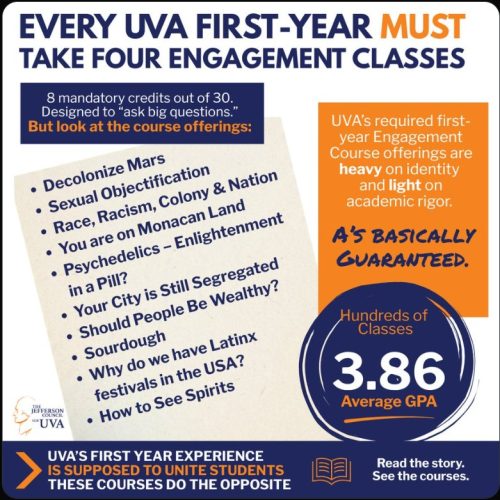
    Every incoming student in UVA’s College of Arts & Sciences is required to take four two-credit “Engagements” courses their first year โ€” eight credits total, out of roughly 30 a first-year typically completes. It isn’t optional. It’s a graduation requirement, built into the College Curriculum that replaced UVA’s older general education system in 2017.

    The College markets it as a way to “help students raise big questions. Thatโ€™s the kind of language that could describe almost any course at any school. The Engagements actual course list, however, tells a different story.

    The first year of college is supposed to do one thing above all: take a class of 18-year-olds from every background imaginable and forge them into a single community. That used to be the point of a shared first-year experience. UVA’s Engagements program does the opposite. Instead of bringing disparate students together around a common intellectual foundation, it sorts them into courses organized almost entirely around race, gender, and identity โ€” teaching incoming students to see each other first as members of competing groups, not as classmates.

    We pulled the full list of roughly 170 Engagements course titles directly from the program’s own website. A handful are genuinely academic โ€” “Making History: How Historians Use Evidence,” “Discovering Nature,” “Language Meets Linguistics.” Nobody objects to those.

    But the vast majority read less like an introduction to the liberal arts than a syllabus for identity politics, critical theory, and progressive political activism, dressed up as mandatory coursework for teenagers who are just beginning their college experience. In UVA’s own words:

    (more…)

  • Bacon Meme of the Week


  • Cville Homeless Camp: 80 Dwellers and Counting

    California, here we come!


  • Virginians May Be Asked to Vote for Higher Taxes

    by Rich Tucker

    Do you want higher taxes? Local politicians may soon give many Virginia residents a chance to answer that question for themselves.

    Earlier this year, state Sen. L. Louise Lucas introduced a bill that would have allowed all local governments to impose an additional 1% sales tax on top of existing levies. At the time the bill was drafted, only Charlotte, Gloucester, Halifax, Henry, Mecklenburg, Northampton, Patrick, and Pittsylvania counties and the City of Danville enjoyed that authority. Lucasโ€™ bill died in committee, but she didnโ€™t earn her job as president pro tempore of the Virginia Senate and reputation as the stateโ€™s most powerful elected official by giving up easily.

    Lucas has other ways to get her ideas into circulation. In this case, language that will allow localities to increase the local sales tax on most purchasesโ€”with the new revenue earmarked to fund school projectsโ€”was added to the two-year state budget presented to lawmakers just days before the July 1 fiscal year began.

    They passed the measure and Gov. Abigail Spanberger signed it, which, of course, needed to happen to prevent a state government shutdown. And so, your tax rate may get a boost, depending on where you live and how your neighbors vote.

    (more…)

  • High School Official Used Public Resources to Help Dem

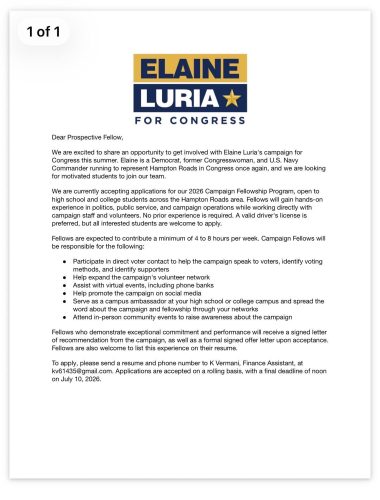
    Virginia Beach school director used taxpayer resources to recruit volunteers for Democrat congressional candidate Elaine Luria.

    by Victoria Manning

    On June 23, Melissa Disher, Director of the First Colonial High School (FCHS) Legal Studies Academy in Virginia Beach, sent out a notification to parents. She called it a volunteer opportunity for a “Campaign Fellows Program.” The email and attached flyer, provided to Restoration News by a parent, was a push to get student volunteers for Democrat Elaine Luria’s congressional campaign.

    School board policies prohibit using taxpayer resources for partisan political activity.

    The description for the “fellows program” sent out to families by Ms. Disher would have student volunteers promote the campaign on social media, assist with virtual campaign events including phone banks, “serve as a campus ambassador at [their] high school,” and “spread the word about the campaign and fellowship through [their] networks.”

    (more…)

  • Solar Farms Come Up Short

    by Kerry Dougherty

    No offense to ordinary, decent schizophrenics, but Virginia Democrats appear to be suffering from this or a similar mental disorder.

    And theyโ€™re off their meds.

    Examples abound, but hereโ€™s just one: The left-wing radicals who once were tree-huggers, have morphed into lovers of solar panels. As far as these loons are concerned, the more fertile farmland thatโ€™s covered in mirrors, the better.

    In fact, the General Assembly passed legislation that took effect July 1 that voids blanket community-wide bans and restrictive caps on solar farms.

    Expect to see more farms and fallow fields transformed into endless seas of reflective solar panels, because โ€œgreenโ€ energy is so much more important than agriculture. No matter how much pollution is created to make the panels.

    According to WJLA reporter Nick Minock, Spotsylvania County, Virginia is home to the largest solar panel development east of the Rockies.

    And itโ€™s hideous. Continue reading.


  • Out-of-State Nursing Home Chains Continue to Plague Virginia – A New Solution

    Out-of-State Nursing Home Chains Continue to Plague Virginia – A New Solution

    by James C. Sherlock

    Nursing home chains headquartered in New Jersey, New York, and Atlanta have, in the last decade, plagued Virginia with their operations here to a degree that should have proven intolerable to the Governor and the General Assembly. New Jersey-based Medical Facilities of America (MFA) is both the largest and the worst-performing chain operating in Virginia, but it is not alone in its practices here.

    Too many facilities of out-of-state chains routinely neglect and abuse Virginians, causing patient injuries and wracked, premature deaths. Those are matters of public record, not conjecture. Many of their facilities and employees have been cited by Virginia Department of Health (VDH) inspection teams and, in some cases, the police at rates that far exceed those of their peers.

    The most direct cause is a combination of understaffing and overpopulation, given existing facility staffing levels. That is actually a model of operation that is imposed and enforced by some chains. It is the core feature of a broader business model that maximizes both profits and tragedy. ย 

    Because of Virginiaโ€™s weakest-in-the-nation nursing home laws, we present a target-rich environment to the unethical. Many out-of-state owners treat their investments as commercial real estate plays and simply do not care about patient and resident outcomes. Virginia regulators, restricted by the General Assembly in authority and personnel, have proven incapable of imposing penalties sufficient to deter them. ย 

    Strong staffing minima have been successfully implemented in nearby states. But none have addressed directly the specific problem posed by the understaff/overadmit business model featured by the worst chains.

    We will highlight an existing option available to all states that is seldom used.

    (more…)


  • Virginia’s #3 for Business Rank Argues for Stability, Not Change

    by Derrick A. Maxย 

    Key Takeaways: 

    • Virginiaโ€™s rise to No. 3 in CNBCโ€™s ranking is good news, but it reflects past strengths more than future policy risks. 
    • Richmondโ€™s new labor mandates, payroll taxes, energy taxes, and data center tax could make Virginia more expensive and less competitive once fully implemented. 
    • To stay near the top, Virginia must protect Right-to-Work, keep taxes competitive, build reliable energy, and raise expectations in education. 

    Key Quote:โ€ฏโ€œVirginiaโ€™s No. 3 ranking is a credit to the Commonwealthโ€™s inherited strengths, not a blank check for Richmond to tax more, mandate more, and make it harder to do business here.โ€ 


    Virginiaโ€™s climb in CNBCโ€™s newest โ€œTop States for Businessโ€ ranking โ€” moving from No. 4 back to No. 3 โ€” should be welcomed. But it should not be misunderstood. 

    The lesson is not that Virginia has solved its problems. It has not. Nor is the lesson that every decision coming out of Richmond is suddenly validated by a national ranking. It is not. The real lesson is more important: Virginia remains one of the strongest, most durable, most business-capable states in America — despite the federal uncertainty and despite policy choices made this year that will weaken our future competitiveness and ranking once fully implemented. 

    That is why conservatives should resist two temptations. 

    (more…)