There are approximately 700 @Flock_Safety police AI surveillance in Northern Virginia
Places like Dulles and Reagan airports, the Pentagon parking lot… and dozens of malls, highways, university campuses, your neighborhood… surrounded, hovering up your movements
While local governments have the ability to zone property into appropriate categories, they cannot arbitrarily restrict uses. In other words, if your property is zoned “residential,” you’re allowed a residential use.
A decade ago, Virginia confronted the issue of short-term rentals, where owners chose to market and rent their homes. The use did not change – the inhabitants did. In the face of competing pressures the General Assembly reached a compromise: localities could regulate short-term rentals and also require them to pay “transient occupancy tax” — just like traditional hotels. In the absence of regulation, the landowner’s rights under Article I, Section 11 control.
“Richard’s Retreat” is a bucolic destination on the banks of Aquia Creek, with a dock and luxury home. Families can rent the Retreat for short-term stays. (It’s a favorite for Marines on leave from Quantico). Stafford County has no law prohibiting short-term rentals. Indeed, a Google search for “Stafford County short-term rental” will bring back nearly 100 hits.
Prior to opening for business, the owners registered the Retreat with the County’s Commissioner of Revenue and obtained a business license. After collecting any charges, they dutifully forward the appropriate taxes to the State and County. Sounds pretty dull, right?
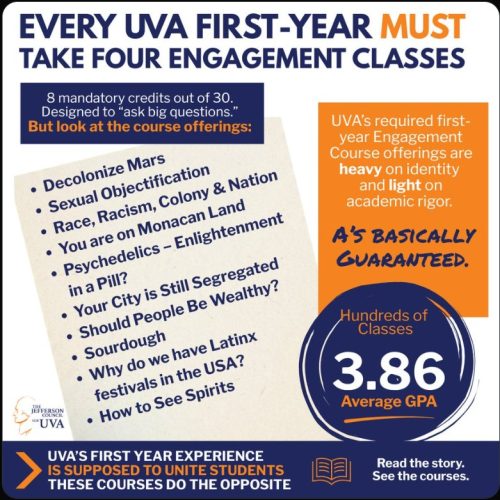
Every incoming student in UVA’s College of Arts & Sciences is required to take four two-credit “Engagements” courses their first year — eight credits total, out of roughly 30 a first-year typically completes. It isn’t optional. It’s a graduation requirement, built into the College Curriculum that replaced UVA’s older general education system in 2017.
The College markets it as a way to “help students raise big questions. That’s the kind of language that could describe almost any course at any school. The Engagements actual course list, however, tells a different story.
The first year of college is supposed to do one thing above all: take a class of 18-year-olds from every background imaginable and forge them into a single community. That used to be the point of a shared first-year experience. UVA’s Engagements program does the opposite. Instead of bringing disparate students together around a common intellectual foundation, it sorts them into courses organized almost entirely around race, gender, and identity — teaching incoming students to see each other first as members of competing groups, not as classmates.
We pulled the full list of roughly 170 Engagements course titles directly from the program’s own website. A handful are genuinely academic — “Making History: How Historians Use Evidence,” “Discovering Nature,” “Language Meets Linguistics.” Nobody objects to those.
But the vast majority read less like an introduction to the liberal arts than a syllabus for identity politics, critical theory, and progressive political activism, dressed up as mandatory coursework for teenagers who are just beginning their college experience. In UVA’s own words:
Do you want higher taxes? Local politicians may soon give many Virginia residents a chance to answer that question for themselves.
Earlier this year, state Sen. L. Louise Lucas introduced a bill that would have allowed all local governments to impose an additional 1% sales tax on top of existing levies. At the time the bill was drafted, only Charlotte, Gloucester, Halifax, Henry, Mecklenburg, Northampton, Patrick, and Pittsylvania counties and the City of Danville enjoyed that authority. Lucas’ bill died in committee, but she didn’t earn her job as president pro tempore of the Virginia Senate and reputation as the state’s most powerful elected official by giving up easily.
Lucas has other ways to get her ideas into circulation. In this case, language that will allow localities to increase the local sales tax on most purchases—with the new revenue earmarked to fund school projects—was added to the two-year state budget presented to lawmakers just days before the July 1 fiscal year began.
They passed the measure and Gov. Abigail Spanberger signed it, which, of course, needed to happen to prevent a state government shutdown. And so, your tax rate may get a boost, depending on where you live and how your neighbors vote.
Virginia Beach school director used taxpayer resources to recruit volunteers for Democrat congressional candidate Elaine Luria.
by Victoria Manning
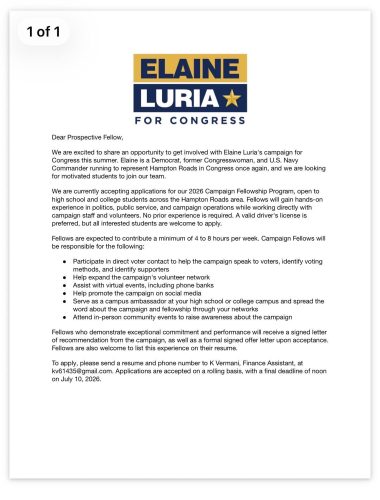
On June 23, Melissa Disher, Director of the First Colonial High School (FCHS) Legal Studies Academy in Virginia Beach, sent out a notification to parents. She called it a volunteer opportunity for a “Campaign Fellows Program.” The email and attached flyer, provided to Restoration News by a parent, was a push to get student volunteers for Democrat Elaine Luria’s congressional campaign.
School board policies prohibit using taxpayer resources for partisan political activity.
The description for the “fellows program” sent out to families by Ms. Disher would have student volunteers promote the campaign on social media, assist with virtual campaign events including phone banks, “serve as a campus ambassador at [their] high school,” and “spread the word about the campaign and fellowship through [their] networks.”
No offense to ordinary, decent schizophrenics, but Virginia Democrats appear to be suffering from this or a similar mental disorder.
And they’re off their meds.
Examples abound, but here’s just one: The left-wing radicals who once were tree-huggers, have morphed into lovers of solar panels. As far as these loons are concerned, the more fertile farmland that’s covered in mirrors, the better.
In fact, the General Assembly passed legislation that took effect July 1 that voids blanket community-wide bans and restrictive caps on solar farms.
Expect to see more farms and fallow fields transformed into endless seas of reflective solar panels, because “green” energy is so much more important than agriculture. No matter how much pollution is created to make the panels.
Nursing home chains headquartered in New Jersey, New York, and Atlanta have, in the last decade, plagued Virginia with their operations here to a degree that should have proven intolerable to the Governor and the General Assembly. New Jersey-based Medical Facilities of America (MFA) is both the largest and the worst-performing chain operating in Virginia, but it is not alone in its practices here.
Too many facilities of out-of-state chains routinely neglect and abuse Virginians, causing patient injuries and wracked, premature deaths. Those are matters of public record, not conjecture. Many of their facilities and employees have been cited by Virginia Department of Health (VDH) inspection teams and, in some cases, the police at rates that far exceed those of their peers.
The most direct cause is a combination of understaffing and overpopulation, given existing facility staffing levels. That is actually a model of operation that is imposed and enforced by some chains. It is the core feature of a broader business model that maximizes both profits and tragedy.
Because of Virginia’s weakest-in-the-nation nursing home laws, we present a target-rich environment to the unethical. Many out-of-state owners treat their investments as commercial real estate plays and simply do not care about patient and resident outcomes. Virginia regulators, restricted by the General Assembly in authority and personnel, have proven incapable of imposing penalties sufficient to deter them.
Strong staffing minima have been successfully implemented in nearby states. But none have addressed directly the specific problem posed by the understaff/overadmit business model featured by the worst chains.
We will highlight an existing option available to all states that is seldom used.
Virginia’s rise to No. 3 in CNBC’s ranking is good news, but it reflects past strengths more than future policy risks.
Richmond’s new labor mandates, payroll taxes, energy taxes, and data center tax could make Virginia more expensive and less competitive once fully implemented.
To stay near the top, Virginia must protect Right-to-Work, keep taxes competitive, build reliable energy, and raise expectations in education.
Key Quote: “Virginia’s No. 3 ranking is a credit to the Commonwealth’s inherited strengths, not a blank check for Richmond to tax more, mandate more, and make it harder to do business here.”
Virginia’s climb in CNBC’s newest “Top States for Business” ranking — moving from No. 4 back to No. 3 — should be welcomed. But it should not be misunderstood.
The lesson is not that Virginia has solved its problems. It has not. Nor is the lesson that every decision coming out of Richmond is suddenly validated by a national ranking. It is not. The real lesson is more important: Virginia remains one of the strongest, most durable, most business-capable states in America — despite the federal uncertainty and despite policy choices made this year that will weaken our future competitiveness and ranking once fully implemented.
That is why conservatives should resist two temptations.
Too often, conversations about data centers are presented as an either-or: tech companies versus local communities, or economic growth versus environmental protection.
That is the wrong debate.
The real challenge is whether communities, businesses, utilities, investors and public leaders can work together to support the infrastructure a growing digital economy requires while planning carefully for the future.
Digital infrastructure has become as essential to modern life as roads, railroads, ports and power plants were for previous generations. Local businesses, schools and hospitals rely on it. Families rely on it every day, often without realizing it.
As demand for artificial intelligence, cloud computing, streaming, cybersecurity, advanced manufacturing and digital services continues to grow, communities across the country are grappling with how best to accommodate that growth while preserving the qualities that make those localities strong.
The answer is not to stop progress. Nor is it to ignore legitimate community questions. The answer is to ensure growth is guided by transparency, collaboration and careful planning.
Virginia’s clear example
Virginia offers a clear example of why this issue is more connected than it first appears.
Through retirement accounts, pension funds, mutual funds, index funds and direct investments, millions of Americans own shares in the hyper-scale technology companies driving the data center boom.
The Virginia Retirement System reported a record investment portfolio of $122.8 billion for the fiscal year ending June 30, 2025, and paid $6.8 billion in retirement benefits that year, with investment earnings funding approximately two-thirds of those payments.
Statement on Governor Spanberger’s Marijuana Budget Debacle
I warned that rushing marijuana commercialization through Virginia would lead to reckless governing. This week, that warning came true in the worst possible way.
Governor Abigail Spanberger and the far-left majority in the General Assembly jammed their marijuana retail scheme into the state budget instead of allowing it to go through the normal legislative process, where it could have received the scrutiny it deserved. Now we know the cost of that shortcut: according to Williamsburg-James City Commonwealth’s Attorney Nate Green, former president of the Virginia Association of Commonwealth’s Attorneys, the drafting is so sloppy that Virginia’s own prosecutors are warning the law banning marijuana distribution, and the law protecting Virginians under 21 from possessing marijuana, may have already been repealed a full year earlier than anyone intended.
Let that sink in.
Because far left Democrats chose to legislate drug policy through a budget bill instead of a real bill with real hearings, prosecutors across this Commonwealth are now uncertain whether they can even enforce the law against selling marijuana to a minor. Mr. Green himself said it plainly: courts resolve ambiguity against prosecutors, and defense attorneys already have grounds to argue these protections no longer exist.
This is not a minor technical glitch. This is what happens when ideology outruns competence. Continue reading.
Ken Cuccinelli rendered in 18th-century garb in the style of Gilbert Stuart. Image credit: Grok
Virginia’s governing Democrats made it a crime to buy, sell, manufacture, or swap so-called assault weapons and high-capacity magazines that hold more than 15 rounds of ammunition. The law’s July 1 enactment, however, sits in a legal limbo as a wave of lawsuits moves through various courts.
Plaintiffs in four state jurisdictions have sued to have the law overturned. The lawsuits all claim that the gun law violates Article I, Section 13 of the state constitution, which reads, in part: “That a well regulated militia, composed of the body of the people, trained to arms, is the proper, natural, and safe defense of a free state, therefore, the right of the people to keep and bear arms shall not be infringed.”
Another case, filed in Fauquier County, makes that same legal argument, but adds that the law also violates the Second Amendment of the U.S. Constitution, which reads, “A well regulated Militia, being necessary to the security of a free State, the right of the people to keep and bear Arms, shall not be infringed.”
Former state Attorney General Ken Cuccinelli, lead counsel in the case filed in Spotsylvania County, told the Daily Signal why that case is unique.
“Our case is unique in that we are suing under the original militia clause. The ‘right to keep and bear arms’ language so familiar to people today was only added to Virginia’s State Constitution in 1971,” Cuccinelli said.
Berry Hill Mega Site in Pittsylvania County. Picture credit: City of Danville via Cardinal News
by Dick Hall-Sizemore
The Colorado-based company, Stack Infrastructure (Stack), has announced that it will move forward with its plans to build a giant data center complex in Pittsylvania County.
As was reported earlier in Bacon’s Rebellion, the company had made its decision to locate in Virginia contingent on the state continuing its exemption of computer equipment purchased by data centers from the Commonwealth’s sales tax. That exemption had been threatened by budget amendments proposed by the State Senate. With the adoption of a budget that leaves the exemption intact, the company will proceed.
This project is of major importance, not only to Pittsylvania County, but to that area of Southside Virginia. In its performance agreement with the regional industrial development authority, the company has pledged to invest at least $100 billion and create at least 2,500 jobs with salaries of at least $80,500 over a 30-year span. Under the provisions of current law, the company will be exempt from the Commonwealth’s sales tax on the purchase of computers and other equipment until at least 2040. That exemption could be extended until 2050 if the company meets certain investment and job creation criteria.
According to the Virginia Economic Development Partnership, the project represents the largest private investment ever announced in Virginia and one of the top five industrial announcements ever made in the United States. One local official declared that the agreement would be “transformational” for the area.
The year: 2075. The American colonies on the Moon are getting restless under Washington’s tyrannical rule….
This second edition of “Dust Mites” has a snazzy new cover, includes helpful lunar maps, and is 5,000 words tighter than the original. The sequel, “Trogs,” is scheduled for publication this summer.
Advertisement
Advertisement
Advertisement
Advertisement
About
Bacon’s Rebellion is Virginia’s leading politically non-aligned portal for news, opinions and analysis about state, regional and local public policy. Read more about us here.
Fund the Rebellion
Shake up the status quo! Your contributions will be used to pay for faster download speeds and grow readership. Make a one-time donation by credit card or contribute a small sum monthly.
Can’t wait until tomorrow
For your Bacon’s Rebellion fix?
Enter your email address to receive immediate notifications of new posts by email.
SUBSCRIBE
Search Bacon’s Rebellion
Categories
Archives
The Jefferson Council
Protecting Thomas Jefferson’s Legacy at the University of Virginia
Forgot Your Password?
Shoot me an email and I’ll generate a new password for you.