• Dominion Sale is Warning Siren on Virginia’s Weak Ethics Laws

    by Steve Haner

    Let me get this straight.ย A main argument against letting Florida-based NextEra Energy buy Virginia-based Dominion Energy is that the giant and rich new company might be so politically powerful that it will corrupt Virginiaโ€™s governance processes.ย That was the big argument from this fellow on the Richmond Times-Dispatch website.

    Shall I tell him or would you like to?ย What he writes about Florida Power and Lightโ€™s behavior pretty much parallels my 20 years of close observations, interactions and occasional outright conflicts with Dominion right here in Richmond. FPL and Dominion are peas in a pod.

    I remain skeptical that the size of the pod will matter to the average residential or business consumer. The new corporate holding company executives will likely be little different from the ones we have now, who are going to get very, very rich off this transaction and scoot to their retirement. But the wild west, anything goes environment has to disappear, and fast.

    The proper and intelligent reaction to what is coming is to make it far more difficult for either Dominion, or NextEra after swallowing Dominion, to keep getting away with it. Virginia must fight the corruption across the board. There must be:

    (more…)

  • Virginians Wonder About Dominion-NextEra Merger

    by Rich Tucker

    Early July brought 100-plus-degree temperatures to large swaths of Virginia, forcing most of the commonwealthโ€™s air conditioners to whir all day and night. Temperatures may hit 100 degrees again this week.

    But staying comfortable costs more this summer: Dominion Energy announced that, starting this month, it will add an $8-per-month charge to every domestic customerโ€™s bill for the next year to cover higher fuel costs. Another increase, $1.80 per month, is coming this fall.

    โ€œThe cost of living is so high already that a higher electricity bill is not something we need right now,โ€ Dominion customer Margaret Murphy told WTVR. โ€œI donโ€™t like to see my bill go up in any way, shape, or form,โ€ added customer Mike Uzel.

    The rising bills may complicate the proposed $67-billion merger of Dominion and NextEra Energy. The deal, which amounts to NextEra purchasing Dominion, was announced on May 18 and aims to create the worldโ€™s largest regulated electric utility by market capitalization.

    But it is a long process. The merger still needs to be approved by the Federal Energy Regulatory Commission, the Nuclear Regulatory Commission, the Virginia State Corporation Commission, the North Carolina Utilities Commission, and the Public Service Commission of South Carolina before it can go forward. That could take more than a year.

    (more…)

  • UVA’s Latest Compliance Report Raises Questions

    In describing how the University of Virginia is dismantling its Diversity, Equity and Inclusion programs, the most recent UVA compliance report to the Department of Justice shows just how extensive those programs were, writes Scott Douglas Gerber in a Richmond Times-Dispatch op-ed.

    The reportโ€™s specifics are telling. The School of Education and Human Development โ€œeliminatedโ€ its Office of Diversity, Equity, and Inclusion and removed hiring requirements demanding โ€œexplicit evidence of skills and experiences related to diversity.โ€ The School of Engineering and Applied Science โ€œno longer tracks data related to hiring metrics that are based on protected traitsโ€ and has eliminated diversity goals for its applicant pool. The McIntire School of Commerce revised its faculty hiring rubric to remove DEI-related research requirements and instructed reviewers that protected characteristics may not be considered. Even the Division of Student Affairs is conducting annual reviews to ensure mentoring programs comply with federal anti-discrimination law.

    These are not cosmetic edits; they are structural reversals. They confirm that UVaโ€™s DEI regime was not merely ideological โ€” it was operational. It shaped hiring, admissions, programming, evaluation and resource allocation. It was woven into the fabric of the institution.

    Gerber explores numerous questions that arise. Read the whole thing.


  • “I See Dead People”

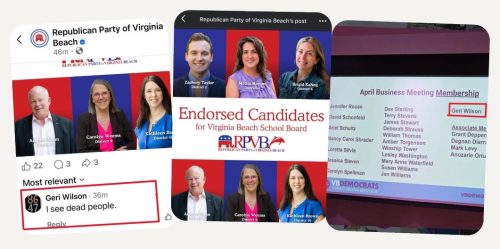
    An implied threat against school board candidates prompts concern among Virginia Beach Republicans.

    by Victoria Manning

    A Virginia Beach Democratic Committee member’s Facebook comment has prompted police reports from multiple school board candidates and forced local party leaders to publicly address the growing concern over political violence against conservatives.

    On July 14, the Republican Party of Virginia Beach announced its six endorsements for school board elections in the city. Then a commenter, Geri Wilson, made a vile response that caused safety concerns for the candidates. Under the endorsement post she wrote, “I see dead people.” Further digging revealed Wilson is a member of the local Virginia Beach Democrat Party.

    Wilson fills her Facebook page with far-left extremist rhetoric, including her profile picture that says 86 47โ€”a reference widely recognized as a call to kill President Trump. She posts obsessively on Facebook, dozens of times a week. One recent one said, “Don’t piss off old people . . . the older we get the less life in prison is a deterrent.”

    (more…)

  • The Merit Gap: How Eliminating Tests Harmed Students and Schools

    by Stephanie Lundquist-Arora
    As published in iWFeatures

    Several universities have recently reversed policies put into place during the pandemic to make standardized tests optional for applicants. At the end of May, Yale joined all the other Ivy League universities, in addition to Stanford and Caltech, in announcing its reinstated SAT or ACT test requirement for future admissions cycles.

    In the spring of 2020, when testing centers nationwide closed at the onset of the COVID-19 pandemic, hundreds of universities understandably adopted test-optional policies so that students unable to take standardized exams would not be disadvantaged in the admissions process. However, many institutions extended these policies for multiple years as a way to increase diversity in admissions.

    The University of California (UC) system went further, adopting a โ€œtest-blindโ€ policy under which standardized test scores are not considered, even when applicants choose to submit them. 

    Spoiler alert: Itโ€™s not working out so well for them.   

    letter signed by thousands of UC faculty to bring back standardized testing states, โ€œ[I]n the last five years, the number of students whose mathematics skills fall below high school level increased nearly thirtyfold; moreover, 70% of those students fall below middle school levels, reaching roughly one in twelve members of the entering cohort.โ€

    Perhaps this helps explain why, according to an admissions officer last month, Purdue Universityโ€”home to one of the nationโ€™s premier engineering programs and a school that requires applicants to submit standardized test scoresโ€”consistently attracts a large number of out-of-state applicants from California. 

    (more…)

  • Elaine Luriaโ€™s Flip-Flop on Insider Trading

    Elaine Luria doing the backflip. Image credit: Grok

    by Kerry Dougherty

    Nice try, Elaine. Unfortunately for you, voters in Virginiaโ€™s 2nd Congressional district arenโ€™t stupid.

    We all know that your sudden about-face on insider trading by members of Congress isnโ€™t because of Trump. Or because you suddenly developed a moral compass.

    Clearly, youโ€™ve seen polls that show Americans are disgusted with corrupt politicians who use their elected offices to get rich.

    Fraud is going to be a campaign issue this fall and Luria is vulnerable.

    Who knows. She still has to get through the August 4th Democrat primary. Luriaโ€™s affection for insider trading might have hurt her in the August 4th Democrat primary. Unlikely, though. Luriaโ€™s ability to raise campaign bucks is second only to her ability to trade stocks.

    In a Washington Post story headlined โ€œIn Reversal, Luria Backs Congressional Stock-Trading Ban In House Comeback Bid; Luriaโ€™s support for the stock-trading ban marks the starkest policy shift that the former Navy commander released in a platform Wednesdayโ€ the former mermaid maker was exposed for the transactional politician she is: Continue reading.


  • Lots of Smoke Here. Is There a Fire?

    Virginians deserve answers on Louise Lucas’ taxpayer funded business empire.

    by Victoria Manning

    On April 27, 2026, Carl Randall Upton, Jr., business partner of Virginia Senator Louise Lucas, wasย arrestedย in Atlanta after beingย indictedย in federal district court for three counts of wire fraud. Days later, the FBI raided businesses owned by Sen. Lucas, including the cannabis shop she co-owns with Upton. This has caused increased scrutiny of Lucas’ broader business empire and her political influence over the very agencies who fill her wallet with taxpayer funds.

    Shady partnerships

    The indictment against Upton centers around allegations of fraud in obtaining pandemic relief loans from the federal government. The federal indictment alleges that Upton applied for an Economic Injury Disaster Loan through multiple businessesโ€”including one named Virginia Freedom Life. He submitted a pandemic loan application for that business in April 2020 and received $11,800. On July 13, 2020, Upton applied for another loan with the same business but got denied.

    According to the indictment, Upton “devised and intended to scheme and artifice to defraud, and to obtain money by means of materially false and fraudulent pretenses, representations, promises and omissions.” More specifically, he “sought to fraudulently obtain disaster-related benefits in the form of SBA-sponsored Economic Injury Disaster (EIDL) loans.” In total, Upton received $104,200 in disaster loans through multiple businesses.

    (more…)

  • What You’re Paying for at UVA

    A SWAT team of adolescent psychiatrists to help your kid through his mental health crisis

    Author, entrepreneur and public speaker Scott Galloway is a man of the left, but he’s not doctrinaire. He has a lot of contrarian things to say. To me, the most interesting comments from this stream-of-consciousness clip of Galloway at the University of Virginia was the following:

    The entire orientation for the parents here is to convince you that your kid is already in the midst of a mental health crisis, but not to worry. If he so much as blinks funny, there is going to be a SWAT team of adolescent psychiatrists descending from a helicopter to help him. And there’s about eight hundred 800 numbers to help your kid through the crisis.

    (more…)

  • Let’s Not Forget to Celebrate Virginia’s FIRST Rebellion Against Tyrannical Rule

    The burning of Jamestown in the style of Wenceslaus Hollar. Image credit: Grok

    While everyone is going ga-ga over the 250th anniversary of the United States, Virginians need reminding that 2026 is the 350th anniversary of Bacon’s Rebellion. Preservation Virginia has not forgotten. The organization is sponsoring a series of events this summer, beginning with “Mapping the Dragon: An Indigenous History of Bacon’s Rebellion” today at 6:00 p.m. (you can attend virtually), “The Archaeology of Bacon’s Rebellion” on August 19, and “The Burning of Jamestown,” on September 19. — JAB


  • Too Many Millionaires in Virginia… Or Not Enough?

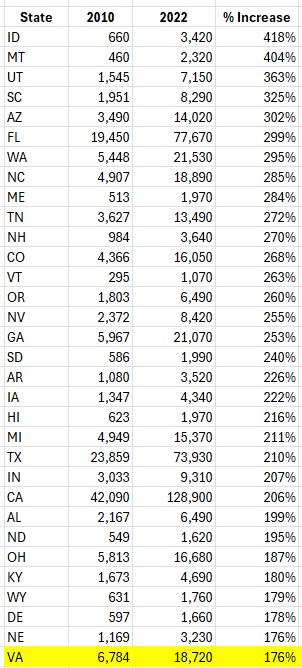
    Some say there are too many millionaires in the United States: The increase in the number of taxpayers earning seven figures or more each year is a sign of growing wealth inequality. Others see the surging number of millionaires as a positive: a reflection of economic dynamism and wealth creation. Not to mention, millionaires pay a disproportionate share of state and local taxes, and they donate to local charities.

    For good or bad, this Internal Revenue Service (Via Competitive NYS) shows that Virginia minted new millionaires at a much slower rate between 2010 and 2022 than 31 other states. — JAB

    (more…)

  • Retail Theft in Virginia: $155 Per Resident Annually

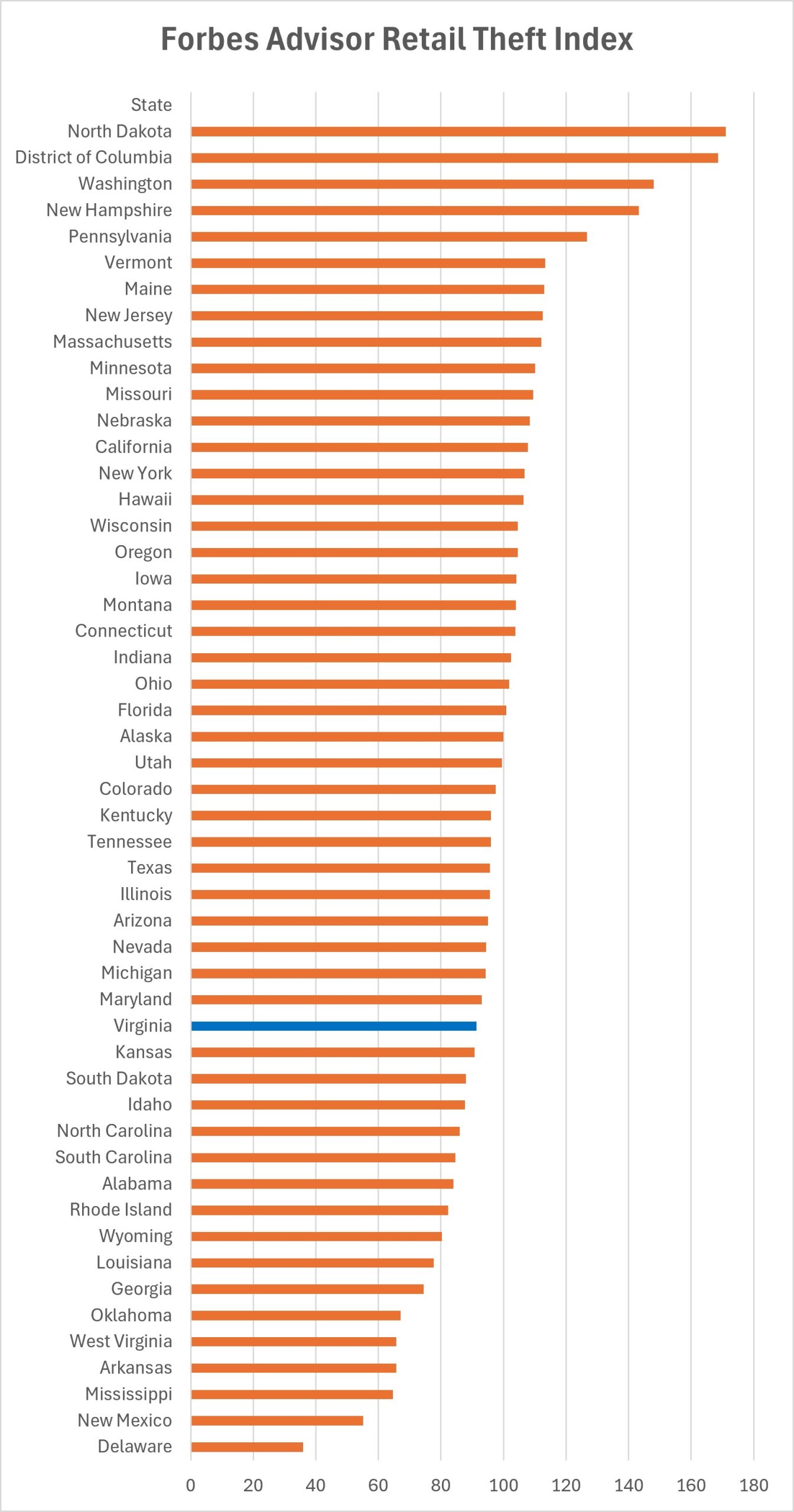
    Retail theft index ranked by Forbes index score.

    Reports Forbes: “Retail theft is more prevalent and has a larger impact on retail businesses of all sizes in some states compared to others. According to our analysis, Washington state ranks as the state most impacted by retail crime, while Wyoming ranks as the least impacted.”

    The cost of theft was highest in the state of Washington: $347 per resident. It was lowest in Wyoming: $17 per resident. At $155 per resident retail theft in Virginia is lower than the national average. — JAB


  • HUD Warns Colleges: End Racially Segregated Dorms

    From Virginia Tech to University of Wisconsin, separate is still unequal.

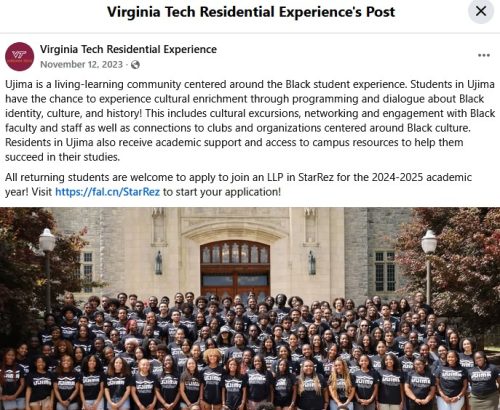
    Virginia Tech closed its Black-only dorm last year.

    by Victoria Manning

    It’s 2026, yet colleges and universities across the nation still push racial segregation on campus. Higher education institutions have spent the last decade building racially segregated dormitories under a friendlier nameโ€””black living learning communities.”

    Now President Trump’s Department of Housing and Urban Development (HUD) is ordering them to end housing segregation or face the consequences.

    On June 23, Craig Trainor, Assistant Secretary for HUD’s Fair Housing and Equal Opportunity, issued a Dear Colleague letter with a clear warning to higher education institutions. “Racial segregation was a moral abomination when it was demanded by the majority in certain regions of the United States many decades past. It is no less morally outrageous when it is demanded by other racial groups today.”

    Trainor points out that the 1968 Fair Housing Act prohibits segregating dwellings based on race. He warns that HUD “will ensure maximum accountability for . . . violating the Act.” HUD encourages whistleblowers to report these racist practices so they can be investigated.

    Colleges across the nation have used living learning communities (LLCs) to openly segregate student dormitories by race without consequences for at least the past decade. In 2018, Virginia Tech started a university sanctioned segregated dormitory for black students called the Ujima LLC.

    (more…)

  • The Rest of the Story on the Dominion Fuel Price Hike

    by Steve Haner

    But will you gladly pay in 2041 for your warm house in 2026? Dominion thinks so.

    The stories making the round last week about Dominion Energyโ€™s bill increase for fuel were blatantly incomplete, as were Dominionโ€™s communications on the matter. Here is what the utility and the well-tamed Virginia โ€œnewsโ€ media have not told you.

    The $8 per month reported as the impact on a typical residential customer was just a sweetener, a loss leader even.ย The real pop to your wallet will come later if the State Corporation Commission approves Dominionโ€™s application โ€“- already blessed by the equally well-tamed General Assembly -โ€“ to finance the bulk of the unpaid fuel costs with bonds that could take a decade or longer to retire.

    This will be the second time in just three years that the utility has taken the money you owe it for fuel and sold it off as a bond, claiming that it is โ€œsavingโ€ you money despite the years and years of added interest expense. 

    Dominionโ€™s application for its second round of โ€œsecuritizationโ€ of uncollected fuel costs would have the additional charge hitting your bills early in 2027. You would be paying for the fuel and purchased power cost of last winterโ€™s bitter cold spell all the way until 2041 under its most expensive proposal, a 15-year payoff. Under that proposal, bankers and bond holders would earn fees and interest (paid by you) of more than $500 million.

    The initial increase that went into effect July 1, which was $8 for that typical residential customer using 1,000 kilowatt hours, covered the increased cost for the upcoming 12 months. Dominion split out another $1.1 billion in uncollected fuel costs from the two previous 12-month periods, blaming much of that on the cold winter.

    (more…)

  • Only 700? They’re Just Getting Started


  • A House Is Not a Hotel

    Even you can rent it out on AirBnb

    by Chap Petersen

    Richard’s Retreat

    One of the best parts of being a Virginian is our State Constitution, specifically Article I, Section 11 which states that private property rights are fundamental and cannot be taken without just compensation.

    While local governments have the ability to zone property into appropriate categories, they cannot arbitrarily restrict uses. In other words, if your property is zoned “residential,” you’re allowed a residential use.

    A decade ago, Virginia confronted the issue of short-term rentals, where owners chose to market and rent their homes. The use did not change – the inhabitants did. In the face of competing pressures the General Assembly reached a compromise: localities could regulate short-term rentals and also require them to pay “transient occupancy tax” — just like traditional hotels. In the absence of regulation, the landowner’s rights under Article I, Section 11 control.

    “Richard’s Retreat” is a bucolic destination on the banks of Aquia Creek, with a dock and luxury home. Families can rent the Retreat for short-term stays. (It’s a favorite for Marines on leave from Quantico). Stafford County has no law prohibiting short-term rentals. Indeed, a Google search for “Stafford County short-term rental” will bring back nearly 100 hits.

    Prior to opening for business, the owners registered the Retreat with the County’s Commissioner of Revenue and obtained a business license. After collecting any charges, they dutifully forward the appropriate taxes to the State and County. Sounds pretty dull, right?

    (more…)