Tag Archives: Bicycles

No Excuses Left!

Bicycle power!

Bicycle power!

Now that Governor Bob McDonnell and the General Assembly have restructured transportation taxes away from a user-pays system to an everybody-pays system, they have (perhaps unwittingly) undermined the justification for short-changing funding for bicycle routes. Cycling advocates Tom Bowden and Champe Burnley drive home the point in a Times-Dispatch op-ed today.

Now our streets and roads will be paid for by everyone, through the sales tax and other general revenues. … With this change comes an obligation. Our streets and roads must be designed for the benefit of all legal users. No longer will pedestrians and cyclists have to endure the snide retorts of motorists that “Roads are for cars because cyclists don’t pay gas tax.” It was never really true in the first place, but now it’s laughable.

Our local streets and roads are for people and always have been. Most roads in Virginia existed long before automobiles, and now that we all pay for them, it’s time our planners and our government acknowledged this simple fact.”

I still believe in a user/beneficiary pays system for funding roads, bridges, highways and mass transit — and bicycles, too, if I could figure out a revenue stream for them. But now that we’ve butchered that principle and stuffed its various precepts and axioms into the incinerator, it’s time to follow through on the implications. Pedestrians and cyclists are taxpayers, too. They have every right to insist upon a share of the revenue stream to support projects that benefit them as well.

– JAB

Time to Get Real about Quality of Richmond’s Bicycle Infrastructure

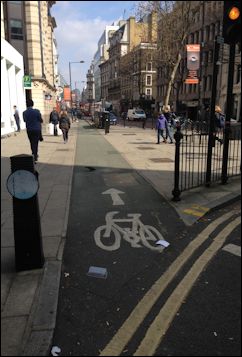
bicycle_infrastructureThe Richmond region has a long way to go before it can truly be considered a bicycle-friendly town. The entire region has only 18.25 miles of paved bike lanes — “sharrow” lanes marked with bicycle icons don’t count — and those lanes are fragmented, unconnected to a broader network.

In 2015, hundreds of thousands of visitors are expected to descend upon the region for the World Road Cycling Championships, creating an “urgent need” for the region to upgrade its bicycle infrastructure.

That’s the appraisal of a new report by Sports Backers, the organization dedicated to transforming promoting an active lifestyle in the Richmond region. The report couched its findings in diplomatic language. I’m under no such obligation. Let me give it to you straight.

The region has 146 miles of dirt trails, but most are unpaved. A third of the total mileage is located in Pocahontas State Park on the region’s periphery, and none of the trails form a cohesive network. That’s not so bad if you’re a recreational mountain biker but the trails are pretty worthless if you’re relying upon bicycles to provide utilitarian transportation. The paved Virginia Capital Trail, which will link Richmond and Williamsburg, is another tremendous asset. But it, too, is free-standing, not part of a network.

The study details the fragmentation of the region’s bicycle assets: 164.2 total miles of bike trails split into 55 mostly unconnected segments.

Will Richmond be ready for the world bicycling championship?

Will Richmond be ready for the world bicycling championship?

“The lack of significant plans for more paved trails in the region will ultimately limit the use of bike infrastructure in the community,” the report states dryly. “Paved multi-purpose trails provide the ultimate level of safety and separation from motorized traffic that provides freedom to bikers as well as runners and walkers.”

The fragmentation might not be a long-term problem if there were a long-term, region-wide plan to tie the pieces into meaningful whole. But there is no plan. Not a single local government has a comprehensive plan for bicycling, the report notes. The City of Richmond is working on one — that’s about as good as it gets.

– JAB

Damned with Faint Praise: Virginia Ranks Tops in South for Bicycle Friendliness

colorado_bicyclesVirginia ranks 16th nationally in the just-published League of American Bicyclists’ “Bicycle Friendly States” ranking, and No. 1 in the South. The state of Washington took the top spot, with Colorado nailing down No. 2.

Colorado cycling has come on strong in recent years as the business community has mobilized around the goal of making the Centennial State the healthiest state in the country. Businesses understand the connection between a healthy population and a healthy workforce, and the link between a healthy workforce and lower medical insurance rates, lower rates of absenteeism and higher productivity. That cause has yet to go mainstream in Virginia, where business lobbies have expended their political capital in recent to increase taxes to pay for more transportation projects without insisting upon any more accountability or results in how that money is spent.

Virginia scored best for “policies and programs” (with a 4 out of 5) and worst in “infrastructure and funding” and “evaluation and planning.”  (See the Virginia state profile here.)

Among the ideas advanced to make Virginia more bicycle-friendly, the League suggested passing laws that protected cyclists on streets and roads, investing more money in bicycle infrastructure, and holding a state bicycle summit.

Bacon’s bottom line: Ranking first in the South ain’t much to be proud of folks. The leading states are lapping us. We can do better. Last time I checked, bicycle-friendly policies don’t violate property rights, they don’t undermine the Constitution and they don’t cost a lot of money. Why are putatively conservative Republicans so hostile? For the price of a single highway boondoggle (the $244 million Charlottesville Bypass, before cost overruns, for instance) we could make massive strides in building bicycle infrastructure throughout the state.
– JAB

Dealing with “Dead Bikes”

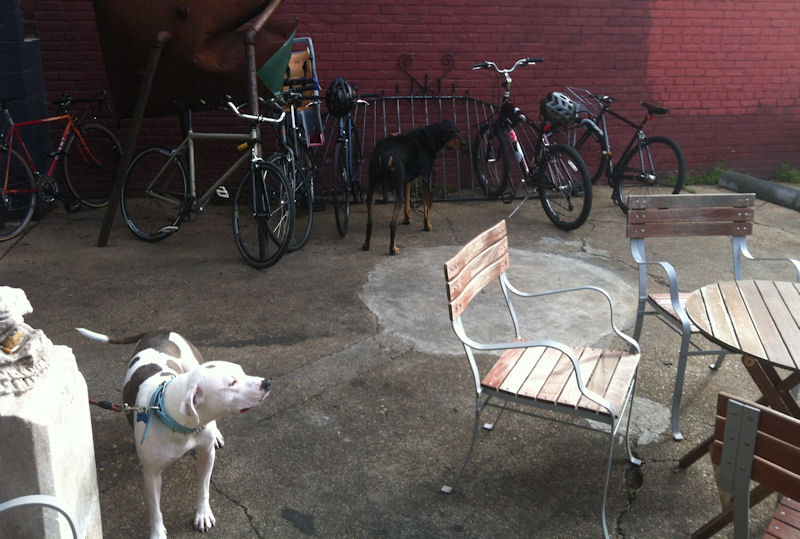
What can happen when you leave your bike leaning against a tree too long.

It’s one thing to say you want to create a bicycle-friendly community, it’s quite another to pull it off. In the abstract, it sounds pretty easy. The devil is in the details.

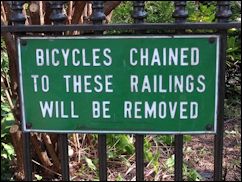
A case in point: Richmond City Council is pondering an ordinance to authorize police to attach a bicycle, motorcycle or moped to a city-owned tree, post, sign or other property after 72 consecutive hours if they are inoperable, or after 10 days if they are abandoned.

This is the kind of thing that comes up when more people use — and abuse — bicycles. In a column today, Times-Dispatch columnist Michael Paul Williams recalls an incident from two years ago in which two guys were visiting a friend and secured their bikes to a no-parking sign. A bit later, the discovered a police officer digging up the sign and threatening to confiscate their bikes. Writes Williams: “The episode embodied the city’s uneasy coexistence with bicycles.”

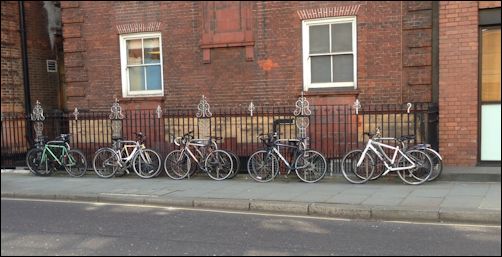
In the most recent case, however, City Council appears to be responding to a real problem — the “dead bike” issue. It’s a fact: People leave inoperable bikes tethered to trees and city property, taking up public space and creating an eyesore. “They are blight,” Williams quotes City Council member Parker C. Angelasto as saying.

I’m a big proponent of cyclist’s rights. But rights come with responsibilities, and cyclists need to be good citizens. Their rights don’t extend to chaining their bicycles to city property for days or weeks on end. The ordinance sounds reasonable to me.

– JAB

Fixing Broken Streams and Broken Dreams

The Bellemeade Walkable Watershed project aims to reclaim a damaged creek, create a route for kids to walk to school, and boost community spirit in a gritty, inner-city Richmond neighborhood.

by James A. Bacon

Bob Argabright got involved with Richmond city schools nine years ago when he volunteered to help two young students learn to read. It wasn’t long before he discovered that the challenges faced by inner city kids run far deeper than a difficulty with letters and words. As he delved deeper into their lives and their surroundings, his volunteer activity became a full-time vocation. Today, the retired paper industry executive is such a fixture at Oak Grove-Bellemeade Elementary School that children wave to him in the hall, call him by name and even run up to give him a hug.

“I think it’s totally unfair for a child to be born in the 23229 zip code and be set for life while a child born in 23224 has a low probability of success,” says Argabright. “Ninety percent of our kids say they want to be a rap star, an NFL football player or a beautician. We’re trying to show them other paths. … We’re teaching these children to dream.”

As unlikely as it might sound, Argabright is hoping that a few children might conceive the ambition of becoming an architect or an environmental engineer.

Making that connection would have been unlikely a year ago, when the students at Oak Grove-Bellemeade were attending the old Bellemeade Elementary School, an aged and decrepit school building that screamed urban blight. But this month they moved into a new, LEED-standard school building next door that is fresh, clean and airy. Every section of the school bears a name associated with the James River — the river bed, forest floor, forest canopy, and the like — to serve as inspiration for teaching about nature. Moreover, the city is moving forward with a project to restore the severely eroded creek behind the school with the aim of creating a community resource and a focus for environmental education.

The Bellemeade Walkable Watershed is a triumph of public-private collaboration, says Michelle Virts, deputy director of utilities. “It’s a great opportunity for the city to stretch our dollars.” The project is funded largely through a $187,000 National Fish & Wildlife grant to restore the creek, and a $60,000 Environmental Protection Agency grant to build a watershed coalition, but the city is chipping in land, public works money and staff time, while not-for-profits like the James River Association and the Alliance for the Chesapeake Bay are providing volunteers for clean-up and money for tree planting.

Perhaps the most intriguing aspect of the walkable watershed is how the community is leveraging a single project to advance multiple goals: stream restoration, environmental education, a community garden and a network of sidewalks and trails. By making it possible for hundreds of kids, many of whom live in housing projects, to walk or bicycle to school instead of ride the bus, the project, it is hoped, will ward off the obesity that plagues Richmond’s inner city.

Many educators, public officials and not-for-profits have contributed to the project. But Argabright is the thread tying the efforts together. “Bob is extremely active in the neighborhood,” says Virts. “He makes things happen.”

“Bob Argabright is totally on fire about this thing,” says Champe Burnley, president of the Virginia Bicycling Federation, who recalls meeting with him more than half a year ago. Argabright was thinking ahead to when the new route opens for children to walk and bike to school. How many poor kids own bicycles? Not many. Even back then, he was working the angles to rustle up some used bikes. He now has 300 (only some of which, he regrets, are suitable for children) sitting in a warehouse in anticipation of the day when they can be used.

Argabright is not one to claim credit. He sings the praises of everyone involved in the project, from Oak Grove-Bellemeade’s principle Jannie Laursen to Lara Kling with the Blue Sky Fund, which has raised $275,000 to fund outdoor nature programs for inner city schools, including Oak Grove-Bellemeade. He depicts his contribution mainly as showing up at community events, pushing to get things done and building a web of contacts linking corporate leaders with City Hall and neighborhood volunteers and activists. Says he: “What I’m doing is networking, doing what I’ve done my whole career.”

Re-greening Richmond

Two developments were key to making the project happen. One was construction of the Oak Grove-Bellemeade School, which opened its doors this year. Children from the old Bellemeade School, located right next door, moved in right away. Students from Oak Grove will transfer next school year. The 90,000-square-foot facility is state-of-the-art. But it’s one thing to teach a subject like science in the abstract to inner-school children who have seldom ventured outside their concrete-and-asphalt domain, and quite another to teach them in a natural environment. More.

An Ignorant Vote on a Good Bicycle Bill

Bicycle parking at a Bogota, Colombia, transit station.

What’s with General Assembly Republicans? They’re willing to raise taxes to fund automobile and mass-transit projects but they’re not willing to support a bill that would make bicycling safer without costing the state a dime. The House version of a bill submitted by Sen. Chap Peterson, D-Fairfax, was defeated yesterday in a tie vote in the House Transportation Committee.

The bill, which would have required drivers and passengers to wait for a reasonable opportunity to open vehicle doors adjacent to moving traffic, was just too much for Republicans to swallow. Of the seven delegates voting for the bill, only one was Republican, while of the seven voting against, six were. Tie votes prevented the bill from passing, thus killing it.

It’s a small bill, hardly as consequential as the legislative proposals restructuring gasoline and sales taxes to raise billions of dollars for new transportation construction projects. But, symbolically, it speaks just as loud. By their actions, Republicans appear to embrace the traffic engineering mentality that the purpose of roads is to move vehicles as rapidly and efficiently as possible, even if it means sacrificing the idea of “complete streets” in which cars share roads with pedestrians and bicycles.

It is ironic that Republicans are comfortable with the idea of increasing funding for mass transit, as seen in their support of Governor Bob McDonnell’s transportation funding package, while refusing to support a measure that would help make mass transit economically viable. Successful transit requires several elements: One is mixed-use development; rail stations should serve a mix of residential, commercial and amenities. A second is higher density; the more people who live and work within a quarter mile of light and heavy rail stations, the more who are willing to walk to the station. A third is a walkable-bikable street environment. Bicycles increase transit ridership by making a station accessible from distances greater than a quarter mile. And unlike cars, they take up only a tiny amount of parking space.

Bottom line: If we want Virginians to ride the mass transit assets we plan to spend billions of dollars on, we need to make streets more hospitable to pedestrians and bicyclists.

Astoundingly, Republicans are willing to throw millions of dollars at mass transit without any understanding of the urban context it takes to make transit successful. It is this kind of nitwittery that makes it so difficult to vote for them. They are saved at the ballot box only by the foolishness of Democrats. God save us all.

– JAB

Wealth-Destroying Streets

Dan Burden

Dan Burden, executive director of the Walkable and Livable Communities Institute, looks like an aging hippie — long white hair, a broomstick of a moustache, a twinkle in his eye — and, for all I know, he is one. But his presentation Friday at the New Partners for Smarter Growth focused on wealth creation. No, he wasn’t touting stocks, gold or collateralized debt obligations. He was arguing that public investment in streets and roads can either destroy the value of nearby property or increase it. To his way of thinking, it makes more sense to build streets and roads that enhance property values.

“It’s amazing how many times we have butchered a city and spent millions of dollars to do that butchering,” said Burden, who conducts “walking audits” used to determine how pedestrian friendly a communities streets are. “We can no longer afford to make changes that subtract from the value of land. Our improvements must add value to land.”

The traffic engineers who design streets seem to determined to make them as wide and fast as they possibly can, all for the purpose of moving automobiles more efficiently. But roads that move cars efficiently at high speeds are not what homeowners want in front of their houses. As a rule, the faster the speed, the lower the property value. Said Burden: “Streets that reduce speed produce high property values.”

Bacon’s bottom line: In Virginia the major factor driving transportation investment is congestion mitigation. (Economic development is an important secondary factor but it is limited mainly to mega-projects.) Traffic accidents, injuries and fatalities cost the economy roughly three times as much as congestion yet safety-related investments are minimal. The impact of transportation investments on property values is not a factor at all.

Streetscapes that accommodate pedestrians and bicycles often are seen as a wasteful expenditure that could be put to better use by adding more lane-miles of road. But such reasoning does not take into account the impact of walkable, bikable street design on property values.

Virginia has no formal methodology for calculating the costs and benefits of different potential investments. It is entirely possible that investments in roads and streets are destroying millions of dollars in property values every year and we don’t even know it.

– JAB

New Rules of the Road: Following Too Closely

Here’s another bill I like: HB 1950. Introduced by Alfonso Lopez, D-Arlington, this bill brings bikes under the protection of the no-tailgating law by deleting one word from existing legislation: “The driver of a motor vehicle shall not follow another motor vehicle, trailer, or semitrailer more closely than is reasonable and prudent…”

In this case, shorter clearly is better.

– JAB

All Hail the Creeper Trail

The Virginia Creeper Trail is arguably the most beloved bicycle trail in Virginia. But it wasn’t always so. As Bill Lohmann reminds us in the Times-Dispatch, many landowners along the trail, which was built upon an abandoned railroad bed, opposed its development in the 1980s. Writes Lohmann:

One group filed a lawsuit. Others placed logs and hay bales across the trail and locked public gates. One farmer put a bull in a field next to the trail and posted a sign warning, “Cross at your own risk.”

By the mid-1990s, when the trail had opened and the world hadn’t come to an end, Lohmann says, a survey of property owners showed that 75% approved of it. That number might well be higher today. Many who live on the trail enjoy it as a recreational amenity. The community as a whole in Abingdon and Washington County certainly loves the trail, which has become a significant visitor attraction and revenue generator.

Tastes are changing. People place a higher value on cycling amenities than they did in the past. Bicycle access increases property values. Higher property values makes people happy.

– JAB

Retaking Roads from Cars

Graphic credit: NC Coalition for Bicycle Driving

Speaking of bicycles… Sen. Chap Peterson, D-Fairfax, has introduced SB736, which would forbid drivers and passengers to open car doors on the side adjacent to moving traffic “until is is reasonably safe to do so.” Violators would be fined by up to $100.

On his Ox Road South blog, Peterson defends the bill as a safety measure in an era in which the number of cyclists is on the increase. He writes:

As bike lanes become more prevalent in our urban areas, “dooring” has become a major threat to cyclists. It’s a threat because there is no way to prevent accidents and serious injuries.

A “dooring” occurs when a bicyclist is legally traveling down a bike lane or a roadway (not a sidewalk). A driver’s side door way is thrown open, causing a collision and sending the bicyclist flying over the handle bars. Permanent injuries or even death can occur from an accident that might otherwise appear innocuous.

Right now, the driver is not at fault. They are permitted to open the car door at their discretion. There is no law to find them negligent of causing the injury.

My bill would change that by shifting the responsibility to drivers to open their doors safely — and otherwise keep them closed — when there is oncoming traffic.

Changes like this are necessary to create a bike-friendly culture in Virginia that elevates bicycles to a legitimate transportation alternative.

– JAB